
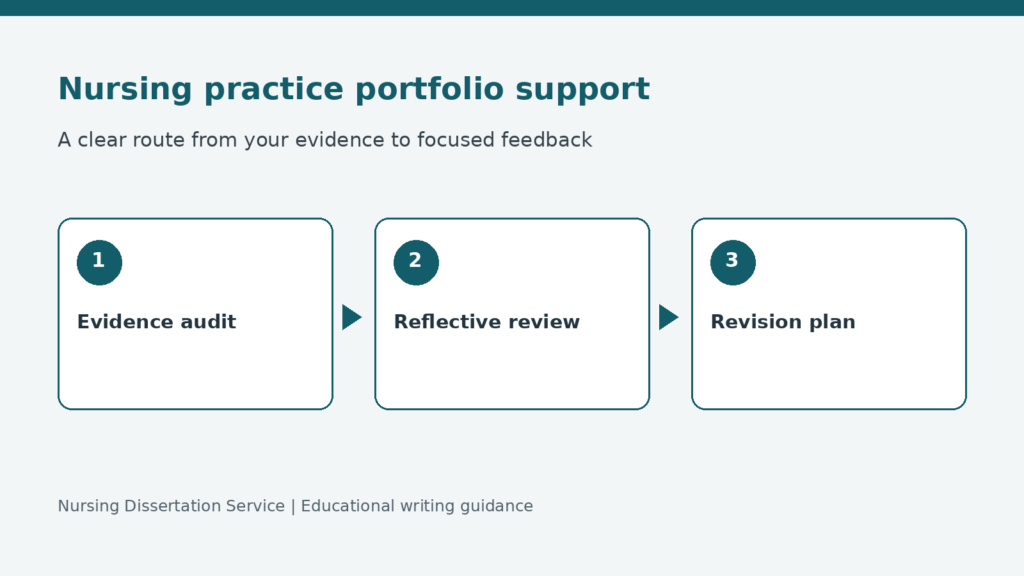
Nursing practice portfolio support helps you organise genuine evidence, explain your learning and identify gaps before you submit your own work. Bring your assessment criteria, selected anonymised entries and the feedback you need to address.
A portfolio can feel difficult even when you have completed the learning activities. You may have many documents but no clear evidence map. Alternatively, your reflection may describe an experience without showing what changed in your thinking. Focused review can help you recognise those problems and plan a practical revision.
Request a portfolio review. Include your country of study, programme level, deadline and the section you want reviewed. Scope, availability and cost should be agreed against your actual materials.
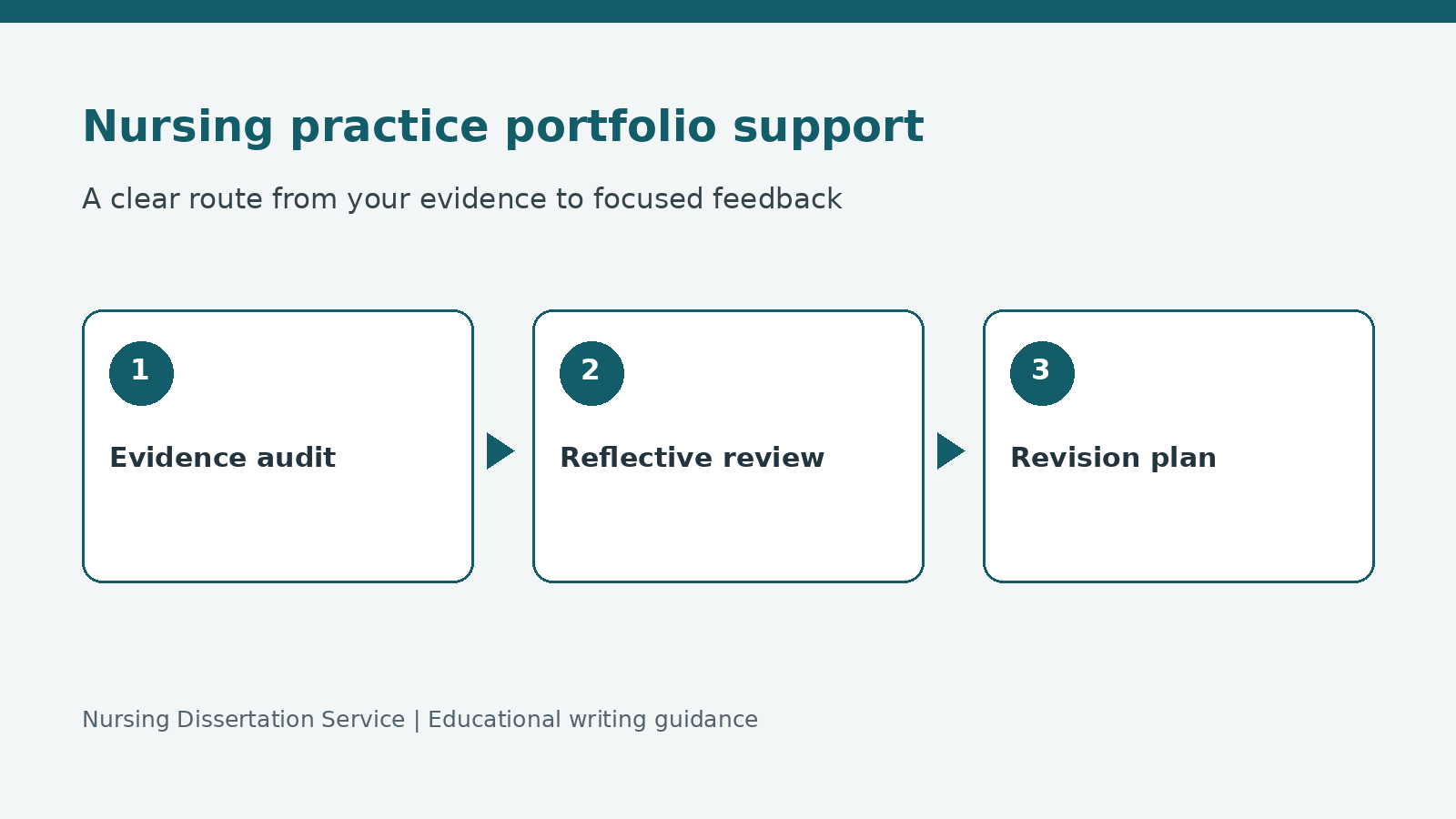
What nursing practice portfolio support covers
This service focuses on the relationship between a claim, its supporting evidence and the explanation that makes the evidence useful. A collection of documents becomes easier to assess when each selected item has a clear purpose. We can review that organisation and the clarity of your commentary.
| Your difficulty | Review focus | Your next action |
|---|---|---|
| Evidence scattered across files | Index, labels and criteria mapping | Build a traceable evidence map |
| Reflection remains descriptive | Reasoning, feedback and learning | Explain the change in your understanding |
| Several items support the same point | Relevance and repetition | Select the strongest permitted evidence |
| Feedback says claims are unclear | Contribution and limits | State accurately what you did and learned |
| Draft is almost complete | Consistency, references and presentation | Complete a prioritised final revision |
For example, the review can be limited to one section, a small selection of annotations or a proposed evidence map. It does not need to cover an entire programme portfolio. Also, tell us whether you want structural feedback, comments on reflective writing or a final presentation check.
How the review works
1. Identify the portfolio’s purpose
First, share the relevant instructions and assessment criteria. A placement record, academic portfolio, employment showcase and research-based portfolio thesis have different purposes. We use the actual task to agree what the feedback should address.
2. Select permitted material
Choose a manageable sample and remove identifying information. Explain which entries you can share under your university and placement rules. You should never provide portal credentials, original patient records or documents you are not authorised to disclose.
3. Review evidence and commentary
Feedback examines whether the selected material supports the claim you make. For example, attendance at a learning session may establish participation, while a separate explanation is needed to show how you applied the learning. An annotation should make that distinction clear.
4. Revise and verify
You decide how to respond to the comments and revise the work in your own words. Questions about evidence acceptance, practice assessment and official sign-off remain with your university or authorised assessor. Finally, keep a short record of the changes you make.
Evidence mapping and reflective feedback
In practice, an evidence map can identify the criterion, item, location, relevant contribution and remaining gap. Its purpose is to help a reviewer find and understand the evidence. It cannot turn an unsupported statement into a demonstrated competence.
In contrast, reflective feedback looks at a different issue: the quality of your explanation. Does the account identify a meaningful decision? How does it consider feedback or another perspective? Which specific learning action follows? As a result, these questions help you develop a reflective argument instead of extending a chronological story.
Suppose your own entry describes contributing to an education activity under supervision. A reviewer can ask you to clarify which part you prepared, how the audience responded and what feedback you received. However, only you can supply the truthful details. If you have no evidence of a later outcome, the entry should say that rather than imply success.
Guidance for different countries and assessment formats
Above all, your current handbook takes priority over any general guide. Therefore, we can review the clarity of your writing against the documents you provide, while keeping local requirements visible. A UK ePAD evidence map, a US academic artifact annotation and an Irish specialist competence account should not be treated as interchangeable submissions.
The country guides linked below address separate learning tasks. Finland’s portfolio-based thesis route also needs attention to research design and synthesis when that format is approved by the programme. It is a different task from preparing a placement record.
- UK: mapping existing evidence to nursing ePAD proficiencies.
- USA: annotating selected artifacts in an academic nursing portfolio.
- Australia: examining assumptions and power in a cultural safety reflection.
- Ireland: organising evidence for a specialist nursing competence portfolio.
- Finland: connecting outputs and analysis in a portfolio-based nursing thesis.
What to send with an enquiry
- The portfolio instructions, rubric and relevant field limits.
- Your country, programme and stage of study.
- An anonymised sample or evidence index you are permitted to share.
- Existing tutor feedback and the questions you want answered.
- The deadline and time zone.
- Any limits your institution places on external assistance.
Explain whether the portfolio is formative or assessed and whether other components are still awaiting verification. That information helps distinguish a writing problem from a practice-assessment issue that requires a conversation with your programme.
Choose a focused service
This page is dedicated to portfolios and their supporting commentary. For a substantial essay or report, see nursing assignment support. For citation problems within an existing draft, see reference verification. Our support process explains how to define a review request.
In all cases, the service provides educational feedback. It cannot supply clinical experiences, alter assessor decisions, validate practice hours or sign competencies. We do not promise particular grades or acceptance by a university. Your portfolio must remain an accurate account of your work and learning.
Frequently asked questions
Can you review one portfolio section?
Yes. Specify the section and the feedback required so a limited review can be agreed.
Can someone write my placement experiences for me?
Placement accounts must reflect your own experience. Feedback can help you explain genuine learning clearly; it cannot create that experience.
Do all nursing portfolios use the same template?
No. Use the template and criteria issued for your programme and purpose. General guidance helps with organisation rather than replacing those instructions.
Can I share my ePAD login?
Do not share portal credentials. Provide only permitted, anonymised material through an agreed review process.
How is the price decided?
The amount of material, complexity, review depth and deadline affect the scope. Request a quote describing exactly what is covered before agreeing.
Request nursing practice portfolio support
Send an enquiry about your portfolio with the criteria, an anonymised sample and your main concern. Review our approach and feedback policy when deciding whether the support meets your needs.