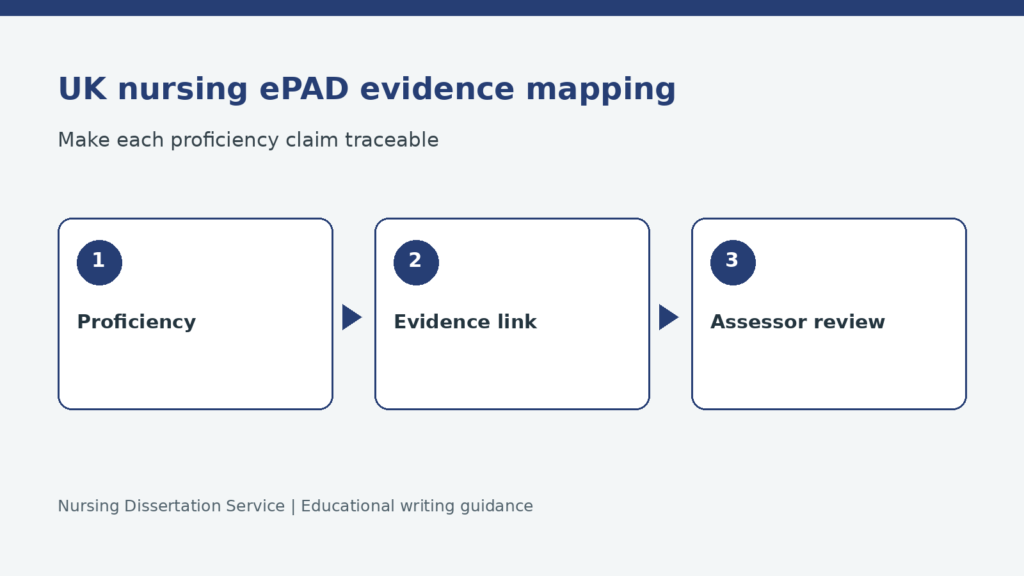
Nursing ePAD evidence mapping means connecting a stated proficiency with relevant placement evidence and a clear explanation of your contribution. Start with your programme’s current document, identify the exact requirement, and make each evidence link easy for the authorised assessor to follow.
A long list of uploaded files does not explain what you learned. Similarly, a confident statement cannot establish a proficiency without suitable evidence and the required assessment process. This guide addresses the organisation of evidence across a UK practice portfolio. For writing about a single care experience, use our separate episode-of-care reflection guide.
University of Leeds guidance describes MYEPAD as a placement workbook and explains that material collected outside it may need to be added and linked within the system (University of Leeds, n.d.). That is one institutional example. Your own platform, terminology and requirements may differ.
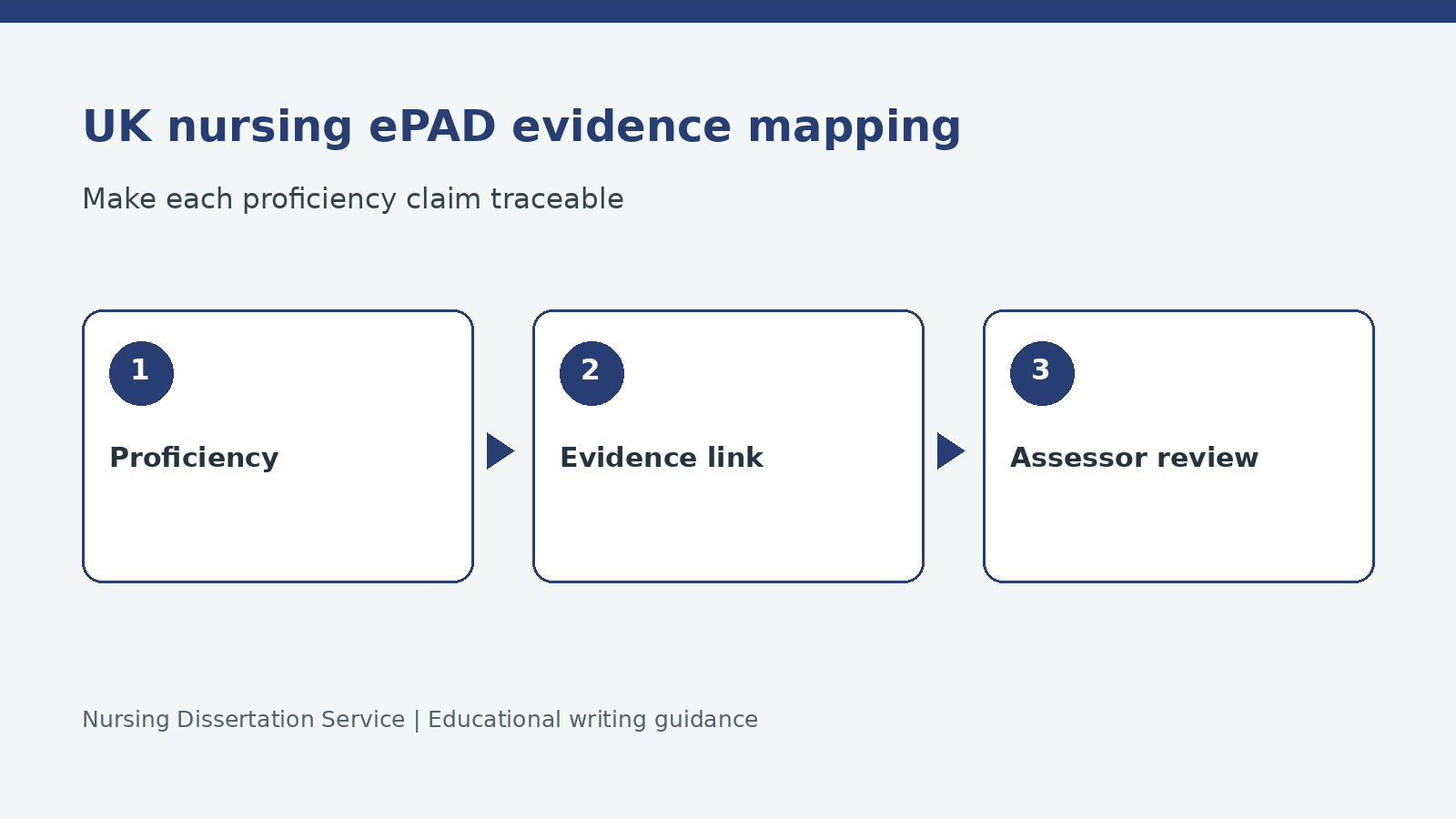
Start nursing ePAD evidence mapping with the current requirement
First, open the relevant section of your own practice assessment document. Check the programme stage and the wording of the proficiency. Do not use an older student’s completed portfolio as the authority for your task. Forms can look similar while asking for different evidence or levels of involvement.
Break the requirement into its meaningful parts. If it includes communication, assessment and evaluation, highlight those parts separately in your planning notes. Then ask what each part would look like in a genuine learning experience. This helps you avoid choosing a memorable event that addresses only one part of the requirement.
Next, distinguish a record you complete from a decision that another person must make. A student explanation, supervisor feedback and assessor judgement serve different purposes. Check who needs to review or confirm the material and when that should happen.
If a phrase is unclear, prepare a focused question. For example: does the form require an observed activity, a reflective account, feedback or several sources? Ask your practice learning contact rather than deciding that any written reflection will be sufficient.
Keep the original wording visible in your map. A short paraphrase can help you understand it, but an overly broad label may hide an important condition. Record the source and version of the document in your private planning notes so you can check that the map still matches the correct requirements.
Build a practical evidence map
A useful map makes it possible to trace a claim without searching through every file. Keep it simple enough to maintain during placement. The following layout is a planning aid; use your institution’s required fields wherever they differ.
| Column | What to record | Check to make |
|---|---|---|
| Requirement | Exact proficiency or authorised identifier | Correct stage and version? |
| Evidence | Permitted item and its location | Accessible to the assessor? |
| Contribution | Your actual role and supervision | Accurate and specific? |
| Explanation | Why the item addresses the requirement | Direct connection? |
| Limitation | What the item does not establish | Further evidence needed? |
| Next step | Question, learning activity or review | Clear owner and timing? |
For example, label an item in a way that reveals its purpose rather than using a name such as final document new version. Use consistent names within the rules of the platform. A label should identify the learning focus without exposing patient information.
Also, distinguish an item that exists from one you hope to obtain. Marking both as complete makes the map misleading. A separate status such as draft, awaiting discussion or review completed can clarify progress, provided those labels do not conflict with the official system.
Once the map is usable, stop adding unnecessary columns. A complex spreadsheet can become another unfinished task. The aim is a clear route from the requirement to the evidence, together with the questions you need to resolve.
Judge relevance before counting evidence items
Begin with the question the evidence needs to answer. An attendance certificate may establish that you attended a session. It does not, by itself, explain how you used the learning during practice. Likewise, a reflective paragraph may explain your reasoning without proving that an activity was directly observed.
Therefore, consider the function of each item. Some material provides context, some records feedback and some shows a specific contribution. The strength of a collection depends on the relationship between those functions. Several documents repeating the same information may leave the central question unanswered.
Check whether the evidence refers to the required activity, the relevant learning stage and your own participation. If the item describes a team achievement, identify your part. If it concerns a different setting, explain why it is relevant rather than assuming the connection is obvious.
However, do not remove required documents because you consider them repetitive. Mandatory records and your optional selection of supporting evidence are different matters. Ask your programme contact when unsure what may be omitted.
A useful self-check is to read the claim and evidence description separately. Could the evidence support a much narrower claim than the one you wrote? If so, revise the claim or identify the missing evidence. This is more defensible than increasing the volume of attachments.
Make your contribution visible without overstating independence
Use verbs that accurately describe your involvement. Observed, discussed, assisted, prepared and carried out under supervision communicate different roles. Choose the one that matches the actual experience. Avoid language that makes a shared decision sound like an independent action.
For instance, writing that you managed an entire episode may be inaccurate if you gathered information and discussed it with a supervisor. A precise explanation can still demonstrate learning. It allows the assessor to understand what you contributed and what support was present.
Next, connect the contribution to reasoning. What information did you notice? What question did you raise? How did feedback affect your understanding? These details can clarify the learning without inflating your responsibility.
Keep outcomes proportionate to what you know. A positive interaction does not establish a later clinical outcome that you did not observe. If follow-up was unavailable, acknowledge that limit. Identify what evaluation would have been useful without claiming it happened.
Finally, check consistency across the portfolio. If one entry says you observed an activity and another describes it as independent practice, resolve the discrepancy truthfully. Consistent role descriptions support a credible account and make review easier.
Worked example: identify a gap in the evidence chain
The following is an illustrative planning example, not an entry to submit as your own experience. Imagine a student has a genuine supervised education activity and wants to map it to a requirement concerning communication and checking understanding.
The student’s first note says: I explained the information clearly and the person understood. The available material consists of the student’s account and a short supervisor comment about the explanation. There is no documented basis for the statement about understanding.
A more careful mapping process separates the supported claim from the unsupported one. The student can identify the explanation delivered under supervision and the actual feedback received. They should then consider what evidence, if any, exists about checking understanding.
| Claim | Available support | Next step |
|---|---|---|
| Contributed to an explanation | Own account and relevant feedback | Clarify exact role |
| Adapted communication | Specific example needed | Describe what actually changed |
| Confirmed understanding | Not established by the current note | Discuss the evidence gap |
The student should not invent a question, response or observation to close the gap. Instead, the map can record the uncertainty and a question for review. Depending on the programme and remaining opportunities, the next step may involve further supervised learning.
The lesson is about evidence quality. Mapping reveals what the present material can and cannot show. It helps you prepare a constructive discussion rather than treating an incomplete account as a completed assessment.
Handle one item linked to several proficiencies
A learning experience may be relevant to more than one requirement. However, the explanation should make each connection explicit. Repeating the same paragraph under several headings leaves the assessor to infer why it belongs in each place.
First, check whether your programme allows the item to support multiple requirements. If it does, write a short, distinct explanation for each permitted link. One part of the event may concern communication, while another concerns recognising a limit and seeking support.
Use cross-references where the system permits them. This can avoid uploading duplicate copies that become inconsistent when you revise an entry. Check that the assessor can open the original item through every necessary link.
Also, avoid turning one experience into evidence for every proficiency. That may indicate that the mapping is too broad. Consider whether the claim relies on an activity you actually completed or on a general association with the topic.
A map is most useful when it exposes uneven coverage. Some requirements may have several strong items while others remain unsupported. Preserve that distinction. It directs your learning conversations towards the remaining gaps instead of producing an appearance of uniform completion.
Protect confidentiality while preserving useful detail
Before preparing an account, decide which contextual details are necessary to explain the learning. A name is not the only identifier. Exact dates, rare circumstances and a distinctive location can make a person recognisable when combined.
Follow your placement and university instructions on what can be recorded, where it may be stored and who may access it. Do not copy patient records into a personal planning file or an external review request simply because the portfolio discusses the same episode.
In an evidence index, use a brief description of the learning purpose. You can explain that an item concerns a supervised interaction without reproducing unnecessary personal details. Keep official evidence within the approved system where required.
If you request writing feedback, share only material that you are permitted to disclose. An anonymised sample should still be checked for indirect identifiers. A reviewer does not need your ePAD password to comment on the clarity of a paragraph.
Confidentiality also affects examples. Do not use another student’s portfolio entry as a template to be lightly altered. Your account should represent your own learning and should comply with the rules that apply to your evidence.
Prepare a focused assessor discussion
A map can make a meeting more productive when it highlights specific decisions. Prepare a short list of items you need reviewed and questions you cannot resolve independently. Avoid asking whether everything looks fine without pointing to the areas of uncertainty.
For each question, identify the requirement, the available evidence and the precise concern. You might ask whether the current evidence addresses an evaluation element or whether another type of observation is needed. That framing makes the issue easier to discuss.
During the conversation, distinguish guidance about future learning from a completed assessment decision. Record the agreed next steps in the appropriate place. Do not mark an official field as achieved merely because you discussed how to improve it.
Afterwards, update your private planning map so it reflects what remains outstanding. If you misunderstood part of the discussion, seek clarification promptly through the programme’s normal arrangements. A vague memory is an unreliable basis for a later claim.
Finally, use feedback to change the evidence process. For example, if links were inaccessible, improve the index. If contributions were unclear, revise the explanation. The most useful outcome is an accurate portfolio that another person can navigate and review.
Keep an evidence revision log
When you revise an entry, note what changed and why in a separate planning log if your programme permits one. This can be as simple as the entry label, the feedback point and the action taken. Avoid storing another copy of sensitive material merely to document the change.
For example, a revision might clarify that an activity took place under supervision. Another might remove an unsupported claim about a later outcome. These are changes to accuracy and reasoning, not just changes to wording. Recording their purpose can help you apply the same lesson elsewhere.
Next, check whether a revised item affects other links in the map. If several proficiencies refer to the same account, a change to the contribution or outcome may alter those explanations too. Review each connection rather than assuming the old links remain valid.
Also, keep drafts and official records distinct. Do not overwrite confirmed information outside the platform’s permitted process. If a record contains an error, ask how it should be corrected and who needs to know. A private planning note cannot amend an official assessment decision.
Before the final review, remove confusing duplicate drafts from any optional submission area where your programme allows this. Keep required records and version history as instructed. The assessor should be able to identify the version intended for review without guessing from file dates.
This final organisation step makes the evidence map easier to use over time. It also gives you a realistic record of the writing skills you have developed: selecting evidence, explaining limits, responding to feedback and making accurate claims.
Final nursing ePAD evidence mapping checklist
- Use the correct programme stage and current requirement.
- Identify a genuine, permitted evidence item.
- Explain your role and level of supervision.
- State why the item addresses this particular proficiency.
- Separate observation from interpretation and outcome.
- Identify missing evidence without inventing it.
- Check confidentiality and document permissions.
- Test links from the assessor’s intended view where permitted.
- Record questions and next steps for official review.
- Leave assessment decisions to authorised assessors.
Complete this check before spending time on visual presentation. A tidy layout helps, but it cannot repair an unsupported claim. Once the evidence chain is clear, check labels, references, spelling and navigation.
Frequently asked questions
Is evidence mapping the same as an episode-of-care reflection?
No. Mapping organises the connection between requirements and evidence across a portfolio. A reflection examines learning from an experience. It can be one item within the wider map.
How many items should support each proficiency?
Use your programme’s instructions and assessor guidance. There is no universal number that this guide can apply to every UK nursing programme.
Can one item support several proficiencies?
Check local requirements. Where reuse is allowed, explain the different connection for each link and ensure the original evidence remains accessible.
What if I discover a gap near the deadline?
Raise it promptly through your placement or programme support arrangements. Explain what evidence exists and what remains uncertain. Do not fabricate a completed activity.
Can external feedback confirm my proficiency?
No. Writing feedback can help with clarity and organisation. Official assessment and sign-off remain with the authorised people in your programme.
Turn your evidence map into a practical revision plan
Start with the weakest evidence chain, identify the missing connection and decide whether the next step is a writing revision or an official learning discussion. For permitted feedback on organisation, see nursing practice portfolio support. Read how support works and our approach, or send an anonymised enquiry.
References
University of Leeds (n.d.) PebblePad. Available at: University of Leeds practice placement guidance (Accessed: 21 October 2026).