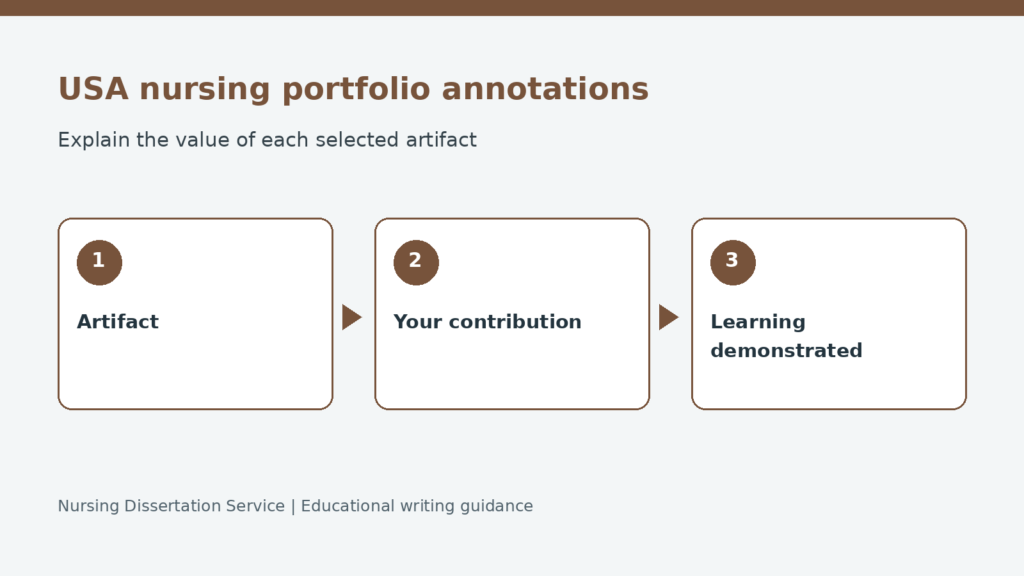
Nursing portfolio artifact annotations explain why you selected an item, what you contributed and what the item reveals about your learning. In a US academic portfolio, an annotation should help the reader interpret the artifact against the course requirements.
An artifact might be an assignment, project output or another item your programme permits. The annotation is the short explanation beside it. Simply uploading a strong piece of work leaves important questions unanswered: why is this item here, which outcome does it address, and what did you learn?
Chamberlain University describes a nursing portfolio as a way to gather and reflect on professional development (Chamberlain University, n.d.). That broad purpose does not establish a universal US assessment rubric. Use your own course instructions to determine required artifacts, word limits, citation style and sharing permissions.
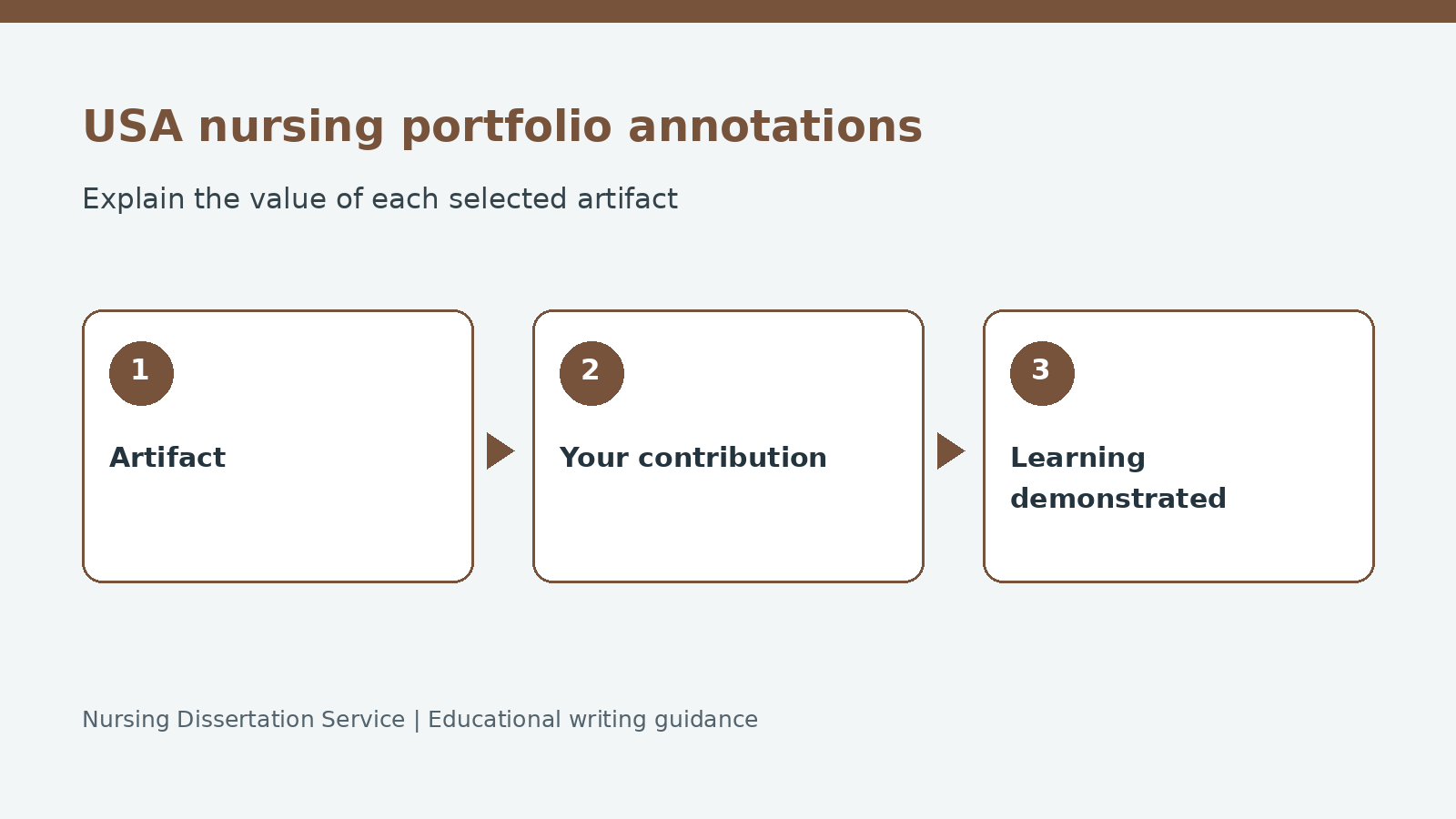
Understand the purpose of nursing portfolio artifact annotations
First, identify who will read the portfolio. An instructor assessing learning needs a different explanation from an employer reviewing selected achievements. This guide focuses on academic annotations. It does not provide a universal employment portfolio template or a substitute for a capstone report.
Read the assignment verbs carefully. Describe asks for an account, while analyse or evaluate requires reasoning about meaning, quality or limitations. If the brief asks how an artifact demonstrates a course outcome, the annotation must connect the item to that specific outcome.
Next, separate the artifact from the evidence claim. A completed paper establishes that a piece of academic work exists. Your commentary needs to explain the relevant thinking or skill within it. A high mark, where sharing it is appropriate, does not by itself explain the learning process.
Also, determine whether the annotation should be written at the time of submission or retrospectively. Looking back after feedback may allow you to discuss development that was not visible in the original paper. Make the timing clear so the reader can distinguish your earlier thinking from your current interpretation.
Keep the task narrow. An annotation is not an autobiography. Choose the details necessary to understand this artifact, its relationship to the learning outcome and its role in the portfolio as a whole.
Choose artifacts for relevance and permission
Begin with the outcome and look for work that provides a useful basis for discussing it. Selecting your longest assignment or most visually impressive slide deck may overlook a shorter item that shows more clearly how you responded to feedback.
For each candidate, ask what the reader can actually see. Does it contain your reasoning, a practical output, a revision or an evaluated decision? If the important learning took place in discussion, consider whether the permitted evidence includes a record of that feedback.
However, do not attach material merely because it is available. Check course rules on group work, clinical information, copyrighted material and external publication. An academic portfolio submitted through a restricted learning platform is different from a publicly accessible website.
Keep a selection note for each artifact. Record its purpose, the intended outcome, the specific feature you will discuss and any permission question. This prevents you from building a portfolio of attractive items that all support the same narrow claim.
Finally, compare your choices as a collection. A good selection should let you discuss development across the required outcomes without making every annotation repeat the same lesson. Where the rubric mandates particular items, include them and use commentary to explain their distinct significance.
Use a clear structure for each annotation
The following structure is an original planning aid. Adapt it to your assignment’s fields and word limit. Its value lies in the questions it prompts, rather than the exact order of the headings.
| Element | Question | Useful detail |
|---|---|---|
| Identification | What is this item? | Title, course context and permitted date |
| Contribution | What did you do? | Individual role and relevant collaboration |
| Connection | Why is it included? | Specific outcome and visible feature |
| Evaluation | What does it show well or imperfectly? | Reasoning, feedback and limitations |
| Development | What changed afterwards? | Revision or a realistic next step |
For a short annotation, these elements may fit into one paragraph. For a longer commentary, separate them into a few concise paragraphs. Do not give each heading equal space automatically. The assessment criteria should determine the emphasis.
Also, avoid repeating the artifact’s introduction. The reader needs an explanation of significance, not a second abstract. Mention the project topic only to establish context, then move to your contribution and learning.
Explain your individual contribution in group artifacts
Group work creates a common annotation problem: the final output belongs to several people, but the portfolio needs to show your learning. Use first person where permitted and identify the work you completed without claiming ownership of the entire product.
For example, you may have searched for evidence, prepared a particular section, compared options or revised slides after group feedback. Explain the contribution that actually occurred. If the final decision was collective, describe it as collective.
Next, discuss collaboration as a process. Did another member challenge an assumption? Did the group identify a weakness that you had missed? Learning from others is a valid part of the account when it is described accurately.
However, avoid including private peer messages or identifying feedback without permission. You can explain the substance of a learning point without reproducing every exchange. Follow the institution’s requirements on attribution and evidence.
End by making the connection to the outcome explicit. If the rubric concerns evidence evaluation, show the evaluation work you contributed. If it concerns teamwork, explain the relevant interaction. The same artifact can support different discussions, but the annotation should make a deliberate choice.
Connect the artifact to an outcome without forcing the fit
Read the full outcome rather than matching a familiar keyword. An outcome about evaluating evidence asks for more than using references. Similarly, a communication outcome may require attention to audience and purpose, not simply the existence of a presentation.
Point the reader towards the relevant feature. You might identify the comparison section, the revised recommendation or the explanation of uncertainty. Use an accessible page or section reference where the portfolio format allows it.
Then explain why the feature matters. A sentence such as this demonstrates critical thinking is too broad unless you identify the reasoning involved. Did you compare competing explanations, question an assumption or narrow a claim after appraising the evidence?
Also, acknowledge partial alignment. An artifact may address one part of an outcome strongly and another part only weakly. That is useful information for selecting additional work or setting a development goal. It is more credible than claiming complete mastery from a single assignment.
If the artifact does not fit, choose another permitted item or seek clarification. Repeatedly rewriting the annotation to sound more impressive cannot create a connection that the work does not support.
Worked example: a patient education project annotation
This example illustrates analysis; it is not a personal experience for readers to submit. Imagine an academic project in which a student helped prepare an education resource and later revised it after feedback.
A weak annotation says: this project taught me communication and teamwork. It was useful and I will use the skills in practice. The statement could accompany almost any group project and does not tell the reader what changed.
A stronger planning approach identifies the student’s actual contribution, the feedback and its effect. For instance, the student might explain that they drafted one section, received feedback that the wording was too technical and revised the explanation for the intended audience. Those details must come from genuine work.
| Broad statement | Question to answer |
|---|---|
| I improved communication | Which wording or design choice changed? |
| Feedback was helpful | What weakness did it reveal? |
| The resource was effective | What evaluation supports that claim? |
| I developed teamwork | What contribution or interaction demonstrates this? |
If the resource was never evaluated with its intended audience, the annotation should acknowledge that. A clearer draft is a writing improvement, while demonstrated educational effectiveness would require additional evidence. Keep those claims separate.
The final annotation can therefore describe a meaningful achievement and a remaining limitation. It gives the reader a clearer view of development than an unqualified claim of success.
Use feedback as evidence of development
Feedback becomes useful when you explain what you did with it. Listing positive comments can turn an annotation into a testimonial. Instead, identify a point that changed your approach and show its effect on the work or your next task.
First, record the original concern accurately. Did the instructor ask for a clearer rationale, stronger synthesis or a more focused conclusion? Avoid interpreting every comment as a request for more references or more detail.
Next, identify the action you took. For example, you may have reorganised a comparison or removed an unsupported recommendation. Explain why that action addressed the problem. A change in wording is meaningful when it improves the reasoning.
If you have not yet applied the feedback, say so. You can describe a planned revision without presenting it as completed development. A future intention is different from evidence that your approach has already changed.
Finally, look for transfer to a later artifact. If the same issue recurs, discuss what remains difficult. Portfolios can reveal uneven progress. An honest analysis of a continuing weakness may support a more useful development plan than a sequence of claims that every problem is solved.
Evaluate limitations without dismissing your achievement
Critical reflection does not require you to portray the work as a failure. It requires a proportionate judgement. Identify what the artifact demonstrates, the conditions under which you produced it and what it cannot establish.
A literature-based paper, for example, may show evidence appraisal but not practical implementation. A simulated activity may demonstrate learning within the simulation without proving independent performance in every clinical setting. Explain the boundary that matters for your claim.
Also, consider how much support you received. Collaboration, tutor feedback and access to a structured template can be relevant context. Acknowledging support does not erase your contribution. It helps the reader understand the process accurately.
Avoid adding a generic limitation to every annotation. Limited time is only useful if you explain its effect on the work and how you handled it. Choose the limitation that changes the interpretation of this particular artifact.
Then identify a realistic next step. That might involve seeking feedback on a revised explanation or applying an appraisal technique in another assignment. Keep the action close enough to the limitation that the reader can see why it follows.
Organise annotations across the whole portfolio
Once individual annotations are drafted, read them together. Check whether they reveal different aspects of development or repeat the same broad statement. A portfolio needs coherence, but identical conclusions make it difficult to see progression.
Use consistent labels and a clear index. An annotation should identify the correct artifact version and any relevant section. If you revised an artifact after feedback, make it clear which version the reader is viewing.
Next, distinguish recurring themes from duplicate content. Communication may appear in several artifacts, but each can show a different challenge: adapting language, organising a presentation or responding to conflicting feedback. Explain that distinction rather than copying a general definition.
Consider the order of presentation. Your rubric may prescribe it. Where you have a choice, a sequence showing development can be helpful, as can grouping items by required outcomes. Select the arrangement that makes the assessment logic easiest to follow.
Before submission, check every link and attachment in the intended submission format. A polished annotation loses value if its artifact cannot be opened. Use permitted access settings and avoid making restricted coursework public merely to simplify a link.
Revise nursing portfolio artifact annotations efficiently
Use separate revision passes. First, check accuracy: can every statement about contribution, feedback and outcome be supported? Next, check alignment: does the annotation answer the relevant assessment question?
Then improve the analysis. Underline sentences that merely describe the artifact and identify where you explain why a decision mattered. If the paragraph contains only chronology, add the reasoning or narrow the claim rather than adding another summary.
After that, remove repetition. Delete details already obvious from the artifact unless they are necessary to interpret it. Shorter annotations often become clearer when they focus on one meaningful learning point.
Finally, proofread for consistent tense, terminology and references. Follow your programme’s specified style, including APA where required. Cite external ideas used in the annotation, while keeping your own experience and interpretation distinct from those sources.
Read the annotation aloud if useful. It should sound like a clear explanation of your work, not a list of abstract qualities. Replace claims such as excellent leadership with a concrete account of the relevant decision, contribution or feedback.
Keep a final copy of the submitted version through your approved course system. This gives you a reliable reference when reviewing feedback later and avoids confusion between an earlier draft and the artifact the instructor actually assessed.
Annotation checklist before submission
- The artifact is required or clearly relevant.
- You have permission to include and share it.
- The annotation identifies your individual contribution.
- The selected feature connects to the actual outcome.
- Feedback and development are described accurately.
- Outcomes do not exceed the available evidence.
- A meaningful limitation is acknowledged.
- The next step follows from the analysis.
- Attachments, links and versions are correct.
- The writing follows your course’s integrity and citation rules.
Use the checklist as a review aid, not an alternative rubric. If your instructor specifies additional elements, include them. When uncertain about reuse or external assistance, ask before sharing the work.
Frequently asked questions
How long should an artifact annotation be?
Use the assignment’s word limit. A short annotation needs a focused explanation; a longer commentary can explore feedback and limitations in more depth.
Should I include my highest-marked assignment?
Only if it meets the portfolio requirements and provides relevant evidence. A lower-marked piece can sometimes support a valuable account of revision and development.
Can a group project be an artifact?
Check the course rules and permissions. If allowed, identify your contribution and credit collaboration accurately.
Is an annotation the same as an abstract?
No. An abstract summarises a work. An annotation here explains its significance for your learning and the portfolio’s assessment purpose.
Can I use the same wording for every item?
A consistent planning structure is useful, but the analysis should reflect each artifact’s actual contribution, feedback and limitations.
Make the selected work meaningful to your reader
A useful annotation turns an artifact into an explained piece of evidence. Identify the contribution, evaluate the learning and keep the claim proportionate. For permitted feedback on your own commentary, explore nursing practice portfolio support. Our review process and support approach explain the scope; contact us with an anonymised sample.
References
Chamberlain University (n.d.) How to create a nursing portfolio. Available at: Chamberlain University portfolio guidance (Accessed: 21 October 2026).