

Nursing Likert-scale data in SPSS must be coded, scored and interpreted according to the questionnaire’s design. The first decision is whether the dissertation analyses an individual ordinal item or a justified multi-item scale measuring a nursing construct.
This guide explains codebooks, reverse scoring, reliability, composite scores, statistical-test selection and accurate nursing interpretation.
Understand the Nursing Questionnaire Before SPSS
Review the instrument, scoring guidance and evidence supporting its use. Identify domains, reverse-worded items, permitted missing responses and rules for calculating totals or subscales. Do not create a composite score merely because several questions share the same response labels.
Create a Codebook for Nursing Likert-Scale Data in SPSS
Record the variable name, full item wording, value labels, missing-value codes, reverse-scoring requirements, subscale membership and allowable range for every calculated score.
Consistent coding is essential when a higher number means stronger agreement on some items but a worse clinical outcome on others.
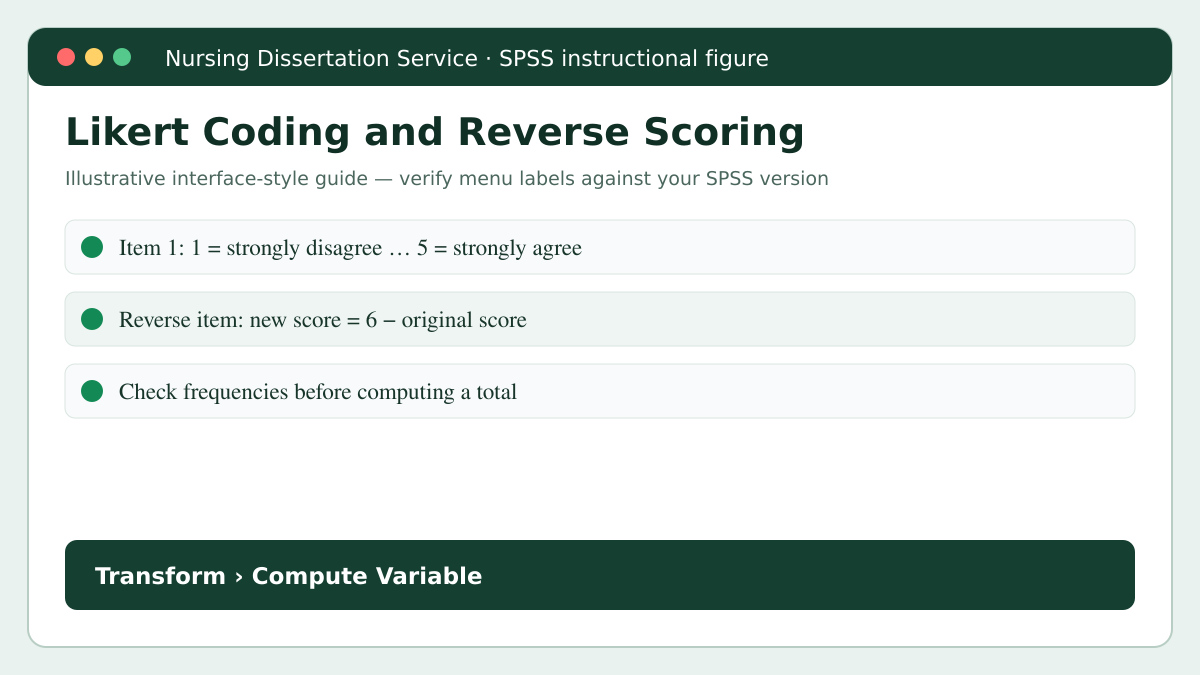
How to apply the coding: Assign one consistent numeric code to every response category and keep missing responses distinct from valid scores. After entry, run frequencies to identify impossible values, unexpected blanks and reversed category labels before creating any scale score.
Enter and Check Nursing Likert Responses
Each row normally represents one nursing participant and each questionnaire item has its own column. Run frequency tables before calculating scores. Frequencies reveal impossible codes, unused response categories and unexpected missingness.
Keep original variables unchanged. If an item needs reverse scoring, create a new transparently named variable and verify several cases manually.
Distinguish Individual Items From Composite Scales
An individual Likert item is ordered categorical data. A composite scale combines several items using an established or justified scoring rule. Analysis should reflect the research purpose, distribution and measurement evidence—not a universal claim that every Likert response must be treated identically.
Reverse-Score Nursing Questionnaire Items Carefully
For a five-point item coded 1 to 5, reverse scoring commonly maps 1 to 5, 2 to 4, 3 to 3, 4 to 2 and 5 to 1. Always follow the instrument’s official instructions. Compare frequencies before and after recoding to confirm the transformation.
Evaluate Reliability Without Overclaiming
Cronbach’s alpha may assess internal consistency for a suitable multi-item scale, but it does not prove validity or unidimensionality. Interpret the coefficient with the number, meaning and relationships of the items.
Do not delete an item solely to increase alpha. Removing content without theoretical justification may weaken the construct the nursing scale was intended to measure.
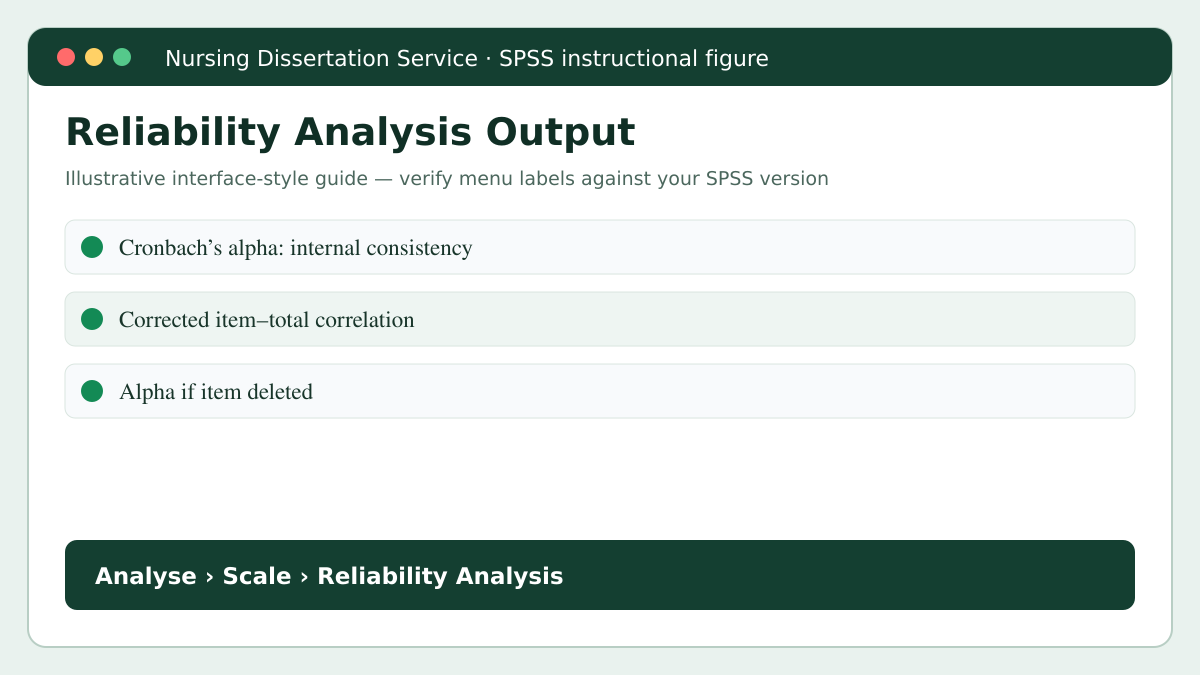
How to interpret reliability: Review item coding, corrected item-total relationships and the reliability estimate alongside the questionnaire’s intended structure. A high coefficient does not prove validity, while an unexpected result may indicate a reverse-scoring error or items measuring different constructs.
Calculate Nursing Scale Scores
Use the approved scoring rule to calculate totals or means. Decide how incomplete responses will be handled before inspecting the outcome. Report the rule clearly enough for another researcher to reproduce.
After calculation, inspect the theoretical range, observed range, distribution, outliers and descriptive statistics. An impossible total usually indicates a coding or formula error.
Choose Statistical Tests for Nursing Likert-Scale Data in SPSS
| Purpose | Possible starting analysis | Key decision |
|---|---|---|
| Describe one item | Frequencies and percentages | Show ordered response pattern |
| Describe a composite score | Mean/SD or median/IQR | Consider construction and distribution |
| Compare two groups | Parametric or non-parametric comparison | Match outcome and assumptions |
| Examine association | Suitable correlation or model | Respect measurement structure |
| Predict an outcome | Regression suited to outcome | Justify coding and model |
Explain the analytical reasoning rather than relying on the SPSS measurement label. Selecting “scale” inside Variable View does not establish that a variable is continuous or valid.
Interpret Nursing Likert Results
State what higher and lower scores mean before reporting differences or associations. If higher scores indicate worse burnout, a positive regression coefficient has a different meaning from a wellbeing scale where higher scores indicate improvement.
Report the observed pattern, magnitude and uncertainty. Avoid converting an average agreement score into a clinical diagnosis or claiming that attitudes caused an outcome in cross-sectional data.
Frequent Likert-Scale Analysis Errors
- Reversing the wrong questionnaire items.
- Mixing response coding across questions.
- Creating a total without a scoring rationale.
- Interpreting alpha as proof of validity.
- Ignoring missing-item rules.
- Forgetting the direction of the final score.
- Choosing a test solely from the SPSS measurement label.
Frequently Asked Questions
Can nursing students calculate means for Likert data?
It depends on whether the analysis concerns an individual item or a defensible multi-item score, plus the purpose, distribution and programme guidance. Explain the decision.
Should every nursing questionnaire use Cronbach’s alpha?
No. It applies to particular multi-item measurement situations. Unrelated questions do not form a scale merely because they appear in one survey.
Can SPSS reverse-score items?
Yes, but the analyst must specify the correct mapping and verify it. Retain the original item.
Get Nursing Questionnaire Analysis Support
Our nursing dissertation data analysis service supports codebook development, data cleaning, scale construction, reliability, statistical testing and results interpretation.
Worked Nursing Likert-Scale Example
Imagine that 220 nurses complete an eight-item workplace-support scale using responses from 1 (strongly disagree) to 5 (strongly agree). Each item should first be checked with frequencies. Reverse-worded items must be rescored according to the instrument instructions before a total or mean is calculated. Individual Likert items are ordinal; the analysis of a justified multi-item scale requires a separate decision based on its construction, distribution and purpose (Sullivan & Artino, 2013).
For reliability, use Analyse > Scale > Reliability Analysis. IBM describes Cronbach’s alpha as an internal-consistency measure based on average inter-item correlation (IBM, n.d.). Report the coefficient, number of items, sample and scale context. Do not describe alpha as proof that a scale is valid or unidimensional.
Dissertation-Ready Likert Reporting Example
“The eight-item workplace-support scale demonstrated acceptable internal consistency in this sample (Cronbach’s α = .82). After reverse scoring Items 3 and 6 according to the instrument manual, a mean score was calculated when at least six items were complete. The median score was 3.75 (IQR 3.25–4.13).” These numbers are illustrative and must be replaced with verified results.
Recent nursing-method research warns that conventional alpha and maximum-likelihood approaches may not always be optimal for ordinal items; the choice should reflect the number of categories, distribution and measurement model (Park, 2024). Scale development should also assess content validity, dimensionality and construct validity rather than relying on reliability alone (Boateng et al., 2018).
Related Nursing Guides
- Missing Data in Nursing Research: SPSS Dissertation Guide
- Nursing Regression Analysis in SPSS for Dissertations
- A Priori vs Post Hoc Power Analysis in Nursing
Before analysis, review our SPSS data-cleaning guide and guidance on handling missing nursing research data. These checks help prevent coding decisions from distorting scale scores or reducing the usable sample unexpectedly.
Conclusion
Nursing Likert-scale data in SPSS require a verified chain from instrument meaning to coding, scoring, reliability, analysis and interpretation. A clear codebook is more valuable than a large volume of unexplained output.
References
- Boateng, G. O., Neilands, T. B., Frongillo, E. A., Melgar-Quiñonez, H. R., & Young, S. L. (2018). Best practices for developing and validating scales for health, social, and behavioral research: A primer. Frontiers in Public Health, 6, 149. https://doi.org/10.3389/fpubh.2018.00149
- IBM. (n.d.). Reliability analysis. IBM SPSS Statistics Documentation. https://www.ibm.com/docs/en/spss-statistics/32.0.0?topic=features-reliability-analysis
- Park, C. G. (2024). Implementing alternative estimation methods to evaluate the reliability of Likert-scale instruments. Women’s Health Nursing, 30(1), 18–25. https://doi.org/10.4069/whn.2024.03.12
- Sullivan, G. M., & Artino, A. R., Jr. (2013). Analyzing and interpreting data from Likert-type scales. Journal of Graduate Medical Education, 5(4), 541–542. https://doi.org/10.4300/JGME-5-4-18


