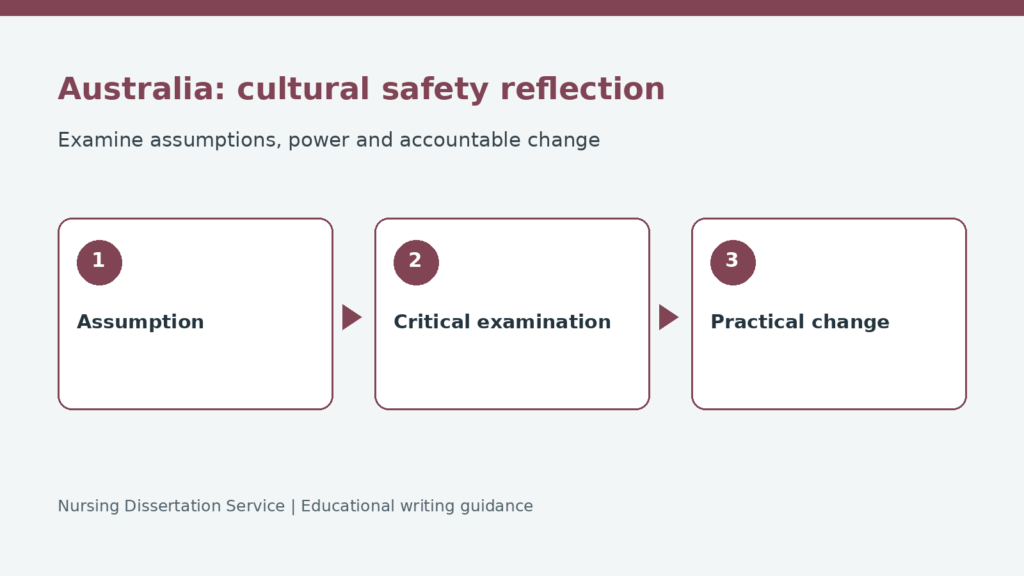
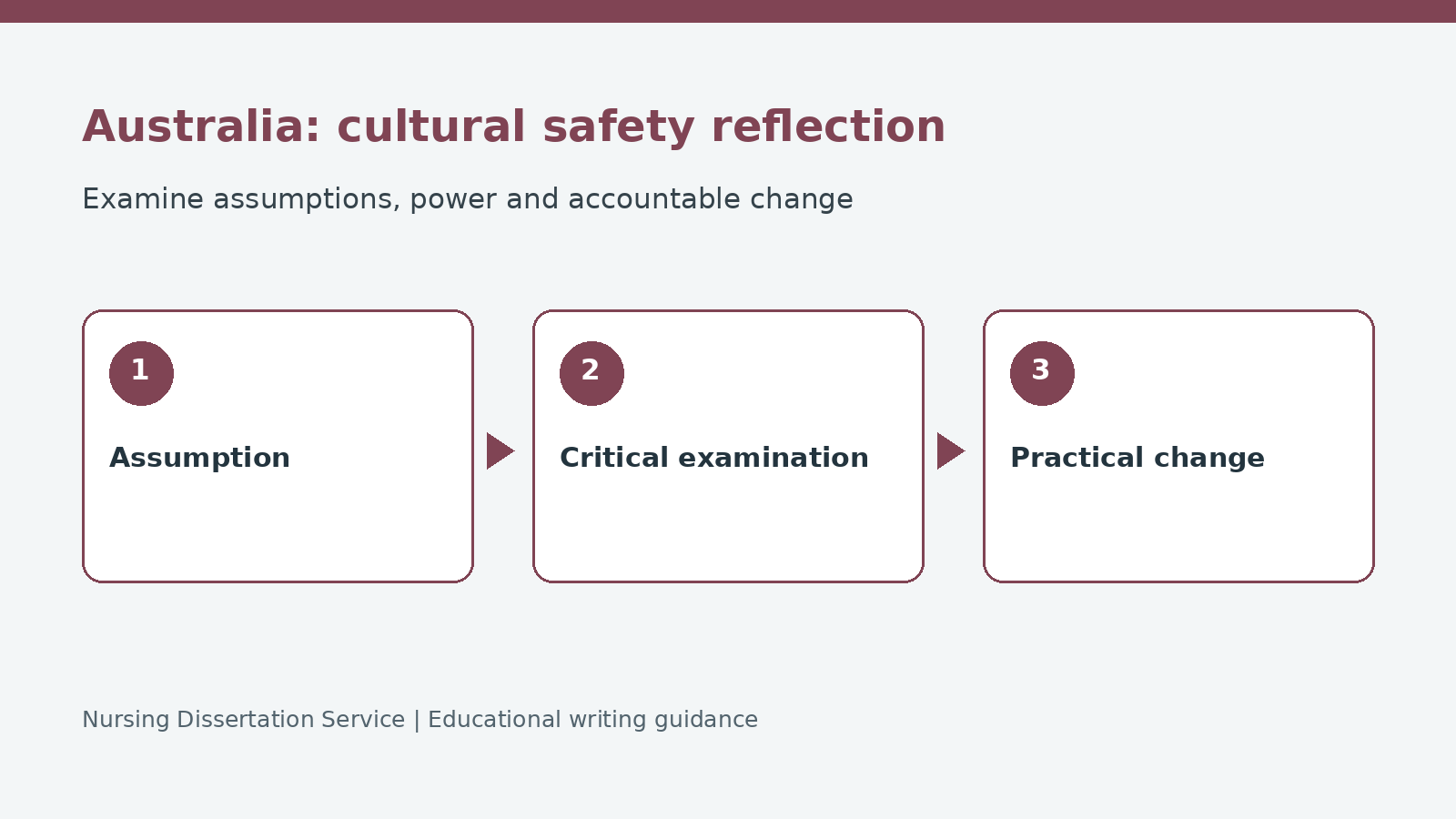
A cultural safety reflection in nursing should examine how your assumptions and position influence your thinking, then identify a justified change in your approach. For Australian assignments, connect the reflection to the actual brief and the relevant learning about Aboriginal and Torres Strait Islander peoples.
Begin with a specific learning moment. Explain what you previously assumed, what challenged that assumption, and why the change matters. A reflection becomes more analytical when it examines your reasoning rather than simply stating that all cultures deserve respect.
Deakin University’s HNN154 unit description identifies cultural safety, context, and Aboriginal and Torres Strait Islander health as domains of learning (Deakin University, n.d.). This provides an example of Australian nursing education content. It does not mean every university uses the same reflective task, model or marking criteria.
Read the cultural safety reflection brief carefully
First, identify what the task asks you to reflect on. It may concern learning from a unit, a permitted practice experience, a reading or a classroom activity. Those starting points require different evidence. Do not replace a reflection on learning with an invented placement encounter.
Check the required focus. A task about Aboriginal and Torres Strait Islander health should not become a general discussion of international cultural differences. Similarly, a question about your changing understanding needs to make your perspective visible rather than summarising the entire unit.
Next, note the reflective model, learning outcomes and word limit. Use a required model accurately if one is specified. If you have a choice, select a structure that gives enough space to examine assumptions, context and future action.
Distinguish reflection from a conventional essay. You may need first-person writing to explain your own thinking. However, personal experience does not remove the need for evidence when you make wider claims about history, policy or health.
Finally, check any restrictions on examples or source materials. Use the readings and perspectives your programme requires. A generic online example cannot establish what you learned, and a polished personal account is unsuitable if its experience did not happen.
Identify an assumption that changed
Choose a specific assumption rather than a broad confession that you once knew little about culture. The reader needs to understand what your original thinking was and how it affected the way you interpreted information.
For example, you might recognise that you previously treated equal provision as sufficient evidence of equitable care. The reflection could examine why that assumption failed to consider different circumstances or power. This is a planning prompt, not a claim about any reader’s actual beliefs.
Next, identify the learning that challenged the assumption. Was it a required reading, discussion, feedback or another permitted experience? Explain the connection. Simply naming a lecture does not show how it changed your reasoning.
Also, consider why the original assumption seemed reasonable to you. It may have reflected a limited viewpoint, an unexamined habit or a focus on the professional’s intention. Examining that process adds depth without making the account a performance of guilt.
Then state what remains uncertain. Learning does not require you to claim complete understanding. A useful reflection can identify a better question you now ask and the knowledge you still need to develop.
Keep cultural safety distinct from a checklist of customs
A weak reflection can become a list of supposed preferences associated with a group. That approach risks treating people as interchangeable. Instead, examine how assumptions about another person shape your interpretation and response.
Use your prescribed sources to define the concepts the assignment requires. If you discuss awareness, competence, humility or safety, do not assume the terms mean the same thing. Explain the distinction relevant to your argument and attribute the source of that explanation.
Also, keep intention and experience separate. A statement that you intended to be respectful does not establish how another person experienced the interaction. Where you have no feedback or permitted evidence of that experience, recognise the limit.
Pay attention to wording. Avoid presenting one person’s account as representative of all Aboriginal and Torres Strait Islander peoples. Where a source concerns a particular community or setting, preserve that context.
In the reflection, focus on the learning responsibility you can explain. What assumption will you examine? Which source or perspective should inform your understanding? How will you recognise when a familiar routine needs questioning? These questions support analysis without turning culture into a fixed set of instructions.
Analyse power rather than listing good intentions
Power can be difficult to discuss because it is less visible than a discrete task. Start with a concrete question: who defined the problem, whose account was treated as authoritative, and who could question the proposed approach?
In a classroom reflection, you can examine whose knowledge shaped your earlier understanding. In a permitted practice account, consider the boundaries of what you observed and what you can responsibly infer. Do not assign motives to people without evidence.
Next, consider your own position. Professional or student language can influence what appears normal or reasonable. A reflection should explain how you became aware of that influence and what you would now examine more carefully.
However, avoid reducing power to the attitude of one individual. Your assignment may require historical and organisational context. Use appropriate sources for those claims and show how the context changes the interpretation of the learning moment.
A useful paragraph links three elements: an assumption in your thinking, a source or perspective that unsettled it, and a consequence for how you would approach future learning. This keeps the discussion connected to reflection rather than becoming an unrelated theoretical summary.
Use historical context with a clear purpose
If your brief requires discussion of colonisation or racism, establish the relevant points from credible sources. Do not add a broad historical overview simply because the topic appears in the unit title. Explain why the selected context changes your understanding of the present issue.
For example, a reflection can ask whether an earlier explanation placed responsibility entirely on an individual while overlooking structural circumstances. The analytical work lies in showing how the evidence changes that explanation.
Next, distinguish a source-supported historical statement from your own response to learning it. The first requires accurate citation. The second requires a truthful account of your thinking. Combining them without a clear distinction can make an emotional response look like evidence for a wider claim.
Also, avoid unsupported statistics. An impressive number adds little if its population, period or meaning is unclear. Use only information you can verify and explain in relation to the assignment’s question.
Keep the reflection proportionate. Historical context should inform your analysis, while the main account still shows the development of your understanding. If the paragraph would fit unchanged into any essay on the topic, revise the link to your specific learning.
Worked example: move from description to reflection
The following example is an illustrative writing exercise. It should not be copied as a personal experience. Imagine a student realises, during a learning activity, that they equated treating everyone identically with providing appropriate care.
A descriptive response says: the activity taught me that culture matters, and I will respect everyone. The statement expresses a positive intention but leaves the change in reasoning unexplained.
An analytical plan would identify the earlier assumption, the material that challenged it and the question the student now asks. For instance, the student could examine whether a standard approach leaves space for the person’s own account and preferences, using the actual unit material to justify that examination.
| Descriptive statement | Analytical question |
|---|---|
| I treated everyone the same | Which assumptions shaped my idea of fairness? |
| I learned culture matters | What changed in how I interpreted the issue? |
| I meant to be respectful | What do I know about the other perspective? |
| I will improve | What action and review point follow? |
The student’s final account must use their own genuine learning. It should not invent a person’s reaction or claim that cultural safety was achieved because the student feels more aware. The reflection can demonstrate a change in understanding while acknowledging the limits of that evidence.
Write about your cultural position without making it the whole essay
Your position may be relevant because it shapes what you notice, expect or take for granted. Choose the aspects that help explain the learning. A long account of your family or identity can displace the assignment’s main focus.
Begin with a relevant belief or experience and explain its influence. Avoid assuming that sharing an identity makes you understand another person’s perspective automatically. Similarities can be meaningful without removing differences.
Next, examine how you interpreted the required material. Did you initially judge it through a familiar professional or personal framework? What did that framework help you see, and what did it hide?
Also, protect other people’s privacy. Your reflection does not require unnecessary personal information about relatives, classmates or people receiving care. Use only the context necessary to explain your own learning.
End the section by returning to responsibility. The purpose of discussing your position is to understand its effect on your thinking and action. It should lead to a more careful way of learning, listening or questioning assumptions, supported by the task’s evidence.
Build a justified and accountable action plan
A closing promise to be more culturally aware is difficult to evaluate. Choose an action linked to the precise issue identified in your reflection. The action should show what you will do, why it follows and how you will review it.
If your main difficulty was an assumption about evidence, the next step might involve examining a relevant source or seeking feedback on how you interpret it. If the issue was language in your writing, a revision and review task may be more appropriate.
Keep the action within your role. A student can identify learning needs and use the programme’s supervision arrangements. The reflection should not claim authority to redesign a service or speak for a community.
Next, specify what would indicate progress. Completion of a reading is an activity; a changed explanation of the issue is a possible learning outcome. Make the distinction explicit so the plan does more than list tasks.
Finally, include a realistic review point. You might revisit the reflection after feedback or in a later learning activity. The aim is an ongoing process of checking your understanding, rather than declaring that one assignment has completed your development.
Use sources and first-person writing together
First person can make a reflection clear when your programme permits it. Use it to identify your own assumption, response and learning. Keep factual claims about populations, history and professional expectations tied to appropriate evidence.
A useful paragraph may begin with what you thought, then examine it through a source, and finish with what changed. However, do not force every paragraph into the same pattern. The argument should follow the learning process.
Quote sparingly and explain any quotation you use. A long extract can occupy the space where your analysis should be. Usually, a careful paraphrase with a citation gives you more room to explain its significance.
Also, check the scope of every source. A paper about one setting should not be presented as proof about all Australian nursing education. An institutional unit page can establish what that institution describes, while your own brief determines the assessment requirements.
Use the referencing style your programme specifies. This site’s reference below follows Harvard presentation for transparency. If your task requires APA, apply that style consistently in your own assignment.
Common problems and practical revisions
Too much description: reduce the account of the activity and explain the assumption or interpretation it challenged. Keep only the contextual details needed for that analysis.
Generic respect statements: identify a particular decision, word choice or reasoning process. Explain why it needs attention instead of relying on broad positive values.
Speaking for others: separate your interpretation from the perspectives you can actually cite or report. Avoid inventing agreement, satisfaction or a community view.
Deficit language: examine whether your wording locates every problem within a person or group. Use evidence to consider context and revise unsupported assumptions.
An unrelated action plan: connect the final action to the issue analysed. A plan to improve time management does not address an unexamined assumption about power unless the connection is explained.
Claiming completion: replace a declaration of complete competence with a precise account of what changed and what remains to learn. Acknowledging limits can strengthen the analysis.
Revise the reflection in three passes
During the first pass, check the learning chain. Can the reader identify the initial assumption, the challenge, the analysis and the resulting change? If an element is missing, repair that connection before polishing sentences.
During the second pass, check perspective and evidence. Highlight claims about other people and ask what supports them. Then highlight claims about your own experience and confirm that they are truthful. This separates unsupported generalisation from incomplete reflection.
During the third pass, improve clarity. Shorten long sentences, explain unfamiliar terms and remove repeated claims that culture is important. Each paragraph should add a distinct point to the development of your understanding.
Also, check that the conclusion follows the analysis. It should not introduce a new problem that the body has not examined. State the most important change and the action that follows from it.
Keep feedback questions specific. Instead of asking whether the reflection is good, ask whether the analysis of a particular assumption is clear or whether the action plan addresses the identified issue.
Cultural safety reflection review checklist
- The account answers the Australian assignment’s actual question.
- The learning moment is genuine and appropriately described.
- An identifiable assumption or interpretation is examined.
- Relevant perspectives and context inform the analysis.
- The discussion avoids stereotypes and unsupported group claims.
- Intention is distinguished from another person’s experience.
- Historical and factual statements have appropriate evidence.
- The action follows from the learning need.
- Confidentiality and academic integrity are protected.
- The final draft follows the rubric and required referencing style.
Frequently asked questions
Do I need a placement example?
Only if your brief requires one. A task about unit learning may use a reading or activity. Do not invent a clinical encounter.
Can I write in first person?
Follow your programme guidance. First person is often useful for making your own assumptions and learning visible.
Should I describe cultural customs?
Include only what the task requires and what reliable evidence supports. A reflection should avoid treating a group as having one fixed set of preferences.
How much history should I include?
Enough to support the analysis required by the question. Explain how the selected context changes your understanding rather than adding a disconnected overview.
Can I claim I now provide culturally safe care?
Be precise about what your evidence shows. A reflective assignment can demonstrate changed understanding without establishing how every future interaction will be experienced.
Develop the reflection from your own learning
A strong account shows what changed, why it changed and what you will examine next. For permitted feedback on a reflective entry, see nursing practice portfolio support. Read how feedback works and our approach, or enquire with an anonymised draft.
References
Deakin University (n.d.) HNN154: Aboriginal and Torres Strait Islander Peoples’ history, cultures and health. Available at: Deakin University unit information (Accessed: 21 October 2026).