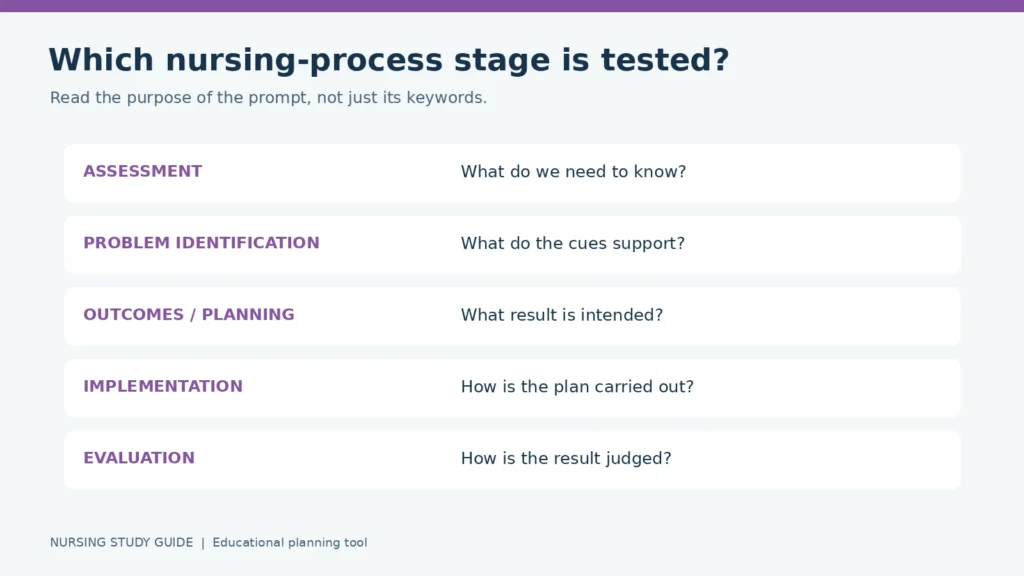
Nursing process homework often tests whether you can recognise the reasoning required at a particular stage. A question about missing assessment information is different from one asking you to evaluate an outcome, even when both use the same scenario.
Before answering, identify the stage, the evidence supplied and the exact action requested. This guide helps you classify short homework prompts. For the complete care-plan document, use our separate guide to writing a nursing care plan.
Recognise the process without treating it as a rigid sequence
The American Nurses Association describes assessment, diagnosis, outcomes/planning, implementation and evaluation as core elements of the nursing process (ANA, n.d.). Their educational value lies in the connections between information, judgement, intended results, actions and review.
In homework, a prompt may focus on just one connection. You do not need to reproduce every stage unless the question asks for the whole process. Equally, a stage label alone does not demonstrate reasoning.
Use your programme’s terminology. Some modules separate outcome identification from planning; others group them. Some require a named diagnostic taxonomy, while others use a problem statement. Follow the specified framework rather than assuming one abbreviation is universal.
A prompt-to-stage reference table
| Prompt language | Likely focus | What the answer should show |
|---|---|---|
| What further information is needed? | Assessment | The information gap and its relevance |
| Which nursing problem is supported? | Diagnosis or problem identification | A judgement linked to supplied cues |
| What change should be achieved? | Outcomes/planning | An intended result for the person |
| How would the agreed action be carried out? | Implementation | Action, responsibility and relevant conditions |
| How would you know whether the plan worked? | Evaluation | A comparison between observed and intended results |
The table is a starting point, not an answer key. Read the complete question. “Evaluate the assessment tool” asks you to appraise a tool, not necessarily to describe the evaluation stage of a care plan.
Assessment questions ask what is known and what is missing
Look for verbs such as collect, clarify, assess, establish or identify additional information. Your task may be to extract existing observations or explain why another piece of information is needed.
Separate a cue from your interpretation. “The scenario records a change” is a statement about supplied information. “The change proves a particular cause” is an inference that requires further support.
A strong short answer names the relevant information gap and explains how it affects the judgement. Avoid filling gaps with assumed findings. If the case does not report what the person wants, acknowledge that their preferences would need to be explored rather than inventing them.
Diagnosis questions require a supported judgement
Here, the prompt asks what nursing problem or response the evidence supports. List the relevant cues before selecting the problem. Then ask whether your proposed label actually follows from them.
A medical diagnosis does not automatically provide the answer to every nursing problem question. The exercise may be testing the person’s response, functional difficulty or care need. Use the terminology required by the module, and verify any formal diagnosis label against the assigned source.
Do not choose a familiar label first and force the scenario to fit. If several interpretations remain plausible, explain the limitation and identify the additional information that would help distinguish them.
Planning questions focus on the intended result
A plan needs to distinguish what staff do from what should change for the person. “Provide an explanation” is an action. An outcome describes the result the explanation is intended to support.
For a fictional education exercise, the person might be expected to explain an agreed self-care step in their own words. The exact content and review point must fit the scenario and instructions. Do not invent a clinical target or deadline merely to make the statement look measurable.
Ask whether another reader could judge whether the intended result had occurred. If the wording is vague, identify the observable feature you need. If the question supplies an outcome, use it rather than silently replacing it with an easier one.
Implementation questions ask how the plan becomes action
Implementation prompts may ask who acts, what is done, how the person is involved, or what needs to be documented. Answer the action question while respecting the professional roles and limits described in the scenario.
Do not present an action as independent when it requires a prescription, authorisation or supervision in the stated context. Where the prompt does not supply enough detail, explain that the relevant local procedure or supervisor would need to be consulted.
These homework examples are educational and do not establish a clinical procedure. In UK work, the NMC Code provides professional standards concerning effective practice and safety; use the applicable regulator for other jurisdictions (NMC, n.d.).
Evaluation questions compare results with an intended outcome
Evaluation is more than writing “review the patient” or repeating the intervention. Identify what would be compared with the planned outcome and what the comparison would mean.
If the scenario supplies no follow-up result, describe your evaluation method rather than claiming success. An intervention being delivered does not by itself establish that the person’s outcome improved.
A short evaluation answer can distinguish outcome met, partly met, unmet or not yet assessable, where those categories fit the module. Explain the evidence needed for that judgement. If the result is not as intended, consider reassessment instead of assuming the original problem statement must have been correct.
Work through a fictional question set
Imagine a classroom scenario in which a person has received information, but the exercise does not state whether they understood it.
- “What else would you find out?” Identify what the person understands and what they want clarified. This addresses an assessment gap.
- “What result would demonstrate understanding?” Describe a suitable observable explanation by the person. This concerns an outcome.
- “How would you judge the result?” Compare the person’s explanation with the agreed information and identify remaining gaps. This concerns evaluation.
The questions share a topic but require different answers. Writing “give more information” for all three would miss the distinction between finding out, planning and judging a result.
Check the stage and the reasoning together
Before submitting, underline the prompt’s main verb and circle the information your answer uses. Then write the stage in your working notes and ask whether the response performs that stage’s reasoning.
If your answer mixes several stages, check whether that is necessary. A brief reference to assessment can justify a planning decision, but a long account of every stage can obscure the specific answer.
Use a homework error log if you repeatedly confuse an action with an outcome or an assessment cue with a diagnosis.
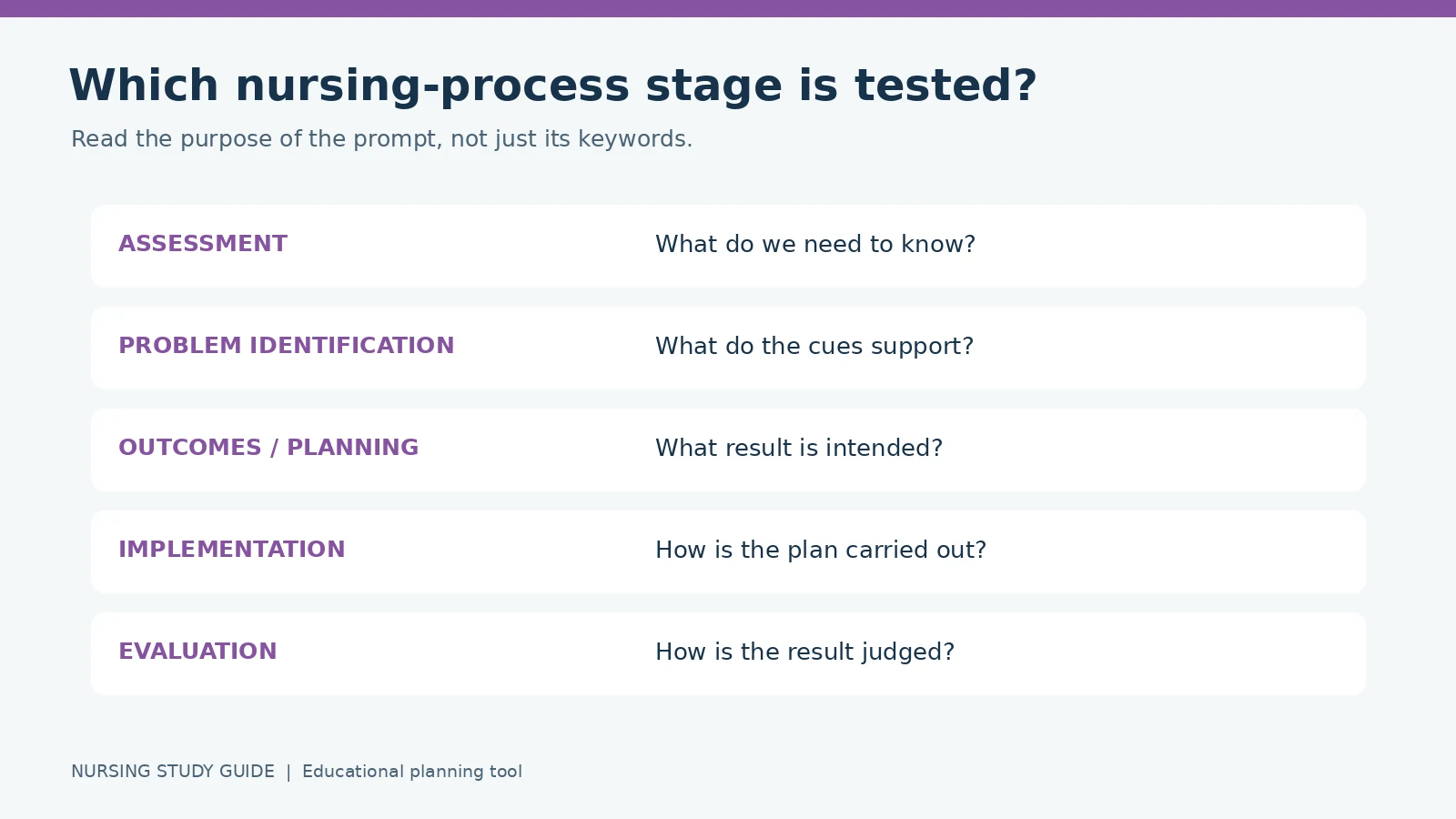
Distinguish a process-stage question from a general academic command
The same word can do different jobs in a question. “Assess the person’s understanding” concerns gathering relevant information. “Assess the strengths of the nursing-process model” asks for academic judgement about a framework. The word alone cannot tell you the answer structure.
Read the object of the verb. What exactly must be assessed, planned, implemented or evaluated? Then identify whether the question is about a stage in a case or about the quality of a concept, tool or approach.
Write a one-line interpretation before drafting. For a stage question, it might be “I need to identify the information required before choosing an outcome.” For an appraisal question, it might be “I need to explain a strength and limitation of this model in the stated context.”
Use a cue-to-stage sorting exercise
Create five columns in your study notes using the stage labels taught on your programme. Add short statements from a fictional exercise and decide where each belongs. Explain the reason for each placement rather than sorting by familiar words alone.
| Statement | Likely stage | Reason to check |
|---|---|---|
| The person describes what they currently understand | Assessment | Information is being gathered |
| The supplied findings support a specified learning need | Problem identification | A judgement connects the findings |
| The person will explain an agreed step in their own words | Outcome planning | The statement describes an intended result |
| The agreed explanation is delivered using the selected approach | Implementation | Someone carries out the planned activity |
| The reviewer compares the later explanation with the intended result | Evaluation | The result is judged against a plan |
A statement can contribute to more than one stage. For example, new information collected during evaluation may prompt reassessment. Explain its purpose in the question rather than insisting that every sentence has only one possible label.
Spot an action disguised as an outcome
Read the subject of the sentence. If the statement describes what a nurse or student will do, it may be an action. If it describes the intended change for the person, it may be an outcome. This is a useful first check, but context still matters.
“Explain the agreed information” describes an activity by the person providing support. “The person explains the agreed information accurately” describes a possible result. Neither sentence alone establishes when review should happen or what accuracy means in the actual task.
Use the scenario and course instructions to supply those details where available. If they are missing, identify the gap instead of inventing a number or time. A statement can look measurable while relying on a target that the evidence does not justify.
Spot a judgement disguised as an observation
An observation is what the case reports. A judgement interprets that information. A homework answer becomes difficult to defend when it presents interpretation as though it were directly recorded in the scenario.
Use three working-note labels: stated, inferred and unknown. Put the supplied finding under stated. Place your proposed meaning under inferred. Record the information needed to test that interpretation under unknown.
This method is especially useful when a question asks you to justify a nursing problem. It makes the supporting cues visible and helps prevent a diagnosis chosen from familiarity rather than the case.
Answer a question that crosses two stages
Some prompts deliberately test a connection: “Using the assessment findings, justify an appropriate outcome.” The main task is an outcome decision, but its justification depends on assessment. Answer both parts without reproducing the whole care plan.
Begin with the proposed outcome. Identify the supplied finding that supports it. Then explain why that outcome addresses the stated need. Add a limitation if missing information could change the choice.
A different question might ask how an evaluation result changes the plan. Here, compare the result with the intended outcome, explain the gap and state what would need reconsideration. Do not simply list the original interventions again.
Use neutral wording when information is incomplete
Wording should reflect what is known. “The case suggests” may be appropriate for a provisional interpretation, while “the scenario states” identifies supplied information. Neither phrase removes the need to explain your reasoning.
Avoid giving every answer the same cautious ending. State the specific uncertainty: perhaps the person’s preference is unknown, the baseline is missing or no follow-up observation is reported. A precise limitation is more useful than a generic reminder that further assessment is needed.
When a prompt asks what you would do next, explain the information-seeking or review step relevant to that gap. Keep any practice action within the educational scenario and the roles described by the task.
Compare two incomplete student answers
Consider a fictional question: “How would you determine whether the intended learning outcome was achieved?” Answer A says, “Provide an explanation and give a leaflet.” Answer B says, “Check whether the person can explain the agreed information and identify remaining misunderstandings.”
Answer A lists activities. It may belong in an implementation discussion, but it does not establish how the result would be judged. Answer B addresses the evaluation purpose more directly. It still needs to match the actual outcome supplied by the exercise.
The lesson is to evaluate the function of the answer, not its length. A detailed list can miss the question, while a shorter response can show the required connection clearly.
Make your own practice prompts
Take a fictional scenario from an authorised learning resource and write one question for each process stage. Keep the case information unchanged. This helps you see how the question changes the response while the topic remains constant.
Start assessment practice by asking what else you need to know. Next, identify the judgement the cues support. When planning, ask about the intended result. Implementation questions address how someone carries out the agreed activity. Finally, evaluation asks how you would judge the result.
Attempt the answers without looking at your stage notes. Afterwards, explain any changes you make. If you only memorise the label, the exercise has not yet tested whether you can perform the reasoning.
Know when to use a different guide
If your task requires a complete table with diagnoses, outcomes, interventions and rationales, return to the full care-plan guide. If it requires an extended discussion of a person’s needs, use the relevant case-study writing guidance.
If your difficulty is simply interpreting several short prompts, start with the multi-question homework worksheet guide. That method helps organise the response slots before you decide what each process-stage answer requires.
Choose support according to the obstacle. A stage-recognition problem needs concept practice. A full assignment problem may require structure, evidence and argument review. Keeping those needs distinct helps you request feedback you can act on.
Check the reason for your stage label
Before accepting a stage label, finish the sentence “This belongs here because…” Use the purpose of the statement in your explanation. “Because it mentions a nurse” does not distinguish implementation from assessment, while “because it describes carrying out the agreed activity” identifies a function.
Try changing the verb while leaving the topic unchanged. Gathering information about understanding, planning a result concerning understanding and judging later understanding involve related content but different reasoning. This small exercise can reveal whether you are relying on keywords rather than purpose.
If two labels still seem plausible, explain the context needed to choose between them. A later observation can serve evaluation of an existing outcome and assessment for a revised plan. The question may deliberately test that connection.
For a short answer, keep the final response proportionate. Give the label if requested, identify the supporting feature and explain the link. Avoid adding a full care-plan table when the prompt asks only for recognition and justification of one stage.
Frequently asked questions
Must every answer include ADPIE?
No. Use the framework required by the task. A question about one stage usually needs a focused answer rather than a full care plan.
Is “evaluate” always the evaluation stage?
No. It can be an academic command to judge a model, study or tool. Read what you are being asked to evaluate.
What if no result is given?
Explain the information needed and how it would be assessed. Do not claim success without evidence.
Practise identifying the task before drafting
Classify the prompt, select the relevant scenario information and make the reasoning visible. For help with a particular misunderstanding, request focused nursing homework tutoring and include your own attempted answer.
References
American Nurses Association (n.d.) The nursing process. Available at: ANA nursing process overview (Accessed: 21 October 2026).
Nursing and Midwifery Council (n.d.) Read The Code online. Available at: NMC Code (Accessed: 21 October 2026).