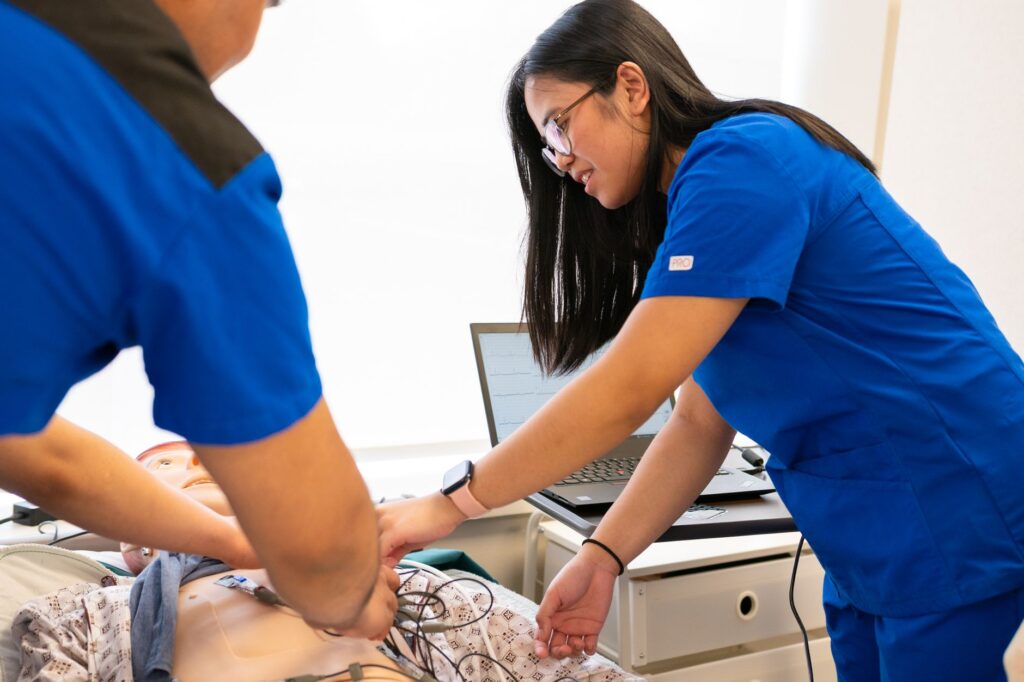
Nursing academic support for Chinese international
students should help learners understand unfamiliar
expectations. However, support must not stereotype learners or replace assessed
work. Chinese students beginning a nursing programme in the UK or USA
may encounter different terminology, evidence standards,
clinical-assessment systems and academic-integrity rules. This guide
explains those differences, shows how to search for legitimate support
in English and Chinese, and provides a practical way to evaluate
services found through WeChat or the wider web.
This is not a guide to nursing assignment formats. For essays, case
studies, reflections, literature reviews and presentations, use the
separate guide to types
of nursing assignments UK students encounter. It also does not
replace your university handbook, module brief, placement documentation
or academic-integrity policy.
Quick Guide: UK and USA Nursing Study Support
| Need | Useful English search | Useful Chinese search |
|---|---|---|
| Nursing academic tutoring | nursing academic support for Chinese international students | 护理留学生学业辅导 |
| UK nursing assignment guidance | UK nursing assignment guidance | 英国护理留学生作业辅导 |
| US nursing coursework tutoring | US nursing coursework tutoring | 美国护理留学生课程辅导 |
| Academic English | nursing academic English support | 护理学术英语辅导 |
| Dissertation guidance | nursing dissertation guidance | 护理毕业论文指导 |
| Feedback-led editing | nursing assignment feedback support | 护理作业反馈修改指导 |
| Referencing guidance | nursing referencing support | 护理论文引用格式辅导 |
In Chinese, 辅导 generally communicates tutoring or
guided learning, while 指导 communicates guidance.
Students looking for legitimate academic development should be cautious
about advertisements using 代写 (ghostwriting),
代考 (taking an examination for someone) or
guaranteed-grade claims.
给中国护理留学生的快速建议
- 先确认作业属于英国还是美国课程,并使用相应的护理标准和证据来源。
- 搜索辅导或指导服务,而不是代写、代考或“保证成绩”的服务。
- 发送文件前删除患者姓名、学号、登录信息和其他敏感资料。
- 要求辅导者解释评分标准、证据选择和修改原因,确保你能理解并说明最终作业。
- 始终遵守所在大学关于辅导、翻译、校对和人工智能使用的规定。
Need a bilingual nursing vocabulary guide? Use our English nursing terminology guide for Chinese students for UK–US terms, academic command words, research vocabulary and abbreviation safety.
What Makes Nursing Study Different for International Students?
Nursing education combines academic learning with professional
expectations and, in many programmes, assessed practice. A fluent essay
alone cannot establish safe nursing competence. Students may need to
analyse evidence, apply it to a case, communicate clinically,
demonstrate skills and meet progression requirements.
In the UK, Nursing and Midwifery Council (NMC) standards shape
approved nursing education, student supervision and practice assessment.
The NMC states that assessment should be objective and fair and provide
assurance that required proficiencies have been achieved.
In the USA, programme expectations vary by institution and state. The
American Association of Colleges of Nursing (AACN) Essentials provide a
competency-based framework used widely in professional nursing
education. AACN describes competency-based education as involving
instruction, assessment, feedback, self-reflection and evidence that
expected knowledge, attitudes and skills have been learned.
Therefore, students should not transfer one country’s terminology or
professional framework automatically into another. The current programme
and assessment brief determine what is required.
UK and US Nursing Assignments: Important Differences
Professional standards and evidence sources
A UK nursing assignment may ask students to apply the NMC Code, NHS
policy, National Institute for Health and Care Excellence guidance or UK
legislation. These sources are not automatically appropriate for a US
assignment.
A US nursing paper may instead require sources such as federal
agencies, state-specific rules, professional bodies or American clinical
guidelines. The exact authority depends on the topic and location.
The principle is simple: use the professional and clinical sources
relevant to the country, population and claim. Do not replace empirical
evidence with a professional code, and do not cite a UK source merely
because it appears authoritative if the question concerns US
practice.
Referencing conventions
Many UK universities use a version of Harvard referencing, but
institutional variations are common. US nursing schools frequently
require APA style. Neither rule is universal.
Students should use the referencing guide named in the module
documentation. A reference may contain accurate information yet still
lose marks if its format does not follow the required institutional
system. More importantly, a perfectly formatted source is still
unsuitable if it does not support the associated claim.
Spelling and academic language
British and American English differ in spelling and some clinical
terminology. Examples include organisation/organization,
behaviour/behavior and paediatric/pediatric.
Consistency matters more than changing every word mechanically.
Use the English variety expected by the institution and preserve the
official spelling of organisation names, titles and quoted material. Do
not change “Centers for Disease Control and Prevention” to British
spelling, for example, because it is a proper name.
Assessment structure
UK modules often state learning outcomes and marking criteria
explicitly. US courses may organise requirements through a syllabus,
rubric, weekly discussion tasks and cumulative coursework. These are
broad patterns, not universal rules.
Before planning any task, identify:
- the exact question or prompt;
- command words;
- learning outcomes or course objectives;
- rubric categories and weightings;
- required evidence and date limits;
- referencing style;
- word, page or time limit;
- submission format; and
- permitted forms of assistance.
Academic English Without Losing Your Meaning
Chinese international nursing students have varied educational
histories and English proficiency. It is inaccurate to assume that every
Chinese student faces the same language problem. However, students
working in an additional language may need to adjust to unfamiliar
conventions.
Move from translation to argument
Writing a complete paragraph in Chinese and translating it word for
word can produce grammatically plausible English without a clear
academic argument. English academic writing often makes the paragraph’s
purpose explicit early, then uses evidence and analysis to develop
it.
A useful paragraph sequence is:
- state a focused claim;
- provide relevant evidence;
- compare or evaluate that evidence;
- apply the judgement to the nursing problem; and
- connect the conclusion to the question.
This is a reasoning structure, not a fixed sentence template.
Paragraphs should vary according to their function.
Distinguish cautious language from weak language
Academic caution does not mean avoiding a conclusion. Phrases such as
“the evidence suggests,” “may be associated with” and “within this
sample” can keep claims proportionate to study design. However, adding
“perhaps” to every sentence makes the argument uncertain rather than
critical.
Match the verb to the evidence. A cross-sectional association does
not prove causation. A qualitative study can explore experience but
cannot estimate population prevalence by itself. A small improvement
project may inform local practice without establishing universal
effectiveness.
Learn nursing terms in context
A bilingual glossary can support comprehension, but clinical terms
should be learned through their definition and use rather than through
one-to-one translation alone. Similar words may carry different
professional meanings.
| English term | Chinese support term | Important distinction |
|---|---|---|
| critical analysis | 批判性分析 | Evaluation and reasoned judgement, not simply negative criticism |
| evidence-based practice | 循证实践 | Integration of evidence, professional expertise and the person’s context/preferences |
| learning outcome | 学习成果 / 学习目标 | The capability the assessment expects you to demonstrate |
| marking rubric | 评分标准 | Criteria used to judge performance |
| reflective writing | 反思性写作 | Analysis of learning and future action, not only narration |
| clinical reasoning | 临床推理 | Interpretation and prioritisation of information to support decisions |
| academic integrity | 学术诚信 | Honest authorship, attribution and permitted assistance |
| formative feedback | 形成性反馈 | Developmental feedback intended to improve later work |
Always use the terminology specified by the course, placement and
relevant professional body.
How to Use WeChat to Find Legitimate Nursing Support
WeChat is used for communication and information sharing among many
Chinese students, although individual preferences differ. Research
involving Chinese students at a UK university has described WeChat as a
means of addressing communication barriers and supporting engagement.
UKCISA has also documented projects using WeChat to engage international
students.
Finding a provider through WeChat does not verify its quality. Treat
a WeChat post, group recommendation or contact card as a lead that still
requires independent checking.
Use accurate Chinese search terms
Ethical search phrases include:
- 英国护理留学生作业辅导 — UK nursing assignment tutoring;
- 美国护理留学生课程辅导 — US nursing coursework tutoring;
- 护理学术英语辅导 — nursing academic English tutoring;
- 护理毕业论文指导 — nursing dissertation guidance;
- 护理论文引用格式辅导 — nursing referencing guidance; and
- 护理作业反馈修改指导 — feedback-led nursing assignment revision
guidance.
Avoid phrases offering ghostwriting, examination impersonation,
fabricated placement evidence or guaranteed grades.
Verify the public website
Before sending documents or paying, check whether the provider has a
public site that clearly explains:
- what the service does and does not do;
- who provides nursing or research support;
- how sources are selected and verified;
- revision and refund terms;
- privacy and data-handling practices;
- responsible academic-use boundaries; and
- a stable method of contact beyond a personal QR code.
A polished WeChat profile is not proof of subject expertise, business
identity or safe data handling.
Need help checking a nursing brief?
Send the official UK or US assessment instructions through our contact page after removing confidential information. We can explain the brief, evidence requirements and permitted academic-support options before any work begins.
Ask for a scope explanation
A trustworthy provider should be able to explain the proposed support
in relation to your brief. Useful questions include:
- Which learning outcomes will the session or review address?
- Will you explain feedback rather than simply rewrite the work?
- How will UK or US evidence requirements be handled?
- Can you verify that references exist and support the claims?
- What information should I remove before sharing documents?
- What assistance must I declare to my university?
If the answer focuses only on a promised grade, similarity percentage
or detection-avoidance output, do not proceed.
Red Flags When Choosing Nursing Help Through WeChat
Guaranteed grades
No external provider controls university marking. Guarantees of a
pass, distinction, A grade or publication outcome are unreliable.
Guaranteed detection-avoidance claims
No provider can guarantee how an institution’s screening system will classify a document. Choose support based on transparent teaching, verifiable sources, clear revision advice and compliance with university rules—not claims about bypassing checks.
Requests for identifiable patient information
Do not share patient names, record numbers, addresses, photographs,
screenshots of clinical systems or other unnecessary identifiers. Real
placement material must be handled according to the university,
placement provider and professional requirements.
Examination or clinical impersonation
No service should complete an examination, simulation, clinical
assessment or placement documentation on behalf of a student. These
actions undermine academic and professional integrity and may create
patient-safety risks.
Fabricated evidence or references
Invented studies, altered results and false clinical experiences can
be difficult to detect quickly, especially when working across
languages. Open important sources and confirm that each one supports the
claim made.
Pressure to pay immediately
Be cautious when a provider refuses to explain scope, price,
deadlines or revision terms before payment. Keep a written record of
what has been agreed.
What Ethical Nursing Academic Support Can Include
Legitimate nursing academic support for Chinese international
students can help learners understand expectations and improve work they
remain responsible for.
Appropriate support may include:
- interpreting the assignment brief and rubric;
- explaining unfamiliar nursing or research terminology;
- planning a structure around learning outcomes;
- teaching critical reading and evidence synthesis;
- reviewing whether sources support the claims;
- explaining UK or US referencing requirements;
- giving feedback on clarity and academic English;
- demonstrating statistical methods with authorised data;
- helping a student understand tutor feedback; and
- checking whether a draft remains within the stated scope.
The university’s rules remain decisive. Some institutions require
students to declare proofreading, tutoring, translation or automated writing assistance. Students should ask when the policy is unclear.
How to Prepare for a Nursing Academic-Support Session
1. Collect the official instructions
Provide the complete assessment question, syllabus or module brief,
learning outcomes, rubric, referencing guide and deadline. A screenshot
containing only the title is rarely sufficient.
2. State the country and programme
Specify whether the task belongs to a UK or US institution, the
programme level and the nursing field. This prevents inappropriate
transfer of professional standards or terminology.
3. Identify your main difficulty
Explain whether you need help understanding the question, finding
evidence, building an argument, applying feedback, analysing data or
improving language. A focused request produces more useful teaching.
4. Remove sensitive information
Redact unnecessary personal, patient, staff and placement
identifiers. Do not upload access credentials or confidential
clinical-system material.
5. Retain ownership of decisions
Keep notes explaining why sources, methods and conclusions were
chosen. You should be able to explain the final work and connect it to
the brief.
A Practical UK–USA Evidence Checklist
Before using a source, ask:
| Check | Question |
|---|---|
| Country relevance | Does this source apply to the UK, USA or another system? |
| Authority | Is it a professional standard, clinical guideline, policy or research study? |
| Claim match | Does it directly support the sentence attached to it? |
| Currency | Is it current enough for the topic, and has it been replaced? |
| Population | Does the evidence concern the relevant learners, patients or setting? |
| Study design | Can the method support the type of conclusion being made? |
| Referencing | Is the source formatted according to the required style? |
Students writing for a UK institution can use the guide to applying
UK evidence in a nursing dissertation for more detail. Students who
primarily need help with academic English can use the broader nursing
dissertation writing guide for international students.
Frequently Asked Questions
Can I search for nursing academic support in Chinese?
Yes. Chinese search terms can help you locate understandable
information, but the final provider should still demonstrate relevant
nursing knowledge, transparent terms and ethical boundaries.
Is WeChat nursing tutoring allowed by universities?
The platform does not determine whether support is permitted. The
nature of the assistance and the university’s policy matter. Tutoring
and feedback may be allowed while ghostwriting, impersonation or
undisclosed prohibited assistance is not.
Should a UK nursing assignment use APA or Harvard?
Use the referencing system specified by the university or module.
Many UK institutions use a form of Harvard, but APA and other systems
are also used.
Do US nursing programmes use the NMC Code?
The NMC regulates nursing and midwifery in the UK. A US task normally
requires the professional and regulatory sources relevant to its
institution and jurisdiction unless the assignment explicitly asks for
international comparison.
Can a tutor translate my complete nursing assignment?
Check the university’s policy. Translation may change authorship and
language in ways the institution restricts. Developmental language
feedback, vocabulary explanation and discussion of unclear sentences may
be safer, but the student must follow the applicable rules.
What documents should never be sent through WeChat?
Do not send passwords, university login details, examination
materials obtained without permission, identifiable patient records or
confidential clinical screenshots. Remove unnecessary identifiers from
legitimate academic documents.
Can academic support guarantee a particular mark?
No. A provider can improve understanding, alignment and revision, but
assessment decisions remain with the institution.
Conclusion
Nursing academic support for Chinese international students should
bridge genuine differences in language, academic convention and
professional context while preserving student ownership. UK and US
programmes may use different standards, evidence sources, terminology,
rubrics and referencing systems, so the current institutional
instructions must guide every task.
WeChat can help students discover bilingual guidance, but it should
not replace verification. Use tutoring-focused Chinese search terms,
inspect the provider’s public information, confirm the agreed scope and
avoid guarantees, ghostwriting, impersonation and fabricated
evidence.
For ethical support with a UK or US nursing brief, academic English,
evidence selection or tutor feedback, use the contact page
and provide the official instructions after removing confidential
information.
References
American Association of Colleges of Nursing (2026) The
Essentials: Core competencies for professional nursing education.
Available at: https://www.aacnnursing.org/Portals/0/PDFs/Publications/Essentials-2026.pdf
(Accessed: 27 August 2026).
Cowley, P., Sun, H., Smith, S. and Rayment, P. (2017) ‘Enhancing
international students’ engagement via social media: a case study of
WeChat and Chinese students at a UK university’, EDULEARN17
Proceedings. Available at: https://pure.northampton.ac.uk/en/publications/enhancing-international-students-engagement-via-social-media-a-ca/
(Accessed: 27 August 2026).
EducationUSA (n.d.) EducationUSA. U.S. Department of State.
Available at: https://educationusa.state.gov/
(Accessed: 27 August 2026).
Nursing and Midwifery Council (2023) Objective and fair
assessments. Available at: https://www.nmc.org.uk/supporting-information-on-standards-for-student-supervision-and-assessment/practice-and-academic-assessment/assessment/objective-and-fair-assessments/
(Accessed: 27 August 2026).
Nursing and Midwifery Council (2024) Standards for student
supervision and assessment. Available at: https://www.nmc.org.uk/standards-for-education-and-training/standards-for-student-supervision-and-assessment/
(Accessed: 27 August 2026).
UK Council for International Student Affairs (n.d.) Student
advice and support. Available at: https://www.ukcisa.org.uk/
(Accessed: 27 August 2026).