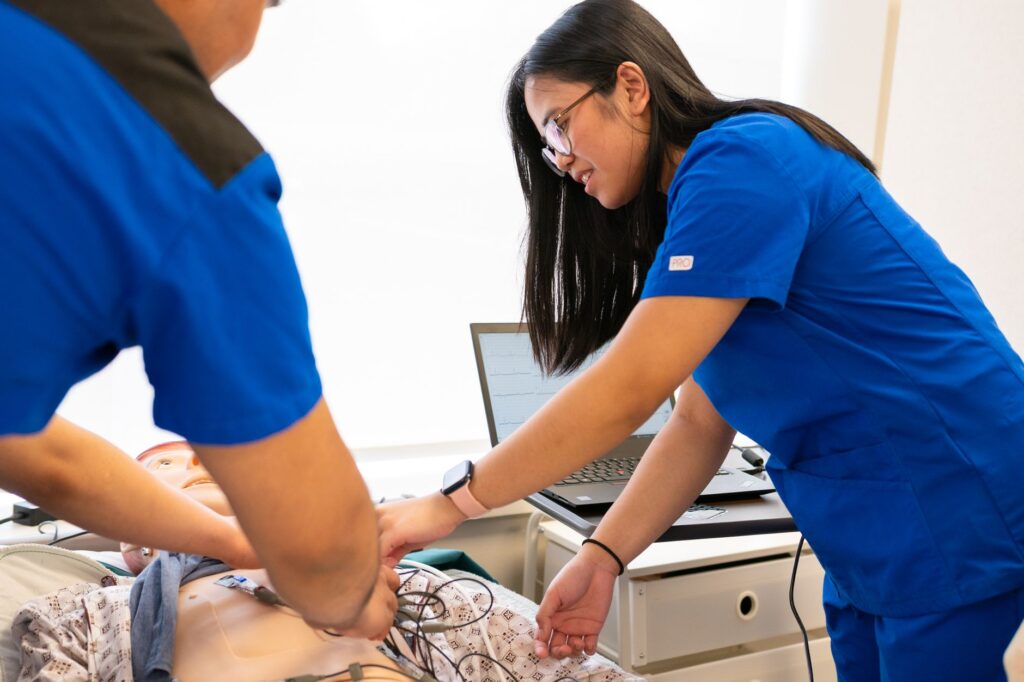
MRI safety in a nursing care plan should connect an individual patient’s assessment to practical nursing actions and a clear evaluation. A generic instruction to “prepare for MRI” leaves the reader unsure what needs attention, who takes responsibility and how progress will be assessed.
This guide shows nursing students how to write that connection. It covers academic care planning rather than a scanner operating procedure. The examples are hypothetical and should be adapted to your assessment brief. Decisions about access to the MRI environment and suitability for examination require the responsible MRI team and local arrangements.
Identify why MRI appears in the case
Begin with the reason given for the examination. Your care plan does not need to reproduce an entire radiology textbook. It needs to explain the nursing priorities that arise while the patient is waiting, preparing, attending and returning. If the brief concentrates on one stage, stay within that stage.
Separate known information from unanswered questions. A supplied case may mention anxiety, an implanted device or a need for assistance with movement. These details can shape your plan. However, a missing detail should become an assessment question, not an invented patient history.
For example, write “Clarify whether the patient has an implant requiring MRI-team review” only where this is relevant to the assessment being described. Do not write “The implant is MRI-safe” without the necessary evidence. Your plan should show how uncertainty is addressed, rather than hide it beneath reassuring language.
Explain MRI safety in a nursing care plan accurately
MRI does not use ionising radiation. Its safety discussion includes the magnetic environment and the examination’s specific hazards. Therefore, an X-ray dose-reduction paragraph will not provide an adequate MRI care-plan rationale. The Medicines and Healthcare products Regulatory Agency publishes dedicated safety guidance for MRI equipment in clinical use (MHRA, 2026).
The current guidance was updated in September 2026. Use the version you actually read, and distinguish the date of the guidance from the date of your access. Avoid citing an old edition automatically because it appears in a previous student example.
You only need enough technical explanation to justify the nursing plan. For instance, an unresolved equipment or implant question should lead to communication with the MRI team. It should not lead to a student independently deciding that the patient or an item can enter the scanner area.
Choose an assessment framework that fits the brief
If your university specifies an assessment framework, use it consistently. Otherwise, organise the relevant information around physical needs, communication, understanding, emotional concerns and continuity of care. The framework should help you interpret the patient’s needs rather than force every possible domain into the table.
Record what you know, how you know it and what still needs clarification. “The patient says they feel frightened by enclosed spaces” is different from “The patient has diagnosed claustrophobia.” The first can be included when the case supplies the statement. The second requires additional evidence.
Keep the assessment tied to a response. If you record that the patient cannot hear ordinary verbal instructions easily, explain how that affects preparation and communication. If a detail does not change an action or evaluation, consider whether it belongs in this focused plan. This approach makes the table easier to read and defend.
Write a specific problem or need
A care-plan problem should identify what needs nursing attention. “MRI” is a procedure, not a complete nursing problem. Likewise, “risk of everything going wrong” is too broad to support a coherent plan. Use the language required by your module and the information available in the case.
A hypothetical need might be: “The patient expresses uncertainty about the examination and has unanswered preparation questions.” Another could concern communicating unresolved screening information to the MRI team. Do not attach a formal diagnostic label unless the brief requires that system and you can use it correctly.
When several needs appear, prioritise them. An unresolved safety question may require attention before a general comfort goal. Explain the basis for that priority in the accompanying discussion. The point is to demonstrate reasoning, not to produce the longest possible list of problems.
Turn the assessment into a realistic outcome
Useful outcomes describe an observable change or completed process. “The patient will be safe” is important as an aspiration but too vague as an evaluation criterion. “The patient will never feel anxious” is also unrealistic and may ignore their preferences.
For an understanding-related need, an illustrative outcome is: “Before the planned transfer, the patient can explain the agreed preparation and identify whom to ask about unresolved questions.” For an information gap, the outcome might be documented communication and a recorded MRI-team decision according to local arrangements.
Time points should match the scenario. A care plan for an appointment next week differs from one for a patient already waiting on a ward. Do not invent a deadline that could create an unsupported clinical instruction. Explain why the chosen review point is suitable for the academic example.
Use a care-plan table with connected reasoning
| Hypothetical assessment | Proposed goal | Nursing action | Evaluation question |
|---|---|---|---|
| Preparation questions remain unanswered. | The patient understands the agreed preparation before transfer. | Establish questions, explain within competence and involve the MRI team where needed. | Can the patient explain the agreed plan? |
| Implant information is incomplete. | The relevant uncertainty reaches the MRI team for review. | Communicate available details and document the response through the local process. | Is the responsible team’s review documented? |
| The patient reports anxiety about the appointment. | The patient identifies an acceptable support approach. | Discuss concerns and agreed options with the patient and imaging team. | Does the patient report that the plan addresses their concern? |
| Transfer assistance is required. | Transfer arrangements reflect assessed needs. | Coordinate assistance and communicate relevant requirements. | Were the agreed arrangements available? |
This is a writing example, not a clinical checklist. Select only the rows justified by your case. Add the rationale and references required by the brief. For general structure, see nursing care-plan assignment support and use any feedback in line with your university’s rules.
Explain screening as a shared process
In your care plan, distinguish gathering information from making a specialist safety decision. A nurse may contribute relevant information and recognise an unresolved question. That does not mean the nurse independently approves an implant, device or item for the MRI environment.
Write who receives the information and how the response affects the plan. “Inform radiology” is vague. “Communicate the unresolved screening detail to the responsible MRI team through the local process and document the response” gives the reader a clearer sequence.
Also avoid treating a completed form as proof that every risk has been resolved. Your academic analysis can consider whether the available information answers the relevant question. If it does not, describe the need for clarification. This is a useful critical point without claiming that a real screening failure occurred.
Handle implants and equipment without blanket rules
An implanted device should not be discussed with a universal statement such as “all implants prevent MRI” or “modern implants are safe.” The particular device and examination conditions matter. Your role in the assignment is to show the need for appropriate information and specialist review.
MHRA guidance addresses MRI hazards and safety arrangements. Use that source to support a short explanation, then return to the care plan (MHRA, 2026). Do not provide an invented device classification or reproduce a manufacturer’s instructions from memory.
For a hypothetical case, identify which detail is missing: the device name, documentation or the team’s recorded assessment. Then explain how the nursing plan addresses that missing information. The evaluated outcome can concern a completed review process. It should not claim that the student has personally established technical compatibility.
Make communication an individualised intervention
“Reassure the patient” is often too broad to justify. Ask what the patient is worried about and what information they need. In an academic example, the concern might involve the appointment process or uncertainty about how to communicate during the examination.
State the proposed conversation and its purpose. For example: “Ask the patient to identify their main concern, discuss the preparation within competence and arrange input from the MRI team for examination-specific questions.” This tells the marker what the action involves.
Evaluate the response rather than assume success. The patient may still feel worried after receiving information. Your plan can record this and consider further agreed support. For a fuller approach to person-centred writing, read how to include the patient voice in an assignment. Do not turn a patient’s remaining anxiety into a judgement that they are uncooperative.
Keep contrast and sedation discussion conditional
Not every MRI examination uses contrast or sedation. Include either only if the supplied case or relevant examination context makes it necessary. Otherwise, these sections can expand the plan while distracting from the actual patient need.
If the case includes a medicine, identify the evidence needed for its assessment, administration and monitoring. Use a source that addresses that medicine and context. A general MRI safety document does not automatically support an exact dose, monitoring interval or contraindication you have introduced.
For sedation-related planning, avoid suggesting that the nursing student selects a drug independently. Explain the relevant prescribed plan and competent professional responsibilities if the case provides them. If it does not, keep the discussion at the level of identifying a question for the responsible team. Your assignment should preserve the difference between considering an option and documenting an authorised treatment.
Plan continuity before and after the appointment
A care plan can become fragmented when it ends at the department door. Where the brief covers the whole patient journey, explain what information needs to accompany the patient and what should be reviewed on return. The relevant content depends on the examination and the patient’s assessed needs.
A useful writing question is: “Who needs to know what has changed?” Another is: “Which proposed outcome remains to be evaluated?” These questions help you connect the radiology visit to ongoing nursing care without inventing a post-procedure protocol.
Do not assume that obtaining an image means the result has been reviewed or communicated. In a case discussion, identify what the scenario actually documents. If the result is unavailable, state that limit and explain the planned follow-up within local arrangements. Do not manufacture a diagnosis to complete the care-plan story.
Write a rationale that explains the action
A rationale should answer why the intervention fits the assessed need. Repeating the action in different words adds little. “Explain the scan because explanation is necessary” does not show the relationship between the patient’s concern and the proposed conversation.
An improved rationale might say: “The patient’s unanswered preparation questions create a need for clarification; addressing these questions supports an informed discussion of the planned appointment.” Add a suitable source where you make a professional or clinical claim. Keep any promised outcome proportionate to the evidence.
For more examples of this writing move, see how to justify nursing interventions. Your rationale can also identify a limit: explaining the process does not substitute for the MRI team’s assessment of an unresolved safety issue. That qualification makes the paragraph more precise.
Evaluate MRI safety in a nursing care plan honestly
Evaluation should return to the stated outcome. If the goal concerns understanding, consider the patient’s explanation of the agreed plan. If it concerns communication of a safety question, consider whether the response is documented. Do not evaluate an information goal only by saying that the scan took place.
For a planned care assignment, you may be asked to propose how evaluation would occur. Use future or conditional wording. For a retrospective case, report only outcomes the supplied evidence supports. A table can contain “not yet evaluated” when that accurately reflects the case.
Explain what you would reconsider if the goal remains unmet. The next step might be another discussion or clarification with the responsible team, depending on the issue. The academic strength lies in making the review logical. It does not require inventing a perfect result.
Build a focused evidence and editing checklist
- Check the task verb and required care-plan format.
- Identify the patient information supplied and the questions still open.
- Use current MRI-specific guidance for MRI-specific claims.
- Connect each problem to a goal, action, rationale and review.
- State professional boundaries where specialist decisions arise.
- Check that examples remain hypothetical and anonymised.
- Remove irrelevant interventions and unsupported outcomes.
As you edit, make sure every citation addresses its neighbouring claim. The guide to missing references in nursing assignments can help you check evidence coverage. Also review the radiation safety writing guide if you need to explain why MRI should be discussed separately from ionising exposure.
Use a short worked revision
Weak example: “The nurse will reassure the patient and make sure MRI is safe. The patient will have no anxiety and the scan will be successful.”
Improved example: “The patient’s stated preparation concerns would first be explored. The nurse would explain the agreed arrangements within competence and involve the MRI team in unresolved examination-specific questions. Evaluation would consider whether the patient can describe the plan and whether any remaining concerns have an agreed response.”
This revision replaces vague tasks and guaranteed outcomes with a clear need, bounded action and observable review. Adapt the approach to your case, not the exact wording. The final paragraph should reflect your own reasoning, the module brief and the evidence you have read.
Frequently asked questions
Does MRI use ionising radiation?
No. Your care plan should use MRI-specific safety guidance. A brief comparison with X-ray or CT can clarify this distinction, but a radiation dose paragraph will not explain MRI screening or the magnetic environment.
Can I assume an implant rules out MRI?
Do not make a blanket assumption. Show how the relevant details are communicated for MRI-team review. Your academic plan should not invent a device classification or substitute a student judgement for the responsible team’s decision.
What makes a care-plan outcome measurable?
It identifies something you can review, such as the patient explaining the agreed preparation or an unresolved question receiving a documented response. Choose a realistic time point and avoid promising complete absence of anxiety or all risk.
Should every plan include contrast precautions?
No. Include contrast-related discussion when it is relevant to the case or examination. Explain the source and clinical context behind your proposed actions rather than copying a generic medicine checklist into every MRI plan.
Can I use this table in my assignment?
Use it to understand the structure. Build your own table from the supplied patient information, required framework and references. Follow the institution’s rules on assistance and do not present a hypothetical example as care that you delivered.
Conclusion
A useful MRI care plan begins with the patient’s actual needs and ends with an honest review. Keep screening information, specialist decisions, communication and continuity connected. Explain each nursing action and its limit. This produces a stronger academic plan than a general promise that the examination will be safe.
References and further reading
Medicines and Healthcare products Regulatory Agency (2026) Safety guidelines for magnetic resonance imaging equipment in clinical use. Fifth edition; publication page updated 30 September 2026. Available at: MHRA MRI safety guidance (Accessed: 3 October 2026).
Prepared by Nursing Dissertation Service as an educational writing guide. All examples are hypothetical. No clinical review credentials are claimed. Follow current local procedures and your institution’s academic-integrity policy.