

Calculate sample size for a nursing dissertation only after defining the primary question, outcome, design and planned analysis. Starting with an arbitrary target such as 30, 100 or 200 participants can produce a study that is too weak, unnecessarily large or impossible to justify.
Key takeaways
- Match the calculation to the primary analysis.
- Justify the expected effect or required precision.
- Specify alpha and desired statistical power.
- Adjust the analysis sample for attrition and unusable responses.
- Report every assumption, not only the final number.
What sample size means in nursing research
Sample size is the number of analysable participants or records required to estimate an outcome with suitable precision or test a planned hypothesis with acceptable power. It is not automatically the number you recruit. If withdrawals or incomplete questionnaires are expected, the recruitment target must be higher.
Two broad approaches are common. Precision calculations aim to estimate a proportion or mean within a chosen margin of error. Power calculations ask how many observations are needed to detect a specified effect with a chosen probability. The research aim determines which approach is defensible.
Step 1: define the primary nursing outcome
Choose one primary outcome for the calculation. Examples include medication-adherence score, pain score, pressure-injury incidence or the proportion of nurses reporting burnout. Calculating separately for every exploratory outcome and choosing the smallest target would weaken the design.
Step 2: identify the planned SPSS test
| Question | Likely test | Effect measure |
|---|---|---|
| Are two independent nursing groups different? | Independent t-test | Cohen’s d |
| Does the same group change over time? | Paired t-test | Paired standardised difference |
| Are two categorical variables associated? | Chi-square | Cohen’s w |
| Are two continuous measures related? | Correlation | Expected r |
| Do several factors predict an outcome? | Multiple regression | f² or incremental R² |
Step 3: justify the effect size
The most credible estimate comes from closely comparable nursing evidence, a pilot dataset or a clinically meaningful difference combined with an expected standard deviation. Conventional small, medium and large benchmarks can support sensitivity analysis, but they should not replace substantive justification (Lakens, 2022).
Step 4: choose alpha and power
Alpha is the tolerated probability of a false-positive conclusion under the null model, commonly 0.05. Power is the probability of detecting the specified effect when it exists, commonly 0.80 or 0.90. Increasing power, lowering alpha or targeting a smaller effect increases the required sample.
Step 5: calculate and adjust recruitment
Run the a-priori analysis in an appropriate procedure. If 128 complete cases are required and 20% may be lost, calculate 128 ÷ 0.80 = 160 initial recruits. Adding 20% directly would give 154 and would not fully replace the expected loss.
For unequal groups, cluster sampling or repeated measures, include the relevant allocation ratio, intracluster correlation or within-person correlation. These design features can materially change the target.
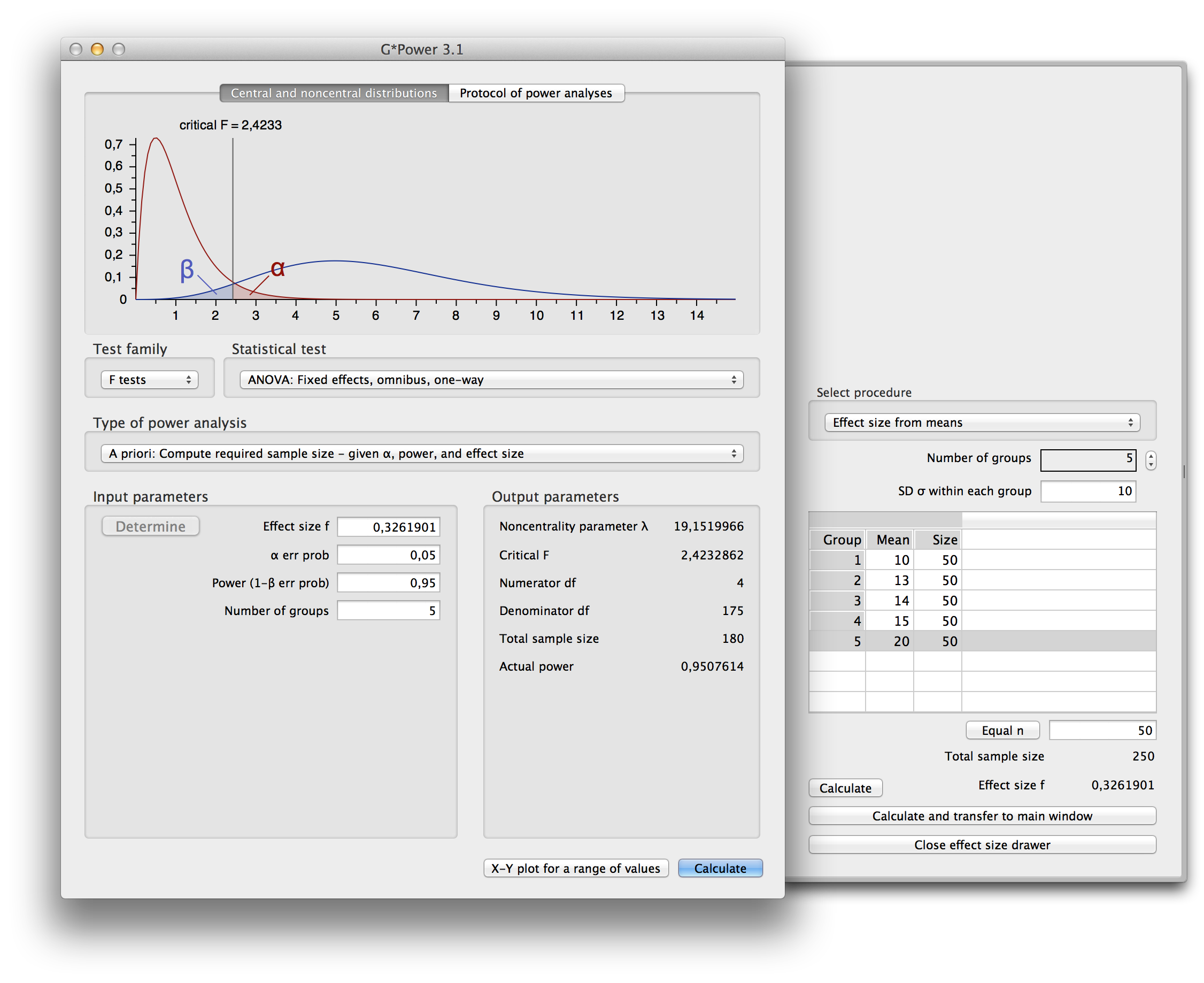
What this screenshot shows: Use the test family, statistical test and analysis-type fields to match the calculation to the planned SPSS analysis. The lower input panel then records the justified effect size, alpha, desired power and group allocation before G*Power calculates the required nursing sample.
How to report the calculation
A strong methods paragraph identifies the test, analysis type, effect size and source, alpha, desired power, allocation and attrition assumption. It should also name the software and version. Reporting only “G*Power suggested 128” is incomplete because readers cannot reproduce the result.
Common mistakes
- Using a generic online calculator without matching it to the test.
- Assuming every dissertation needs at least 30 participants.
- Selecting a large effect only to reduce recruitment.
- Ignoring the number of regression predictors.
- Confusing completed responses with initial recruitment.
- Running post-hoc power and presenting it as a planned calculation.
Frequently asked questions
Can a nursing dissertation use a small sample?
Yes, when the design and aims justify it, but limitations on precision and detectable effects must be acknowledged.
Does qualitative research use G*Power?
Usually not. Qualitative sampling is normally justified through information needs, design, depth and analytic adequacy rather than hypothesis-test power.
Should I calculate for every outcome?
Base the main target on the primary outcome and conduct sensitivity checks for other important analyses where appropriate.
Can I use SPSS instead of G*Power?
Yes for supported procedures. The essential issue is whether the selected model and assumptions match the nursing design.
Related Nursing Guides
- Effect Size for Nursing Research: SPSS and G*Power Guide
- A Priori vs Post Hoc Power Analysis in Nursing
- G*Power for Nursing Research: Step-by-Step Guide
Conclusion
To calculate sample size for a nursing dissertation responsibly, connect the clinical question to a primary outcome, statistical test and justified assumptions. Preserve the output and explain how attrition and feasibility shaped the final recruitment target.
Continue with our nursing SPSS sample-size and power analysis service, SPSS data-analysis service, statistical-test selection guide, SPSS output interpretation guide, or contact us.
References
- Faul, F., Erdfelder, E., Lang, A.-G. and Buchner, A. (2007) ‘G*Power 3: A flexible statistical power analysis program for the social, behavioral, and biomedical sciences’, Behavior Research Methods, 39, pp. 175–191.
- Faul, F., Erdfelder, E., Buchner, A. and Lang, A.-G. (2009) ‘Statistical power analyses using G*Power 3.1’, Behavior Research Methods, 41, pp. 1149–1160.
- Kang, H. (2021) ‘Sample size determination and power analysis using the G*Power software’, Journal of Educational Evaluation for Health Professions, 18, 17.
- Lakens, D. (2022) ‘Sample size justification’, Collabra: Psychology, 8(1), 33267.


