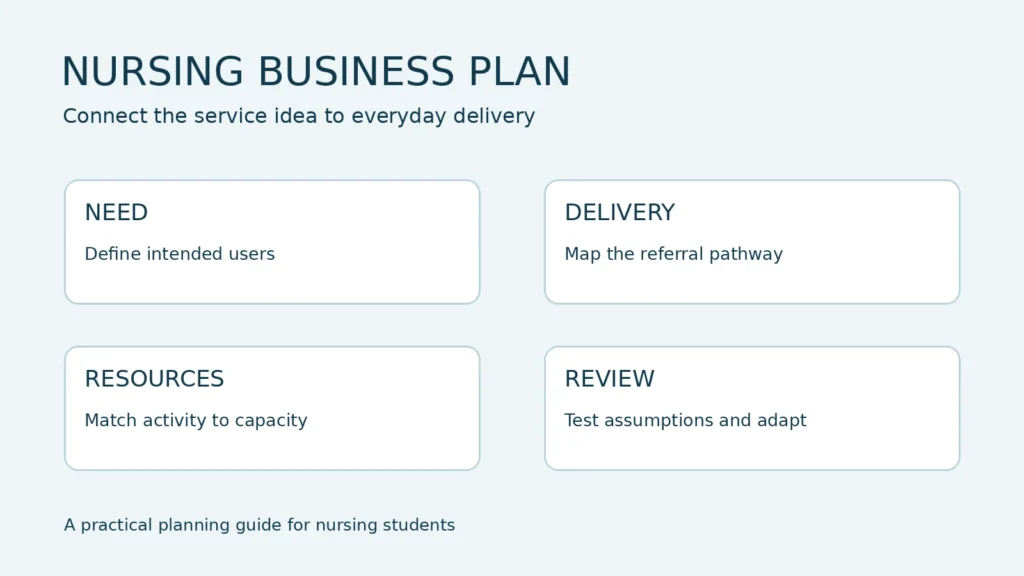
A nursing business plan assignment explains how a proposed nursing service could operate, use resources and remain viable. Your task is to connect a patient need with a practical delivery model. A persuasive idea is only the starting point. The reader also needs to understand who will use the service, how referrals will arrive, who will deliver care and what happens when assumptions change.
This guide takes you from the assessment brief to a coherent operational plan. It includes a suggested structure, an illustrative capacity calculation, a resource table and a worked analytical paragraph. The examples are teaching examples, not clinical recommendations or verified local service data. Adapt the approach to your own university requirements and permitted evidence.
Understand the document your brief requires
Begin by highlighting the assessment verbs. Does the brief ask you to develop, justify, evaluate or critically discuss a proposed service? Then identify the audience. A plan addressed to a service manager will usually need a clearer account of delivery responsibilities than a general essay about entrepreneurship.
A business plan and a business case can share information, but they answer different central questions. A business case asks why a particular investment or change should receive approval. A business plan explains how an enterprise or service will work and sustain its activities. Some university briefs combine these purposes, so the required headings take priority over generic templates.
If your main task is to compare investment options, consult our nursing business case assignment support page. This article concentrates on the operating plan: users, referral routes, activity, capacity, resources and delivery. It does not replace a full options appraisal or provide a submission-ready assessed business plan.
Make a short requirements grid before drafting. Record each learning outcome, where you will address it, the evidence needed and any word limit. Check whether tables count towards the limit and whether appendices are permitted. Do not move essential reasoning into an appendix merely to make the main report shorter.
Choose a service with a manageable boundary
A useful nursing business plan assignment starts with a proposal small enough to examine properly. “Improve community health” is too broad to cost or schedule. A defined nurse-led follow-up service for a specified population is easier to analyse, provided its clinical scope is appropriate and supported by evidence.
State the proposed setting, population, service offer and operating period in one sentence. Then identify exclusions. For example, a hypothetical follow-up service might provide planned education and agreed review appointments while referring urgent problems through existing pathways. Its exact clinical boundaries would require local agreement; they cannot be established by a student’s business assumptions alone.
Use a boundary statement to prevent the plan expanding halfway through. If you add home visits, remote consultations and group sessions, each activity creates different staffing, travel, technology and administrative demands. Include only what you can explain consistently within the assessment.
Also ask what currently happens. A new service could improve access, duplicate an existing offer or move work from another team. Describe that starting position fairly. Avoid presenting the existing service as ineffective without evidence. Where local information is unavailable, explain the uncertainty and the information you would need to resolve it.
Use a structure that follows the service journey
The following structure is a planning aid rather than a universal marking scheme. Reorder it when your brief specifies different headings. Write the executive summary last, after checking that the activity forecast, workforce plan and costs describe the same proposal.
| Section | Question to answer | Useful output |
|---|---|---|
| Executive summary | What is proposed and what makes delivery plausible? | A concise account of the service, resources and uncertainties. |
| Need and intended users | Who needs the offer and what evidence supports that need? | A defined population and a balanced needs statement. |
| Service and referral model | How will people enter, receive and leave the service? | A pathway with responsibilities and boundaries. |
| Demand and capacity | How much activity is expected and can staff deliver it? | Traceable assumptions and a capacity calculation. |
| Resources and funding | What must be paid for, and when? | Costs separated by timing and a stated funding assumption. |
| Implementation and review | Who will establish the service and test its viability? | Milestones, risks, measures and review decisions. |
Give the most space to sections that carry your assessment’s analytical marks. Do not spend half the report describing a condition if the brief mainly assesses service planning. Equally, a financial table alone will not explain whether the proposed activity addresses a nursing need.
Build a credible account of need and demand
Need describes a problem or unmet requirement. Demand describes the activity likely to reach the service. They are related, but they are not interchangeable. A population may have substantial need while facing barriers that limit referrals or attendance. Your plan should explain the route from population evidence to expected service use.
Separate population size, eligible patients, expected referrals, appointment offers and completed contacts. Each stage can change the forecast. For example, a referral count does not tell you whether each person needs one appointment or several. State the expected number of contacts per person and explain the basis of that assumption.
NHS England’s demand and capacity resources distinguish current provision from the capacity required to meet service demand (NHS England, n.d.). For your assignment, use this principle to test the proposed workload rather than simply assuming every available appointment will be filled. Show what you know, what you estimate and what would require validation.
Create an evidence note for each important assumption. Record its source, date, population, unit and limitation. Published activity from a different service may provide a starting point, but differences in eligibility or appointment length can make direct transfer misleading. Explain those differences before using the figure.
When reliable local data are unavailable, use an explicitly hypothetical forecast if your brief permits it. Do not describe invented interviews, referral audits or stakeholder meetings as completed research. A transparent assumption is more defensible than an apparently precise number with no traceable origin.
Describe access, referrals and the everyday workflow
A nursing business plan assignment needs a service pathway that a reader can follow. Start with the referral source. Identify who checks eligibility, who books the appointment, how the person receives information and how the clinical team records the outcome. Then describe discharge, onward referral or follow-up.
Consider the administrative work between clinical contacts. Someone must manage cancellations, clarify incomplete referrals and respond to routine queries. If the plan allocates all staff time to appointments, these tasks have no owner. That omission can make the proposed capacity look stronger than it is.
Explain access choices through the intended population. A remote option may reduce some travel demands while introducing technology or communication barriers. A clinic-based model may require attention to transport, appointment times and accessibility. Avoid claiming that one format works for everyone without checking the evidence.
Define how the service will communicate its offer to referral partners and potential users. In a public service proposal, this may mean clear referral criteria and accessible information rather than commercial advertising. In an enterprise assignment, the brief may also require market positioning. Keep any promotion consistent with the service’s actual scope and professional responsibilities.
Finally, identify dependencies. The service may rely on room availability, records access or another team accepting onward referrals. Record these as conditions to confirm. A pathway drawn on paper does not establish that another organisation has agreed to participate.
Calculate capacity before promising activity
Use a simple example to make your assumptions visible. Suppose a hypothetical service has two weekly clinic sessions. Each session provides three hours of appointment time, and each booked contact occupies thirty minutes including its associated documentation. That gives twelve planned appointment slots per week: two multiplied by three hours, divided by half an hour.
These are illustrative teaching figures. They do not establish a safe staffing level or a suitable appointment duration. The calculation also assumes the full session is available for booked work. Training, meetings, travel, leave cover and unexpected clinical demands require separate consideration.
Now test the effect of a longer appointment. If the same sessions require forty-five minutes per contact, weekly slot capacity falls to eight. A small change in an assumption therefore changes the delivery promise. Explain whether your forecast concerns appointments offered, appointments attended or individual patients supported.
If there are forty hypothetical operating weeks, twelve weekly slots produce 480 offered appointments. With an assumed attendance rate of eighty per cent, that becomes 384 completed contacts. Do not label this forecast as observed performance. Also avoid treating non-attendance as free time that automatically becomes productive capacity.
Use sensitivity analysis to show the consequences of uncertainty. Compare a central forecast with lower attendance, longer appointments or slower recruitment. You do not need an elaborate model to identify the most influential assumption. You do need consistent units and an explanation of what the alternative result means for the plan.
Make the resource plan match the workflow
List resources by activity rather than copying a generic business checklist. If the pathway includes telephone booking, identify the administrative time and systems involved. If it includes remote consultations, consider equipment, approved software, training and support. Then explain which resources already exist and which would need funding.
| Resource | What to specify | Common weakness to avoid |
|---|---|---|
| Clinical staff time | Role, paid hours, service hours and cover assumptions. | Costing appointment time while ignoring other paid duties. |
| Administration | Booking, referral processing and routine communications. | Assuming nurses can absorb every task without lost capacity. |
| Premises and equipment | Availability, access arrangements and replacement needs. | Treating an existing room as available without checking. |
| Training and supervision | Preparation time, support arrangements and competence needs. | Budgeting for equipment but not its safe use. |
| Information systems | Recording, reporting, support and access requirements. | Using a software price as the whole implementation cost. |
Distinguish one-off setup costs from recurring expenditure. Also distinguish additional cash spending from the use of existing resources. A room already owned by an organisation may require no new purchase, but using it could displace another activity. Explain the assumption rather than calling it simply free.
If your plan includes income, state who would pay, for what unit of activity and under which assumed arrangement. An expected referral is not guaranteed revenue. For a public service, explain the proposed budget or funding source without inventing approval. For a hypothetical enterprise, distinguish revenue, costs and the timing of cash receipts.
Keep financial claims cautious and traceable
For a detailed calculation exercise, see the nursing finance assignment guide to budgets and variance, which covers unit costs, activity-adjusted budgets and the difference between cash savings and released capacity.
Every important figure needs a unit and a period. “Staffing costs £20,000” is incomplete unless the reader knows the role, hours, cost components and timeframe. Use consistent annual or pilot-period figures, then explain any conversion. Check that staff hours in the budget match those in the capacity calculation.
Avoid equating released time with cash savings. Reducing time spent on one task may allow more activity without reducing expenditure. Similarly, a possible reduction in hospital use does not automatically release money to your proposed service. State the mechanism and evidence needed before treating such effects as financial benefits.
Keep an assumptions log beside the budget. For each estimate, record whether it comes from an authorised local source, a public price, published research or an illustrative assumption. Include the date and any excluded components. This allows a reader to judge the forecast’s reliability.
Then identify the minimum conditions for viability. Perhaps the service needs enough eligible referrals, a confirmed room and protected staff time. Explain what would happen if one condition fails. A strong plan can recommend a smaller pilot or a staged start when evidence is incomplete. It does not need to claim immediate expansion is justified.
Connect governance and risks to delivery decisions
Patient safety and confidentiality belong within the operating model. The NMC Code includes responsibilities concerning privacy, evidence-informed practice, competence and safety (Nursing and Midwifery Council, 2018). In an assignment, connect relevant responsibilities to specific arrangements rather than adding an isolated paragraph saying the service will follow professional standards.
For example, explain who would supervise staff entering a new role, how concerns would be escalated and which existing record system would support continuity. Use conditional wording where local arrangements have not been agreed. Do not imply that a student proposal establishes authorisation to practise beyond competence.
Choose a small number of material risks. For each, identify a cause, a possible consequence, an owner, a response and a review trigger. Recruitment delay might require changing the launch date. Referral uncertainty might justify a preliminary demand check. A room conflict might require reducing sessions or securing another location.
Do not present a risk score as proof that a service is safe. Explain the reasoning behind the assessment and acknowledge uncertainty. If the course requires a particular risk matrix, use its definitions consistently. The important question is how the risk changes what you propose to do.
Write an implementation and evaluation plan
Work backwards from a realistic launch. Separate preparation, readiness checks, initial delivery and review. Assign each milestone to a role and state its dependency. For example, staff preparation should precede delivery, while referral information should reflect the eligibility criteria actually agreed.
Define what must be confirmed before the service starts. This might include staffing, access to premises, a documented pathway and the relevant local approvals. State these as proposed requirements for the scenario, not as approvals already obtained. Keep your academic plan distinct from real organisational authority.
Select measures that test the plan’s promises. Referral volume tests demand assumptions. Completed contacts test activity. Waiting time can help examine access. Staff time per contact can test workload. Include a patient perspective where appropriate, and explain how any feedback would be collected ethically and practically.
Use balancing measures as well. Higher activity could coincide with longer documentation backlogs or increased pressure on another team. A service should not appear successful merely because one convenient indicator improves. Explain who reviews the measures, how often and what finding would prompt a change.
Set decision points rather than promising indefinite continuation. A pilot review might support continuation, revision or closure, depending on agreed evidence. Specify the questions to answer at that review. Distinguish proposed targets from evidence-based thresholds and avoid inventing an acceptable clinical standard.
Turn description into critical analysis
Critical writing explains why a planning choice is reasonable and where it could fail. Instead of listing “two clinics, one nurse, telephone booking”, connect each element to the demand forecast, patient access and available resources. Then consider an alternative or limitation.
Illustrative analytical paragraph: A two-session model offers a manageable starting point for testing the proposed referral pathway. However, the forecast of twelve weekly slots depends on thirty-minute contacts and protected appointment time. Longer consultations would reduce capacity, while booking and coordination could require additional support. A staged launch is therefore more defensible than immediately promising full access. The initial review should compare actual contact duration and referral volume with the assumptions before considering expansion.
The paragraph makes a proposal, identifies its assumptions, evaluates a limitation and reaches a qualified judgement. It does not claim that the teaching figures came from research. Add relevant sources to your own argument where you rely on clinical effectiveness, population need or professional requirements.
Use tools such as SWOT only when they improve a decision. “Limited staff” in a box adds little unless you explain its effect on activity, cost or timing. Your reader should see a chain from evidence to assumption, from assumption to delivery choice, and from delivery choice to review criteria.
Review the nursing business plan assignment before submission
Read the document once for alignment. Does the population in the introduction match the eligibility criteria? Do the workforce hours support the promised activity? Are the same operating weeks used throughout? Check that your conclusion reflects the uncertainties described in the main report.
Next, check evidence and presentation. Every borrowed claim needs an appropriate citation, while every table needs a clear title and units. Label hypothetical figures prominently. Use short paragraphs, informative headings and consistent terminology. Define abbreviations at first use and remove statements that merely repeat a table.
Finally, check confidentiality and academic integrity. Use only workplace information you are authorised to share. Remove unnecessary identifying details and follow your university’s rules for external feedback and AI use. Keep ownership of the reasoning, calculations and final submission.
Frequently asked questions
What is the difference between a nursing business plan and a business case?
A business plan centres on how a service will operate and sustain delivery. A business case centres on the justification for a particular investment or change. Your brief may combine elements, so use its wording and marking criteria to decide the emphasis.
Can I use hypothetical costs in my nursing business plan assignment?
Only when your assessment allows them. Label the figures as illustrative assumptions, state their units and show the calculations. If the brief requires actual local information, explain any evidence gap to your tutor rather than disguising invented figures as service data.
Does the assignment need a profit forecast?
That depends on the proposed organisation and the assessment. An enterprise plan may require revenue and profit projections. A public nursing service may instead need a credible funding and resource account. Neither format removes the need to explain costs, activity and uncertainty.
Should I put the financial table in an appendix?
Follow the brief. If affordability is central to the task, include enough financial information and interpretation in the main report for the reader to assess your argument. Use permitted appendices for supporting detail, not to hide essential analysis.
Get feedback on your own service plan
If you need help connecting the brief, capacity assumptions and written analysis, send an enquiry about nursing academic support. Include the assessment instructions, your own draft and the sections where feedback would help. Remove confidential records and unnecessary identifiers before sharing material. For investment-focused work, see the business case review scope.
References and further reading
NHS England (n.d.) Service level demand and capacity planning. Available at: NHS England demand and capacity resources (Accessed: 22 October 2026).
Nursing and Midwifery Council (2018) The Code: Professional standards of practice and behaviour for nurses, midwives and nursing associates. Available at: Read the Code online (Accessed: 22 October 2026).
University of Kent (n.d.) Business Plan Development – CMAT6030. Available at: Business Plan Development module overview (Accessed: 22 October 2026). This general business module is further reading on planning; it is not a nursing assessment brief.