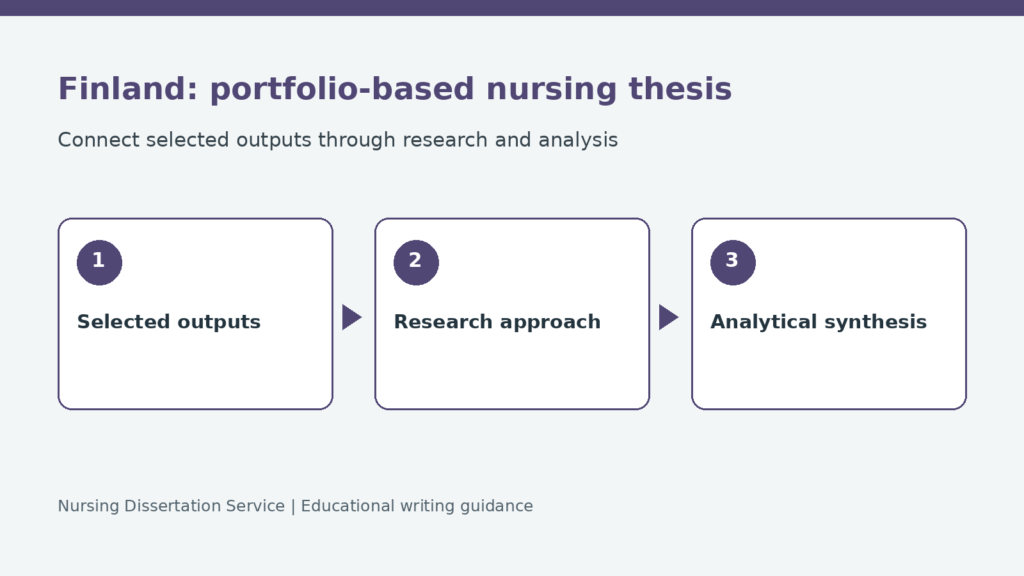
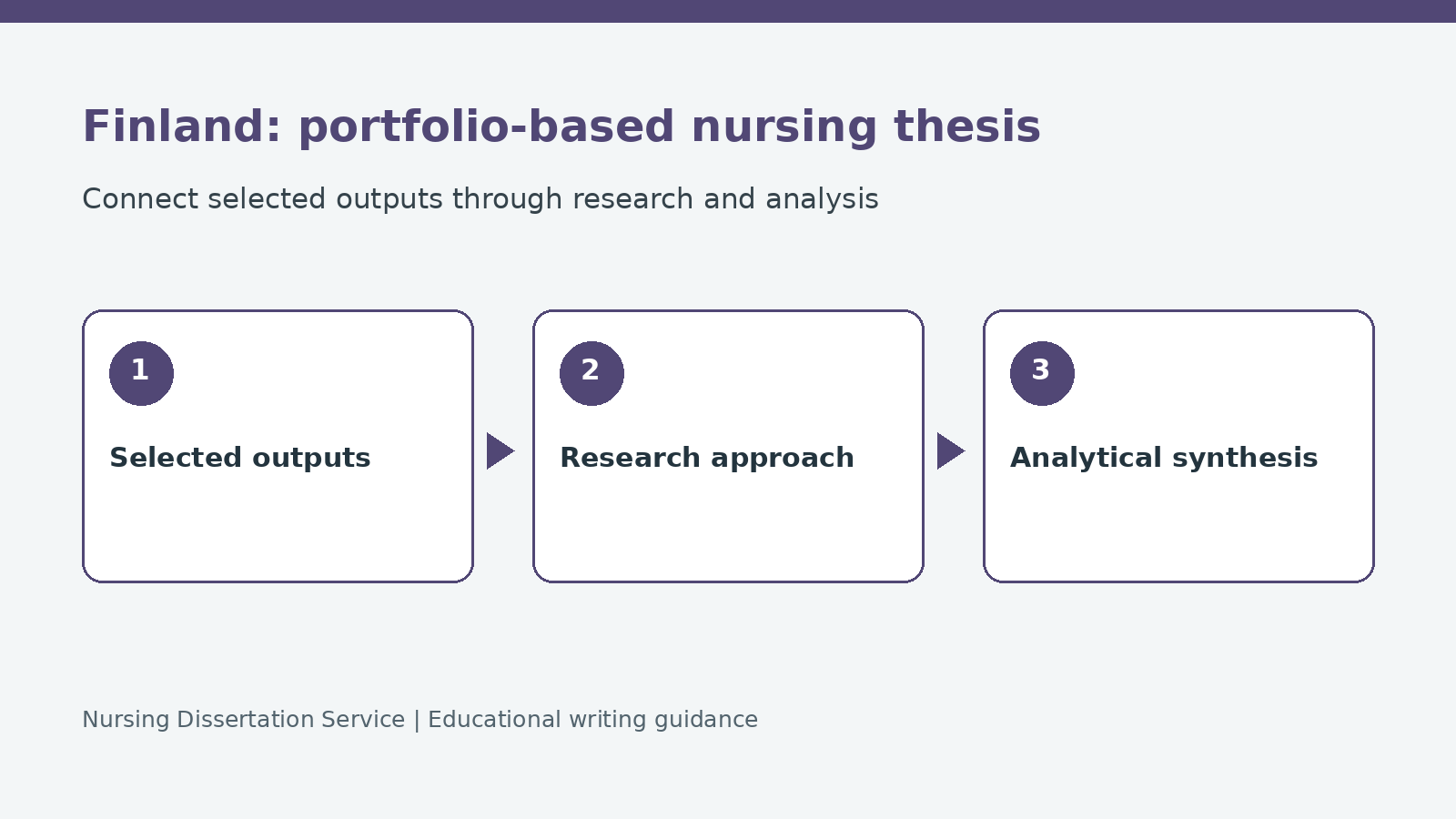
A portfolio-based nursing thesis needs a research-informed argument connecting selected outputs, your learning and a clearly defined purpose. In Finland, confirm that your programme accepts this format before choosing it or treating existing work as thesis material.
The central writing challenge is synthesis. A collection of outputs does not become a thesis simply because you add an introduction. Explain why the outputs belong together, how you selected and examined them, and what the analysis contributes to the agreed question.
Jamk University of Applied Sciences describes several thesis formats and advises students to discuss suitability with their supervisor. Its guidance identifies a portfolio-form approach alongside other formats (Jamk University of Applied Sciences, n.d.). This is an institutional example, not evidence that every Finnish nursing programme offers the same route.
Confirm the portfolio-based nursing thesis route
First, ask your supervisor whether the format is suitable for your programme, level and proposed topic. The existence of a general institutional guide does not establish that every degree accepts every method.
Bring a short outline rather than only a preferred label. Explain the practical or academic issue, the outputs you may use, the analysis you propose and the intended contribution. This gives the supervisor something concrete to assess.
Next, establish which documents govern the work. You may need programme guidance, reporting instructions, assessment criteria and data management requirements. Use the current versions and record any agreed decisions about format.
Also, clarify whether existing work is eligible and how it should be acknowledged. Previously assessed coursework, workplace outputs and collaborative materials may raise different questions. Do not assume that permission to view a document includes permission to republish it in a thesis.
Keep approval decisions separate from your own planning preferences. Until the route and scope are agreed, treat the outline as provisional. This reduces the risk of producing a large collection that cannot meet the thesis requirements.
Distinguish the thesis from an academic or employment portfolio
A portfolio used to display achievements has a different purpose from a thesis. The thesis needs an explicit question or development purpose and a justified way of examining material. The outputs support that inquiry.
Similarly, a placement record may demonstrate learning within a practice assessment process. It does not automatically provide a research design. If you wish to examine professional development through a portfolio approach, discuss what analytical framework and permissions are required.
Next, distinguish the document collection from the report. The report should make the selection and analysis understandable even when some underlying material cannot be reproduced. Decide with your supervisor what belongs in the main text, appendices or an approved separate output.
Also, consider the reader. A thesis examiner needs enough information to understand how you reached the findings. An attractive presentation cannot replace a transparent account of selection, interpretation and limitations.
Use the format to serve the inquiry. If your purpose is better answered through another approved thesis method, discuss that possibility before committing. A portfolio approach is a methodological choice, not a shortcut around analysis.
Define a focused nursing question or development purpose
Begin with a specific issue connected to nursing learning or work. Avoid a purpose as broad as showing everything I have learned. That scope gives you little basis for deciding what to include or how to analyse it.
For example, an approved inquiry might examine the development of a particular aspect of educational communication across selected outputs. The question should be feasible within your programme and should not imply clinical outcome evidence you do not possess.
Next, identify the boundary. Which period, type of output, role or setting will the portfolio cover? Explain why that boundary makes sense. It should help create a coherent body of material rather than simply reflect what is easiest to access.
Also, check the relationship between the question and the available outputs. If the question concerns evaluation but your material contains only initial plans, you may need different evidence or a narrower question. Discuss this early.
Write a short rationale linking the issue, selected material and expected analytical value. That rationale gives the report a direction and provides a basis for later explaining why some otherwise interesting outputs were excluded.
Select outputs using explicit criteria
Selection is part of the method. Explain what made an output relevant to the inquiry and what excluded other material. A collection based only on your favourite achievements may conceal important difficulties or contradictory evidence.
Possible planning criteria include relevance to the question, identifiable contribution, sufficient contextual information and permission to use the material. Your supervisor may require additional criteria. Apply them consistently and record exceptions.
Next, distinguish the complete pool of possible material from the final selection. Even a small selection process should be understandable. State whether you began with a defined collection or identified material through another approved process.
Also, retain evidence of difficulty or revision where it is relevant and permitted. A weaker early output can help explain development when compared carefully with later work. Excluding every challenge may produce a misleading account.
Finally, avoid selecting outputs solely to confirm a conclusion already decided. The analysis should be open to finding limited progress, inconsistency or unresolved questions. A defensible thesis can acknowledge those results.
Plan the report around analysis
Use your institution’s required report structure. The following outline is an original planning example showing the functions a report may need to perform. It is not an official Finnish thesis template.
| Report part | Purpose |
|---|---|
| Introduction | Define the nursing issue and rationale |
| Knowledge base | Establish concepts and relevant evidence |
| Purpose and question | State the inquiry and boundaries |
| Approach and material | Justify selection, analysis and ethical handling |
| Findings or synthesis | Present patterns supported by outputs |
| Discussion | Interpret findings and examine limitations |
| Conclusion | Answer the question and identify implications |
Keep output descriptions proportionate. The report should not devote most of its space to explaining each document while leaving only a short final paragraph for synthesis.
Instead, plan where comparison occurs. You might compare changes in reasoning, differences between intended and revised outputs, or the relationship between feedback and later decisions. The form of analysis must suit the approved question.
Develop a transparent analytical approach
Explain how you will examine the selected material. A statement that you reflected on it is too vague if the reader cannot understand what you actually did. Identify the questions, concepts or analytical procedure guiding the examination.
For example, an approved approach might compare selected features across outputs using a defined set of questions. Another may involve a different reflective or qualitative method. Choose and justify the approach with your supervisor rather than attaching a research label retrospectively.
Next, explain how interpretations will be recorded. A planning matrix can identify the output, relevant feature, initial interpretation, supporting detail and alternative explanation. It can help you distinguish an observation from a conclusion.
Also, consider your relationship to the material. If the outputs are your own work, you bring knowledge of the process but also a personal investment in the interpretation. Explain how you will examine assumptions and attend to evidence that challenges your preferred account.
Keep a decision trail as appropriate. Record important changes to selection, categories or interpretation and explain their reasons. Transparency helps the reader follow the work without implying that interpretation is completely free from judgement.
Worked example: connect outputs through a common question
This is an illustrative planning example, not a thesis topic guaranteed to be accepted. Imagine a student has permission to examine several educational outputs produced during a defined learning period.
The collection includes an initial resource, feedback and a revised version. A descriptive report would explain each item separately. An analytical report would ask a common question, such as how the student’s reasoning about the intended audience changed across the material.
The student could compare the language choices, the rationale for revisions and the feedback that influenced them. However, the analysis would need to distinguish a more appropriate draft from evidence that the resource improved a clinical or educational outcome.
| Material | Analytical question | Boundary |
|---|---|---|
| Initial output | What assumptions about the audience are visible? | Intended effect is not measured effect |
| Feedback | Which concern prompted reconsideration? | One perspective may be incomplete |
| Revision | How did the reasoning change? | Revision alone does not prove effectiveness |
A synthesis might identify a shift in how the student justified audience-related decisions. It might also reveal inconsistent application. Both are possible analytical findings when supported by the actual material.
The value lies in connecting outputs through an explicit inquiry and showing the limits of the interpretation. It does not depend on portraying every revision as successful.
Connect the knowledge base to the portfolio analysis
The knowledge base should supply concepts and evidence that help interpret the selected material. Avoid a broad literature chapter that could accompany any nursing thesis. Choose what the inquiry actually needs.
First, identify the concepts that shape your analytical questions. Explain their meaning and source. If you examine educational communication, for example, establish the relevant ideas rather than listing unrelated nursing theories.
Next, use the concepts consistently. A framework introduced early should influence the analysis or discussion. If it never contributes to interpretation, reconsider whether it belongs in the report.
Also, keep literature and portfolio evidence distinct. A published study can help explain a pattern, but it cannot establish what happened in your own work. Likewise, your output does not by itself demonstrate that a wider theory is correct.
In the discussion, bring the two together carefully. Explain where the portfolio analysis is consistent with relevant literature, where it raises questions and where comparison is limited. Preserve differences in setting, purpose and evidence.
Plan permissions, data handling and publication early
Discuss the use of workplace or practice-related material before collecting or reproducing it. Your university’s current instructions determine what permissions, ethical processes or data management arrangements apply.
A document may contain more than obvious personal identifiers. Internal procedures, feedback and collaborative outputs can also have restrictions. Identify who owns or controls the material and what use is permitted.
Next, consider the final publication context. Material appropriate for a restricted assessment system may be unsuitable for an openly available thesis. Ask how sensitive or restricted information should be handled through the approved process.
Do not remove names and assume every concern is resolved. The remaining context may still identify people or reveal information that you cannot disclose. Review the actual material with the relevant university contact where necessary.
Finally, describe the handling process accurately in the thesis. Do not claim approval or permission that you have not obtained. If access restrictions affect the evidence available to readers, explain the resulting limitation within the permitted reporting arrangements.
Distinguish individual and collaborative contributions
If outputs were produced with others, identify your role and their contributions. A portfolio-based thesis should not present a shared product as entirely individual work merely because the final report is written by one student.
Explain which decisions or sections you can analyse from direct involvement. Also identify where your knowledge of another person’s reasoning is limited. You may observe a revised output without knowing every discussion that produced it.
Next, check the rules governing reuse, acknowledgement and consent. Programme approval of the format does not automatically grant permission to reproduce collaborative work. Resolve these questions before relying on the material.
In the analysis, use accurate language such as contributed to, prepared or revised where appropriate. The purpose is to make your involvement understandable, not to maximise the apparent scale of your responsibility.
Where the question concerns your learning, focus the interpretation on evidence of that learning. Describe the shared context briefly and avoid making unsupported claims about the development or competence of collaborators.
Write a synthesis instead of separate artifact summaries
Read across the outputs using the same analytical questions. Look for patterns, changes, contradictions and gaps. A finding should draw on the relevant material rather than depend only on your recollection of the process.
Group the findings in a way that answers the question. Depending on the approved method, this may involve themes, stages or another justified arrangement. Explain the logic of the grouping.
Next, provide enough supporting detail for the reader to assess the interpretation. Use permitted excerpts or precise references to outputs. Avoid overwhelming the report with whole documents when a focused example would support the point.
Also, discuss exceptions. If one output does not fit the apparent pattern, examine why. It may reflect a different audience, task or level of support, or it may challenge your initial explanation.
End each major section with a clear analytical point. The reader should understand what the comparison reveals and why it matters for the inquiry. Save broader implications and limitations for the discussion where your report structure requires them.
Evaluate limitations and the contribution honestly
A selected portfolio reflects particular material, conditions and decisions. Explain how those boundaries affect the findings. Do not generalise from your own outputs to all nurses or all Finnish programmes.
Selection may favour work that was retained or easy to access. Your interpretation may also be influenced by retrospective knowledge. Identify the limitations that actually apply and explain how you considered them.
Next, distinguish evidence of development from evidence of causation. A later output may differ from an earlier one, but several influences could have contributed. Avoid attributing every change to one teaching activity without support.
Also, state what the thesis contributes at the appropriate scale. It may offer a bounded analysis of professional learning or a useful account of a development process. A modest, well-supported contribution is preferable to an inflated claim.
The conclusion should answer the agreed question and identify realistic implications. Keep recommendations within the evidence and acknowledge where further inquiry or evaluation would be needed.
Portfolio-based nursing thesis planning checklist
- The programme and supervisor approve the format.
- The purpose and nursing focus are explicit.
- The question matches the available material.
- Selection criteria are justified and consistently applied.
- The analytical approach is explained.
- Individual contributions are identified.
- Permissions and data management are addressed.
- The knowledge base informs interpretation.
- Synthesis connects outputs rather than listing them.
- Limitations and conclusions match the evidence.
Use the checklist to prepare a supervisor discussion. It cannot replace the programme’s assessment criteria or determine whether a particular method is acceptable.
Frequently asked questions
Can every nursing student in Finland choose this format?
No universal entitlement is established here. Confirm availability and suitability with your own programme and supervisor.
Can I use previously assessed work?
Ask about eligibility, acknowledgement and permissions. Do not assume that previous coursework can automatically be resubmitted as thesis material.
Is a portfolio thesis the same as a diary thesis?
Do not treat the labels as interchangeable. Review your institution’s descriptions and agree the approach appropriate to the question and material.
How many outputs should I include?
The number depends on the approved design and assessment requirements. Select sufficient relevant material for a defensible analysis rather than aiming for an arbitrary total.
Can I include workplace documents?
Only through the permissions and handling arrangements required by your university and the organisation. Publication may create additional restrictions.
Make the thesis structure follow the inquiry
Agree the format, explain your selection and build an analysis that connects the outputs to the question. For permitted feedback on organisation and reflective synthesis, see nursing practice portfolio support. Review how feedback works and our approach, or send your approved outline for a scoped enquiry.
References
Jamk University of Applied Sciences (n.d.) 2.1 Different types of theses. Available at: Jamk thesis format guidance (Accessed: 21 October 2026).