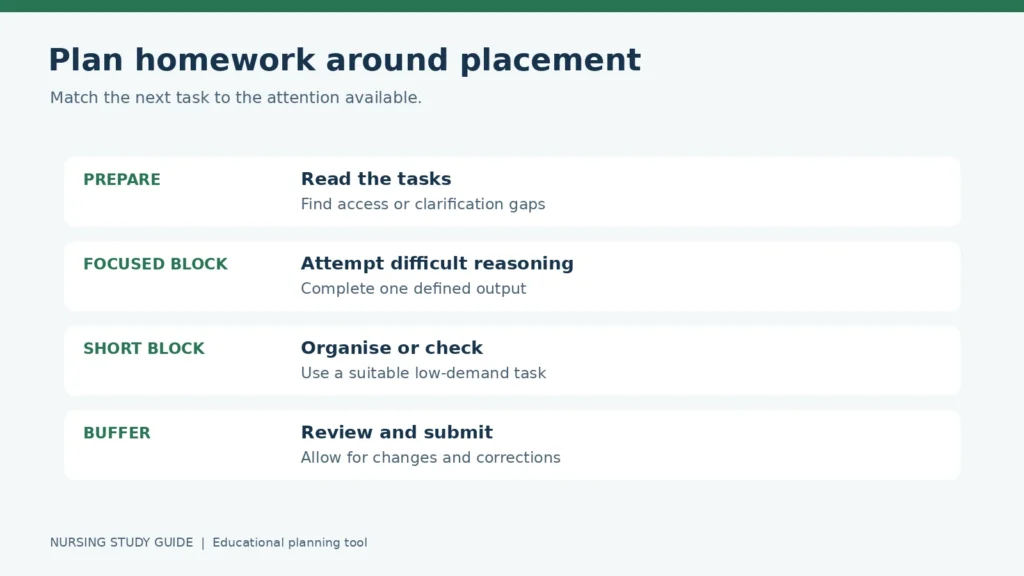
Managing nursing homework between placement shifts can be challenging when weekly tasks compete with travel and preparation for practice. A realistic weekly plan helps you decide what to do with the time and attention actually available.
The aim is not to fill every free minute. It is to identify the next useful task, complete a manageable amount and preserve enough flexibility for the week to change.
This guide addresses recurring weekly exercises during placement. For a wider assessment portfolio, see balancing nursing assignments across multiple modules.
List the week’s homework before allocating study time
Start with the actual tasks: two reading questions, a worksheet, preparation for a seminar or revisions to a formative answer. Avoid vague entries such as “do university work”. They make it difficult to know when a study block is complete.
For each task, note the deadline, what you have already done and the next action. Identify anything that needs clarification or access to a source. A question waiting for tutor guidance should not absorb your whole study session through repeated rereading.
Separate required homework from optional reading. Optional material can be valuable, but it should not silently displace a small compulsory task due before the next class.
Match study tasks to the attention they need
| Available capacity | Possible task | Clear stopping point |
|---|---|---|
| A brief, low-demand opportunity | Check deadlines or organise a reading list | The week’s tasks are recorded |
| A short, focused block | Read one section and make an evidence note | The note answers a specified question |
| A rested, uninterrupted block | Work through an unfamiliar concept or draft a difficult answer | One reasoning problem is attempted |
| A later review block | Check linked answers and revise from feedback | The selected corrections are complete |
These are planning suggestions, not rules about how much anyone should achieve. Your capacity depends on the shift pattern, travel, other responsibilities and the difficulty of the material.
Use a study block that allows you to engage with the task. The Open University describes note-taking as an active way of working with study material (The Open University, n.d.). A brief period of focused reading can therefore have a defined output, rather than becoming an open-ended attempt to read everything.
Prioritise by deadline, learning need and dependency
The closest deadline matters, but it is not the only factor. An unfamiliar concept may need time for clarification. A short question might unlock several later responses. Identify those dependencies before choosing the easiest task.
Use three questions: what is due next, what blocks another task, and what needs help while support is still available? Together, these give you a more useful priority than simply starting at the top of the worksheet.
If two tasks compete, choose a concrete next step for each. You might send a clarification question for one and use the remaining block to complete an independent question in the other.
A fictional placement-week example
Imagine a student with placement on Monday, Tuesday and Thursday. A five-question worksheet is due Friday, and a short reading response is needed for Wednesday’s seminar. The pattern below illustrates decisions rather than prescribing a rota.
| Point in the week | Study action | Reason |
|---|---|---|
| Before the placement week | Read both tasks and identify difficult questions | Find access or clarification problems early |
| First suitable rested block | Read the seminar source and draft the response | It has the earlier deadline |
| Next short block | Complete two independent worksheet questions | Make progress without waiting on the harder section |
| Protected focused block | Work through the linked, unfamiliar questions | They need more attention and reasoning |
| Buffer before Friday | Check answers, references and submission | Allow for revisions and technical problems |
If a shift changes, move the task rather than pretending the original plan remains realistic. Keep the earlier deadline and the difficult dependency visible when you revise the week.
Break homework into outputs small enough to finish
“Complete the worksheet” may be too large for the available block. “Identify the cues for question two” is a clearer first output. Later, use those cues to draft the explanation.
Other small outputs include locating one assigned source, recording a question for a tutor, correcting one recurring error or checking that every subquestion has an answer. The output should move the task forward rather than merely reorganise your notes.
For a multi-question sheet, use our short-answer question map. It helps distinguish independent questions from responses that depend on an earlier judgement.
Leave a restart note when you stop
A restart note prevents the next study session from beginning with a long search through documents. Record where you stopped, the next action and any uncertainty.
For example: “Questions one and two drafted. Next: check whether question three asks for an outcome or an action. Use the module nursing-process notes.” That is more useful than “finish homework later”.
Keep the note with the task. If you work across devices, use an institution-approved method and avoid storing confidential placement material in personal shared folders.
Keep placement information out of casual study tools
Do not photograph patient records or copy identifiable details into a homework planner. An academic task may use a fictional case or require an approved anonymised account; follow the instructions for that specific activity.
The NMC Code sets expectations concerning privacy, confidentiality and safe professional practice in the UK (NMC, n.d.). Those responsibilities matter when study and placement overlap. For programmes elsewhere, use the relevant professional and institutional requirements.
If an actual patient-care concern arises, use the placement’s supervision and escalation processes. Do not leave a practice concern waiting for an online homework response.
Use a buffer instead of relying on the final evening
Leave time for a missing source, changed shift or submission problem where possible. A buffer does not need to be a long extra session. It can be an earlier completion target and a small final review block.
If the week becomes unmanageable, contact the module or placement team early and explain the specific conflict. Check the institution’s process for support or extensions rather than assuming extra time will be granted.
When time is short, reduce optional work and focus on the required task. Avoid removing the very checks that determine whether you answered the question or submitted the correct file.
Review the routine once a week
Ask which blocks were realistic, what repeatedly took longer than expected and what can be prepared earlier. Adjust one feature for the next week instead of rebuilding the whole system.
If the same question type repeatedly delays you, the issue may be understanding rather than scheduling. Use an error log to identify a targeted practice need, then request teaching or feedback on that point.
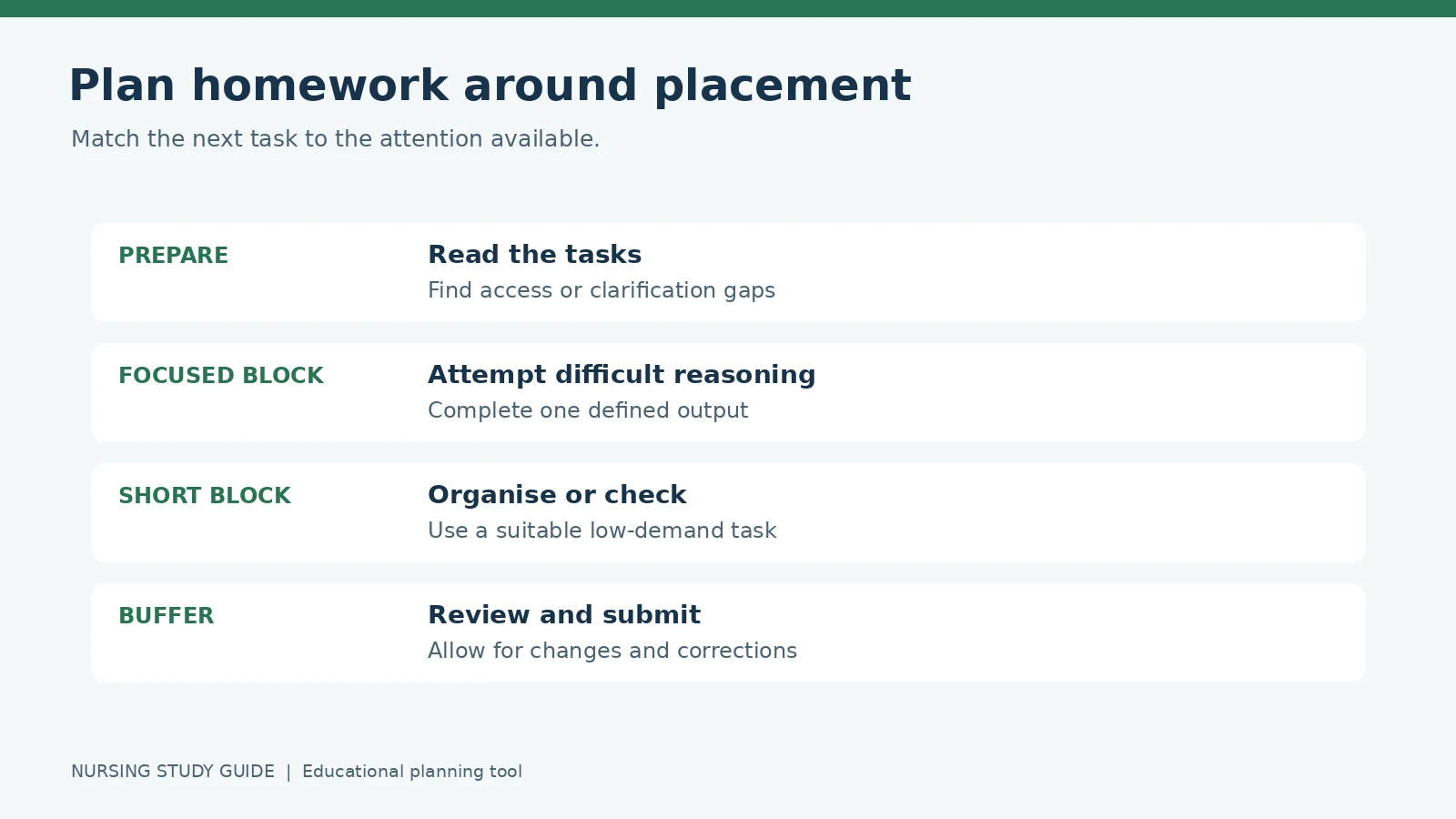
Plan for a changing rota without starting again
A placement-week plan should be easy to revise. Keep tasks separate from the time blocks in your notes. If a shift changes, you can move the unfinished task without rewriting its instructions or losing track of its next action.
Record the fixed commitments first, then identify possible study opportunities. Treat an opportunity as provisional until you know it fits the day. This is particularly useful when travel or family responsibilities also vary.
When the week changes, check three things: the nearest required deadline, the task that needs clarification and the most demanding unfinished question. Preserve those priorities while adjusting optional reading and lower-demand administration.
Use a minimum, expected and optional study plan
Instead of assuming every week will run perfectly, divide your plan into three levels. The minimum covers the essential work needed next. The expected plan includes the progress you can reasonably make. The optional plan contains useful extras if capacity remains.
| Level | Possible output | Decision rule |
|---|---|---|
| Minimum | Complete the reading response needed for the next seminar | Protect the nearest required task |
| Expected | Draft the independent worksheet questions and attempt the difficult section | Use the planned focused blocks |
| Optional | Read an additional example and organise older notes | Do this after required work and review |
This is a planning example, not permission to ignore course requirements. If the minimum plan cannot cover the required work, identify the conflict early and use your institution’s support process.
Estimate effort from the next action
“Read chapter five” gives little information about the work required. “Find the section explaining the concept needed for question two” is easier to estimate. After locating it, you can decide whether the next action is reading, note-making or drafting.
Use your own recent experience to improve estimates. If a supposedly short question repeatedly needs a source search, include that search in the plan. If a reading is familiar, you may need only to verify a specific point.
Avoid interpreting an inaccurate estimate as a failure of effort. The task may have been poorly defined or more complex than expected. Adjust the plan using what you learned about the work.
Prepare for a study block before it starts
A small amount of preparation can make a short block easier to use. Keep the current question, required reading and restart note together. Check source access before relying on a particular opportunity.
If internet access is uncertain, use permitted offline readings or a non-sensitive planning task. Follow licence and institutional rules when downloading material. Do not transfer patient records or restricted placement information to a personal device for convenience.
Decide on one output before opening several tabs. You might aim to explain one concept, complete one response or check a source. A clear output helps you recognise when the block has done its job.
Choose what to do when attention is limited
Some tasks need more sustained attention than others. If you cannot follow a difficult argument, repeatedly rereading the same passage may produce little useful progress. Consider whether a lower-demand task fits the available capacity.
You might organise the question list, identify missing instructions or prepare a precise question for a tutor. Keep those tasks short so that administration does not become a substitute for the learning that still needs a suitable block.
If repeated exhaustion is affecting study or placement, use the relevant student or placement support route. A timetable adjustment may help with organisation, but it cannot resolve every source of difficulty.
Write a clarification request before the support window closes
During a busy placement week, a delayed question can become a blocked task. Identify uncertainty early enough to ask while the module team or librarian is available.
State the task, what you have tried and the exact point needing clarification. For instance, explain that you found the required source but cannot determine which section addresses the question. This gives the recipient something specific to respond to.
While waiting, move to an independent part of the homework. Record the dependency so the unfinished question is not forgotten when you return to the task.
Protect a short review stage
A finished draft still needs checking. Keep a small review stage in the plan for unanswered subquestions, evidence mismatches and the submission file. The review should fit the size of the exercise.
For a worksheet, check each response slot and the connection between linked answers. For a reading response, check that you answered the seminar prompt and can locate the source. For a practice calculation, use the checking method taught by your programme.
Do not assume that a saved file is a submitted file. Follow the institution’s submission process and retain any confirmation it provides. If the system fails, use the published support procedure rather than waiting silently beyond the deadline.
Adjust after a missed study block
If a planned block does not happen, identify what remains and choose the next available action. Avoid automatically doubling the next session without checking whether that is realistic.
Move the required output first. Then reconsider optional tasks and the buffer. If several deadlines can no longer be met within the available time, contact the relevant module team and explain the situation using the actual tasks and dates.
Keep the adjustment practical. A missed reading block may require a smaller, question-focused reading task. A missed drafting block may require reducing the scope of optional background rather than removing the final answer check.
Separate learning support from scheduling support
Sometimes the calendar is workable but one type of question repeatedly stalls progress. That suggests a learning obstacle. Record the question type and ask for an explanation or feedback on your attempt.
Sometimes you understand the task but have several competing commitments. That calls for workload planning and, where necessary, institutional support. Extra tutoring is unlikely to create study time that does not exist.
Identify which issue you want help with before making an enquiry. A specific request is easier to scope, and it helps you judge whether the proposed support addresses the actual problem.
End the week with a short handover to yourself
Record completed tasks, unfinished work and one adjustment for the next week. Keep the note brief enough to use. A detailed account of every hour is unnecessary unless your course specifically requires that record.
Include any source or explanation you need again, with a clear link to the relevant question. Add the next action for unfinished work and the date by which it matters.
The purpose is continuity. When the next placement week begins, you should be able to see what needs attention without rebuilding the whole history of the task.
Check whether the plan is realistic before using it
Read the proposed week as though you were about to follow it. Does each demanding task have a plausible block? Are you relying on an uncertain travel opportunity for work that needs sustained attention? Is there time to obtain clarification before the deadline?
Check the stopping points too. “Study until everything is finished” gives little guidance when the workload is larger than expected. A defined output lets you stop, record what remains and make an informed adjustment.
Finally, check that the plan includes your actual course requirements. A neat timetable is only useful if the necessary tasks appear in it. Use the week to test the plan, then revise it from experience rather than judging it only by how organised it looks.
Frequently asked questions
Should I study after every placement shift?
There is no universal rule. Plan around your actual capacity and responsibilities. Put demanding tasks into a suitable rested block rather than relying on a fixed daily target.
Can I use travel time?
Only when it is safe and practical. A passenger may be able to organise notes, but studying must not distract from driving or other safety-critical activity.
What if my homework keeps taking longer than planned?
Check whether the tasks are too broad, the source access is difficult or a concept needs explanation. Adjust the task and seek relevant support instead of only adding hours.
Make the next task clear
A workable placement-week plan names the next action, matches it to available attention and leaves room for change. For a specific learning obstacle, request nursing homework tutoring and feedback with the question, your attempt and the point you want explained.
References
Nursing and Midwifery Council (n.d.) Read The Code online. Available at: NMC Code (Accessed: 21 October 2026).
The Open University (n.d.) Introduction: Note-taking techniques. Available at: https://help.open.ac.uk/notetaking-techniques (Accessed: 21 October 2026).