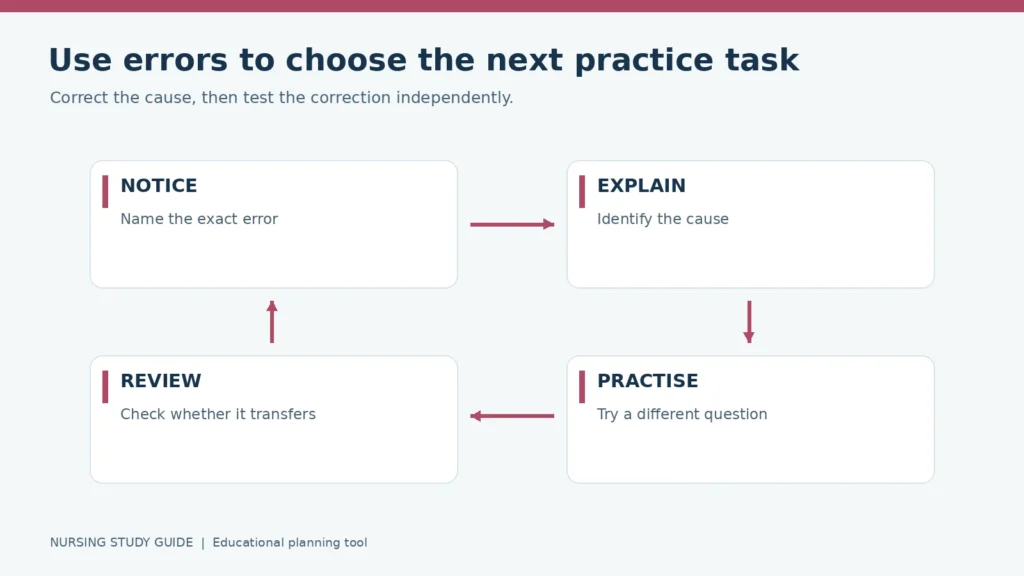
Nursing homework mistakes are more useful when you can explain why they happened. Correcting one answer may resolve today’s worksheet, but a repeated misunderstanding needs a change in how you approach the next question.
An error log records the original problem, the reason for the error and a small practice task that tests your correction. It is especially useful when similar comments appear across weekly exercises.
This guide focuses on learning from recurring errors. For a broad review of a finished assessed paper, use our nursing assignment quality checklist.
Correct the cause as well as the answer
A tutor may write “explain your rationale”, “use the scenario” or “check the source”. These comments identify a problem, but you still need to work out what produced it.
“Explain your rationale” could mean you listed an action without a reason. It could also mean your reason is too general, or that it does not apply to the person in the scenario. Each cause needs a different correction.
Before rewriting, ask: what did I think this question required, what did I actually do, and where did those two things diverge? Record the answer plainly rather than writing “be more careful”. A useful log describes a behaviour you can change.
Classify the mistake before choosing a solution
| Error category | Typical sign | Useful next task |
|---|---|---|
| Knowledge gap | You cannot explain the concept without copying | Review the assigned explanation, then explain it from memory |
| Prompt-reading error | You described when asked to compare | Rewrite the prompt as two explicit answer actions |
| Application error | Your answer could fit almost any scenario | Link each main point to a supplied cue |
| Reasoning error | The conclusion goes beyond the information | Separate observation, inference and missing evidence |
| Evidence error | The source concerns a different outcome or group | Build a claim-specific evidence note |
| Presentation error | A response slot, unit or reference detail is missing | Use a targeted final check for that feature |
One response can contain more than one category. Choose the cause that most affects the answer first. Polishing punctuation will not resolve a conclusion based on the wrong outcome.
Use a short error-log template
A log should be quick enough to maintain. A private document or notebook can work. Avoid recording patient-identifying information or copying restricted assessment material into shared tools.
| Field | Question to answer |
|---|---|
| Task and date | Which learning exercise produced the error? |
| Error in my words | What precisely was wrong or incomplete? |
| Cause | What misunderstanding or working habit produced it? |
| Correction rule | What will I do differently next time? |
| Fresh practice | Which different question can test the correction? |
| Review result | Could I apply the correction independently? |
Keep the correction rule specific. “Use better evidence” is difficult to act on. “Check that the source measures the same outcome as my claim” gives you a concrete decision to make.
Work through a fictional example
A classroom worksheet asks how to evaluate whether a stated outcome was achieved. A student answers by listing the actions carried out. The tutor notes that the response describes implementation.
The error-log entry might read: “I treated completion of an action as proof of a result. Next time I will identify the intended outcome and the observation needed to judge it before describing any action.”
For fresh practice, use a different classroom scenario and identify its intended result, the relevant observation and the possible judgement. Do not simply memorise the corrected wording from the first example.
The American Nurses Association’s overview distinguishes implementation from evaluation within the nursing process (ANA, n.d.). The source helps clarify the conceptual distinction; the error-log routine here is a practical study suggestion rather than a tested intervention claimed to improve marks.
Turn feedback into an instruction you can use
Rewrite broad comments as actions. “Too descriptive” might become “After stating the idea, compare it with an alternative and explain which fits this question better.” However, check the surrounding feedback so you do not assume the tutor wanted comparison when they wanted scenario application.
“Needs evidence” might become “Identify the claim and find a source that supports it.” A source inserted at the end of the paragraph is not enough if it concerns a different population or says something less definite.
“Unclear” may indicate a missing reasoning step. Explain the answer aloud in plain language, then identify where another reader would need a connection. Sometimes the concept is understood but the written answer skips the explanation.
Separate a typo from a knowledge gap
If you can explain the concept accurately and spot the mistake independently, a final-check habit may be sufficient. If you cannot explain why the original answer was wrong, return to the learning material.
Do not label every difficulty as carelessness. That can hide a recurring conceptual problem and lead to repeated proofreading without improvement. Equally, do not reread an entire chapter when the real issue is consistently missing the second part of a prompt.
For calculations, use the method and checking rules taught by your programme. Record whether the problem involved interpretation, formula selection, units or arithmetic. Clinical medicine calculations require the appropriate teaching and supervision; an online study guide cannot validate a real administration decision.
Test the correction on a new question
After reviewing the explanation, close it and attempt a different question. You are checking whether the reasoning transfers, not whether you can recognise familiar wording.
If the same error appears, make the practice smaller. For example, distinguish an observation from an inference before attempting a full case response. If that step is secure, reconnect it to the wider task.
Record what still feels uncertain. A clear question such as “Why does this observation not establish the cause?” is more useful in a tutorial than “I do not understand the whole topic”.
Review patterns without collecting endless entries
At the end of the week, look for repeated categories. Three evidence mismatches may suggest you need to improve source selection rather than proofread references more carefully.
Keep active only the errors that still affect new work. When you can explain and apply a correction independently, retain a brief reminder and move attention to the next learning need.
The log should reduce confusion, not become another large assignment. If it takes longer to describe the entry than to practise the correction, shorten the fields and prioritise the most consequential error.
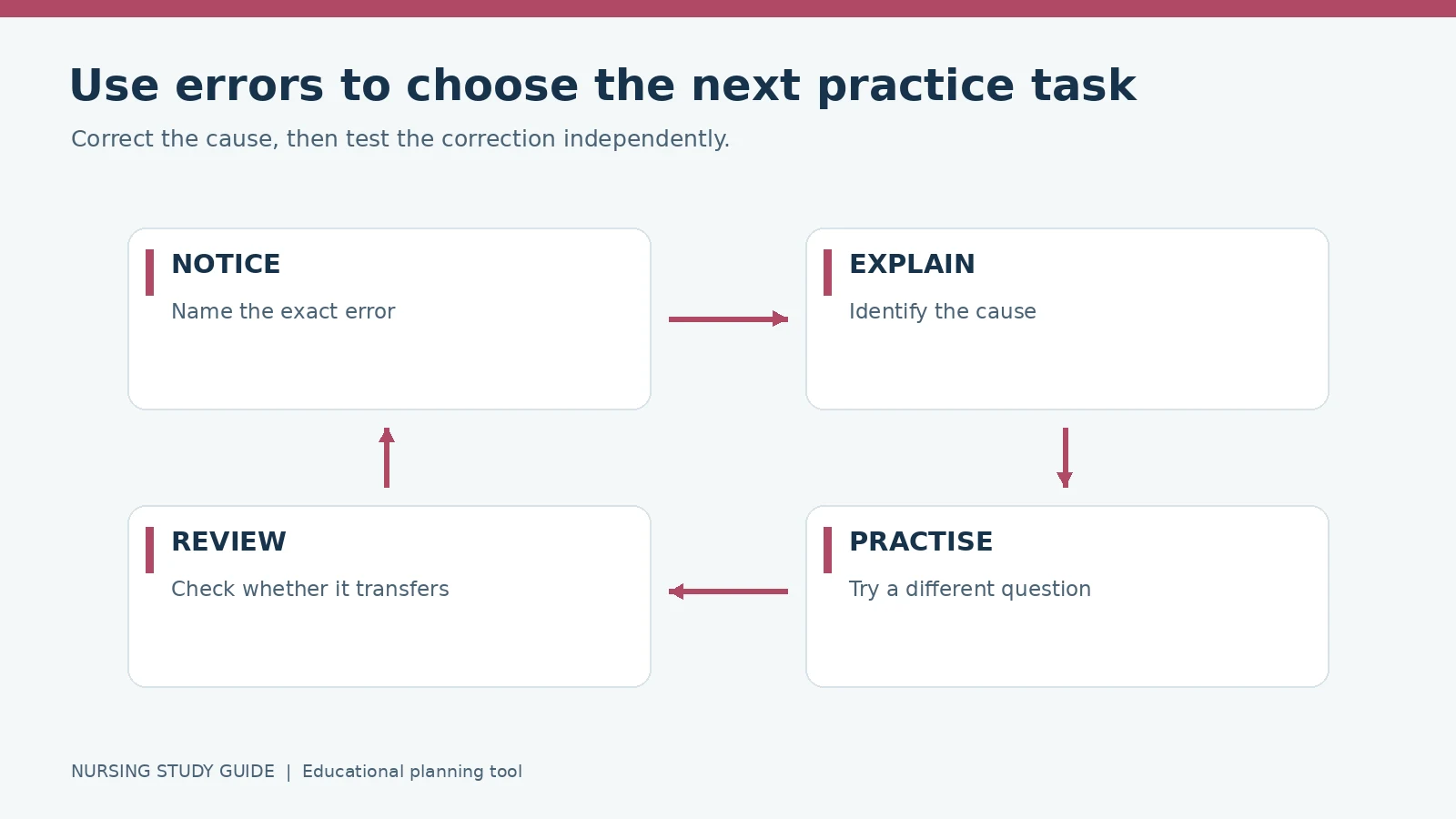
Turn vague correction goals into observable actions
An error log works best when the next action is visible. “Improve critical thinking” is a broad aim. “Write one reason why this source does not fully answer the question” is a practice task you can complete and review.
Choose an action small enough to test on one new prompt. If you cannot tell whether you completed it, make it more specific. For example, replace “apply the case” with “identify the supplied cue that supports each main judgement”.
Keep the correction tied to the error. If your original problem was missing a subquestion, a large reading plan may not help. A response-slot check is more relevant to that particular cause.
Compare weak and useful log entries
| Weak entry | More useful entry | How to test it |
|---|---|---|
| I need better answers | I named an action but did not explain its purpose | Add a case-linked reason to a different action question |
| I used the wrong reference | The source measured confidence, but I claimed improved performance | Match a new source’s outcome to the claim |
| I forgot information | I answered part a and missed part b | Mark every response slot before drafting |
| My answer was vague | I wrote a judgement without identifying its supporting cue | Underline the cue and explain the connection |
The useful entries describe the mismatch. They also make the next practice task different from simply copying a corrected answer. The aim is to change how you approach the next prompt.
Use a second fictional example: an evidence mismatch
Imagine a weekly exercise asking whether a learning activity improved students’ ability to perform a task. The supplied fictional summary says that students felt more confident, but it reports no performance measure.
A student writes that the activity improved performance. The correction is not merely to add a reference. The underlying error is treating confidence and performance as the same outcome.
An actionable log entry would state: “I claimed a result the source did not measure. Before using a study, I will name the actual outcome and compare it with the wording of my claim.” Fresh practice would use a different summary with two outcomes to distinguish.
Use a third fictional example: a misread command
A prompt asks the student to compare two communication approaches in the scenario. The attempted answer describes one approach in detail and names the other in the last sentence.
The knowledge may be partly correct, but the answer does not perform the comparison. The log should record the missing shared basis: the student did not decide which features to examine across both approaches.
A correction rule could be: “For a comparison, choose the same relevant feature for each option and explain the implication.” The fresh task could ask for one matched comparison point, then a reason why it matters in a different fictional scenario.
Decide which error to address first
If a response has several problems, begin with the one that changes its meaning or conclusion. A misunderstanding of the concept may require review before an application error can be resolved. A formatting problem can often wait until the reasoning is sound.
Consider the consequences for later work. If one wrong assumption appears across four linked answers, review that assumption first. Otherwise, you may spend time polishing several responses that need to change together.
This is a prioritisation suggestion, not a marking hierarchy. Your tutor’s feedback and assessment instructions may identify a different immediate priority. Use those instructions when deciding what to practise.
Make practice independent enough to reveal understanding
Repeating the same question immediately after reading its answer can feel easy because the wording is familiar. Choose a different example that requires the same reasoning step.
Keep the learning demand comparable. If the original difficulty was distinguishing an outcome from an action, changing the entire topic and introducing unfamiliar terminology may hide whether that distinction improved.
After the fresh attempt, explain the decision in plain language. If the explanation still relies on “that is how the example did it”, return to the underlying concept. A correction is more secure when you can justify it.
Use feedback discussions efficiently
Bring one or two representative entries to a tutorial. Show the prompt, your attempted reasoning and the correction you think is needed. Ask whether you have identified the right cause.
A useful question might be: “I thought this comment meant I needed more references, but the paragraph already has sources. Is the problem that I have not explained their relevance?” That gives the tutor a specific judgement to clarify.
Record the clarification accurately. Do not turn one comment about one paragraph into a universal writing rule. The appropriate response may depend on the task, academic level and type of evidence involved.
Keep the log separate from a placement incident record
A homework error log is a private study tool. It should not become an informal record of patient incidents or replace an institution’s placement documentation and reporting processes.
Use fictional educational examples or appropriately permitted learning material. Avoid names, identifiers and unnecessary details about patients, staff or placement locations. When a real practice concern needs attention, use the relevant supervision and reporting route.
Keep the distinction clear when requesting academic feedback. You can ask for help understanding a concept without sharing confidential records or asking an external service to make a patient-care decision.
Review progress with evidence from new attempts
At review, compare the correction rule with your fresh answer. Did you identify the cue, complete both parts or match the outcome correctly? Record the result rather than judging progress from how familiar the topic feels.
If the error appears less often but still occurs, keep a short reminder in the next task’s planning notes. If the correction is consistently applied in different examples, reduce its priority and focus on the next gap.
Do not turn the log into a score of your ability. It records changeable learning problems. The useful question is what to practise next and what evidence would show that the practice helped.
A short routine for the next homework session
- Select one recurring error from recent feedback.
- Write the cause in a single clear sentence.
- Choose a correction rule that you can apply to a new prompt.
- Attempt the new prompt without copying the model response.
- Check the reasoning and record what still needs clarification.
Keep this routine proportionate to the task. If you need a long explanation to understand the correction, seek teaching on the concept first. The log organises learning; it does not replace the learning material.
Close an entry when the correction transfers
Choose a simple closure rule for your study log. You might close an entry when you can explain the original error and apply the correction to a different prompt without using the model answer. This is a practical personal rule, not a validated measure of competence.
Record the successful example briefly. If the same mistake returns, reopen the entry and check whether the context changed. A rule that worked for a definition question may need adjustment for an application question.
Retain the explanation that helped you. A concise reminder about the reasoning is more useful than a folder of corrected sentences with no record of why they changed. Keep references to the relevant course material where appropriate.
At the next review, concentrate on active entries. You do not need to rehearse every old mistake indefinitely. The log should help you choose the next useful practice task and recognise when a difficulty needs a tutor’s explanation.
If your attempted correction conflicts with the course guidance, return to that guidance and ask about the specific difference. Do not turn a general online example into a rule that overrides your programme’s requirements.
Frequently asked questions
Should I log every mistake?
No. Prioritise recurring errors, important misunderstandings and feedback you do not yet know how to apply. A one-off typo rarely needs a full entry.
What if I disagree with the feedback?
Compare the comment with the question, rubric and source. Ask for clarification about the exact point of disagreement, using your attempted reasoning.
How is this different from a submission checklist?
A checklist reviews the current document. An error log tracks why a mistake happened and whether you can avoid it on a new task.
Use errors to choose the next learning step
Identify the cause, write a practical correction rule and test it independently. If you need help understanding the pattern, request nursing homework help with targeted feedback and share a relevant attempted answer.
For source-related errors, use the homework evidence-note template. For confusing prompts, start with the multi-question worksheet guide.
Reference
American Nurses Association (n.d.) The nursing process. Available at: ANA nursing process overview (Accessed: 21 October 2026).