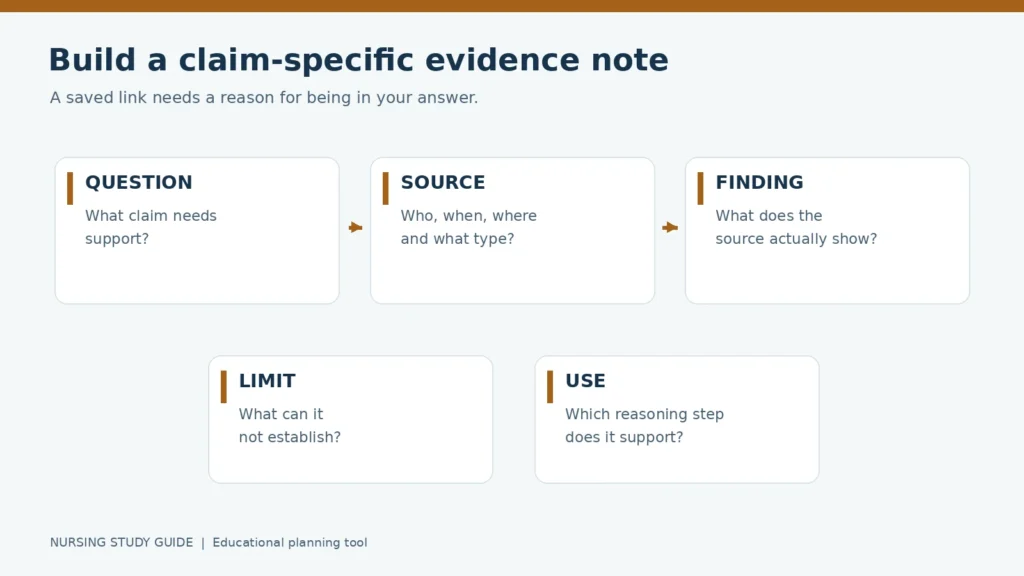
Nursing homework evidence becomes easier to use when you record why a source belongs in a particular answer. Saving a link is only the first step. You also need to know what it supports, what it does not establish and how it relates to the question.
This guide explains a compact evidence note for a short weekly response. It is a study tool rather than a systematic-review extraction table or a professional citation-audit service.
Begin with the claim your answer needs
Before searching, finish this sentence: “To answer this question, I need evidence about…” Be specific about the population, setting and issue where relevant.
A question about an intervention’s effectiveness needs different evidence from one asking what a professional standard requires. A research article can help with a study finding. An official professional document is usually the direct source for that organisation’s standards.
Do not search only for the whole homework question in quotation marks. That can lead to model answers rather than the underlying evidence. Extract the topic concepts and look for sources that allow you to reason independently.
Choose a source route that fits the question
| Information needed | Possible starting point | Check before using it |
|---|---|---|
| A taught concept or definition | Assigned textbook or module reading | Required edition and how the module uses the term |
| A professional responsibility | The relevant regulator’s official standard | Jurisdiction, scope and current version |
| A clinical recommendation | An official guideline relevant to the setting | Population, recommendation wording and update status |
| A study result | The original research report through a suitable database | Design, participants, actual result and limitations |
| A broad evidence summary | A suitable review | Review question, search coverage and applicability |
NICE describes its guidance as evidence-based recommendations for health and social care (NICE, n.d.). That makes it a useful route for relevant recommendation questions, but it does not mean every NICE document applies to every country, patient group or homework task.
Build a small, transparent search
For a fictional homework exercise about older inpatients and exercise, your starting concepts might be older adults, hospital inpatients and exercise. Write alternative terms beside each concept before searching.
In a database, combine alternatives with OR and different concepts with AND where that syntax is supported. Inspect the result titles and abstracts, then adjust the terms if you are retrieving the wrong setting.
PubMed’s user guide explains search tools and filters, including options for dates and article types (National Library of Medicine, 2026). Use the guide when you are unsure how a filter affects your results. A database search is a way to locate publications; it does not certify that every result supports your claim.
For a short homework exercise, record the database, search terms and useful source details. Do not describe a quick search as a systematic review. If your module specifies a database or search log, follow that requirement.
Read beyond the title and abstract
A title can match your topic while the study measures a different outcome. For example, improved balance or strength does not automatically demonstrate fewer falls. Read what was measured and what the results actually show.
Look for the study’s population, setting, comparison and follow-up period. Then locate the result relevant to the question. Check whether the authors discuss uncertainty, missing information or other limitations affecting the interpretation.
If you cannot access the full text, do not imply that you have read it. Use your university’s access routes or identify a suitable source you can inspect. A reference copied from another paper’s bibliography still needs verification.
Use a six-field evidence note
Keep the note short enough to revisit while drafting. Its purpose is to preserve the connection between the homework question and the evidence.
| Field | What to record |
|---|---|
| Question or claim | The precise point this source may help answer |
| Source identity | Author or organisation, date, title and stable link or DOI |
| Evidence type and context | Study, review, guideline or standard; relevant population and setting |
| Relevant finding or statement | An accurate paraphrase, with page or section for checking |
| Limit or mismatch | What this source cannot establish for your answer |
| How you will use it | The sentence or reasoning step it will support |
Keep exact quotations visibly marked in your notes. Otherwise, a copied phrase can become difficult to distinguish from your own summary later. The Open University’s note-taking guidance encourages active engagement with study material (The Open University, n.d.).
A fictional example of an evidence note
Suppose the homework asks whether a study demonstrates fewer falls, while the supplied classroom extract reports improved walking performance and says nothing about falls.
Your note should record the measured walking outcome and the missing falls outcome. Under “how I will use it”, write that the extract supports a statement about walking performance but cannot establish a falls reduction.
This is a fictional interpretation exercise, not a summary of a named study. Its purpose is to show how an evidence note prevents a claim from growing beyond the information available.
Do not solve the mismatch by inserting “may” into an otherwise unsupported causal claim. State the evidence boundary clearly, then look for a source that measures the outcome the question actually asks about.
Turn the note into a concise answer
Write the point your answer needs to make. Add the source-supported information, then explain its relevance to the question. Include the limitation when it materially changes the conclusion.
Avoid arranging the response as a list of unrelated author summaries. Even in a short answer, the reader needs to see why the evidence matters. A source note helps you choose only the detail needed for that reasoning.
Use your institution’s referencing guide. A stable URL helps you find a document again, but it is not a substitute for the author, date and other details required by the chosen style. For formatting guidance, see referencing a nursing assignment.
Check the note before reusing it
A useful note for one question may be unsuitable for another. Recheck the population, setting and claim whenever you reuse a source. Also check whether a guideline or professional document has been updated.
Do not transfer a paragraph from a previous assessed submission simply because the topic is similar. Use the source to develop a fresh response within your institution’s rules.
If you have several questionable citations in an existing draft, that is a different task from building study notes. See nursing reference verification and citation checking for a focused audit.
Keep the question visible throughout the search
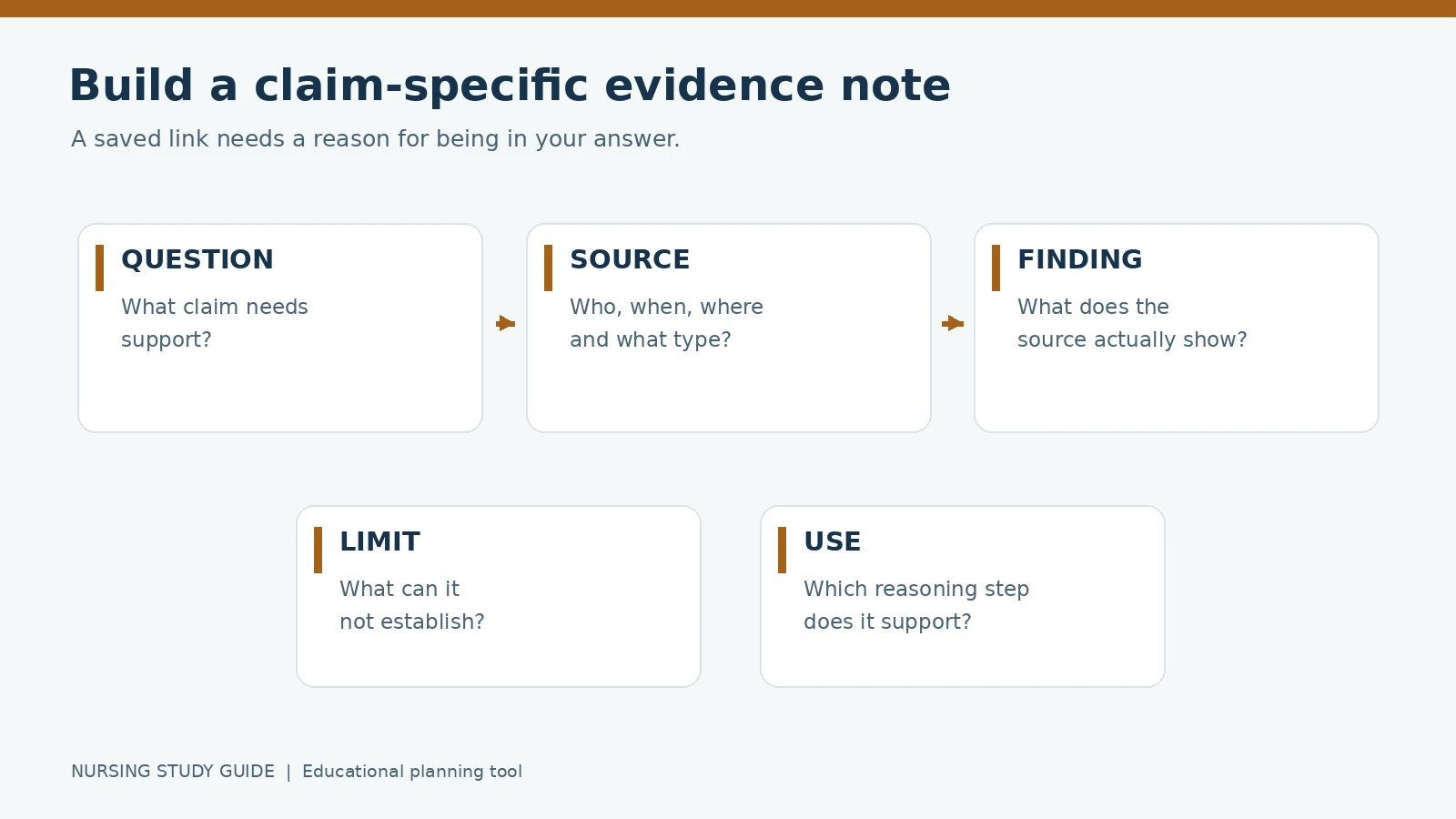
Put the homework question at the top of the evidence note. Under it, write the specific claim you want to support. This keeps the search anchored when several interesting articles appear and makes it easier to reject material that does not answer the task.
If the question changes while you read, record the change. A note built for one outcome should not quietly become evidence for another. You may need a different source rather than a broader paraphrase of the first one.
For example, a task about a person’s experience needs evidence about that experience. A study reporting staff satisfaction might be related to the setting, but it cannot directly establish what patients thought. Similar topic words are not enough.
Use an evidence note for a guideline recommendation
Start by locating the recommendation relevant to your question on the official source. Record its wording in a clearly marked quotation or make a careful paraphrase. Add the section identifier so that you can return to it.
Next, note the group and setting covered. Identify any condition attached to the recommendation. Words such as consider, offer and discuss can carry different meanings within a document, so do not strengthen the wording during paraphrasing.
Finally, explain how you will use it. A recommendation can support a statement about recommended practice in its stated context. It does not by itself prove that a fictional patient received the intervention or achieved a particular outcome.
Use an evidence note for an individual study
For a research report, identify the actual study design before deciding what it contributes. Record who participated, where the work took place and which outcome or experience was examined. Keep the details needed for your question rather than copying the entire methods section.
Find the result that relates to the claim. If the publication has several outcomes, identify which one you mean. A broad statement that the intervention worked can conceal a difference between an improved measure and the outcome your question asks about.
Write one limitation that affects your interpretation. This might concern the setting, follow-up, comparison or information available in the report. Explain its consequence for your answer rather than adding a generic sentence about small samples.
Use an evidence note for a professional standard
Identify the organisation and the jurisdiction before citing a standard. Record the relevant section and distinguish the document’s requirement from your application of it to the homework scenario.
A standard may establish a professional responsibility. Your answer still needs to explain how that responsibility relates to the case. Merely naming the document does not show whether you understand the particular issue.
Do not use a professional code as though it were a clinical effectiveness study. Equally, do not use a single study as the source for what a regulator officially requires. The source’s role matters as much as its authority.
Compare two sources without losing their differences
Sometimes two sources seem to disagree because they ask different questions. Before deciding that the evidence conflicts, compare the populations, settings, interventions, outcomes and timing. Record those differences alongside the findings.
| Comparison field | Source A | Source B | Why it matters |
|---|---|---|---|
| Population | Record the studied group | Record the studied group | Check relevance to the homework case |
| Setting | Record the location or service type | Record the location or service type | Consider whether context changes application |
| Outcome | Name the actual measure | Name the actual measure | Avoid treating different outcomes as equivalents |
| Timing | Record the reported follow-up | Record the reported follow-up | Keep short-term and later findings distinct |
Use the comparison to explain the conclusion your answer can defend. You do not need to force agreement. If the evidence remains uncertain, describe the source of uncertainty and keep your claim proportionate.
Write a paraphrase you can check
Read the relevant passage, make a note of its meaning and then explain it in your own words. Compare your explanation with the original. Check that you have preserved the group, outcome and level of certainty.
Changing a few words is not a reliable way to show understanding. Ask whether you could explain the finding aloud without looking at the sentence. If you cannot, return to the source before drafting the answer.
Keep the page, table or section reference in your notes even if the final referencing style does not require it for every paraphrase. This makes later verification easier and helps you distinguish your interpretation from the source’s statement.
Record numerical information with its meaning
If the task requires a number from a study, record what it counts or measures. Include the group, time period and comparison needed to interpret it. A percentage without its denominator or context can be misleading.
Copy numbers carefully and check them against the relevant table or passage. Distinguish the number of participants from the number of events. Do not describe an absolute difference as a relative change or reverse the direction of a result.
If you are unsure how to interpret a statistic, ask for methodological guidance using the original source. Do not choose the most impressive number simply because it makes the answer sound stronger.
Use a source-verification stopping rule
Before citing, confirm that the title, author or organisation and date match the document you read. Check that a DOI opens the intended publication where one is available. For official web documents, use the relevant organisational page rather than an unattributed copy.
If the source cannot be located or its details conflict, mark it unresolved in your note. Do not repair the reference by guessing a journal, volume or year. Find a verifiable source or ask your librarian for help.
A source can exist and still be unsuitable. Once identity is confirmed, return to the claim-to-source connection. Verification and relevance are separate decisions, and both matter.
Know when the evidence note is complete
For a short homework response, the note is useful when you can identify the claim, locate the supporting passage and explain the important limit. It does not need to become an exhaustive review of the topic.
Stop adding sources when the task’s evidence requirement is met and the necessary reasoning is supported. If a new source would change the conclusion, consider it. If it repeats the same point without adding relevant information, it may not improve the answer.
Use the saved time to check your interpretation. A concise response with accurately used evidence is more defensible than a long response whose references were collected without being read.
Use a final claim-to-note check
Place your draft sentence beside the evidence note. Highlight the population, outcome and strength of conclusion in both. If the wording in your answer is broader, decide whether the source supports that extension. Where it does not, narrow the claim or find appropriate evidence.
Next, check whether the note contains your interpretation or the authors’ conclusion. Both can appear in academic work, but the distinction should be clear. Do not attribute your own inference to the source without explaining how you reached it.
Then follow the reference back to the publication. Can you locate the passage or result again? If not, complete the note before submitting. A reference that only you can recognise from a browser history is not a reliable record.
Keep the final check brief and focused on the claims actually used. Unused notes can remain in your study collection without entering the reference list, subject to the task’s requirements. The submitted answer should contain evidence because it contributes to the reasoning, rather than because you spent time finding it.
Frequently asked questions
Does every homework answer need research articles?
No. The source type should match the task. A professional-standard question may need the official standard, while an effectiveness question needs suitable research evidence.
Should I always use only recent sources?
Follow the brief and consider the claim. Current practice guidance needs a currency check; an original theory may require its foundational source alongside later discussion.
Can I cite an article I found in another reference list?
Locate and read the original where possible. If you cannot, follow your institution’s rules for secondary citation and do not imply direct access.
Make each source earn its place
A reliable evidence note connects the claim, source and limitation. If you need help making that connection for a short exercise, request nursing homework feedback with your attempted answer and the source you are using.
References
National Library of Medicine (2026) PubMed user guide. Available at: https://pubmed.ncbi.nlm.nih.gov/help/ (Accessed: 21 October 2026).
National Institute for Health and Care Excellence (n.d.) NICE guidance. Available at: https://www.nice.org.uk/guidance (Accessed: 21 October 2026).
The Open University (n.d.) Introduction: Note-taking techniques. Available at: https://help.open.ac.uk/notetaking-techniques (Accessed: 21 October 2026).