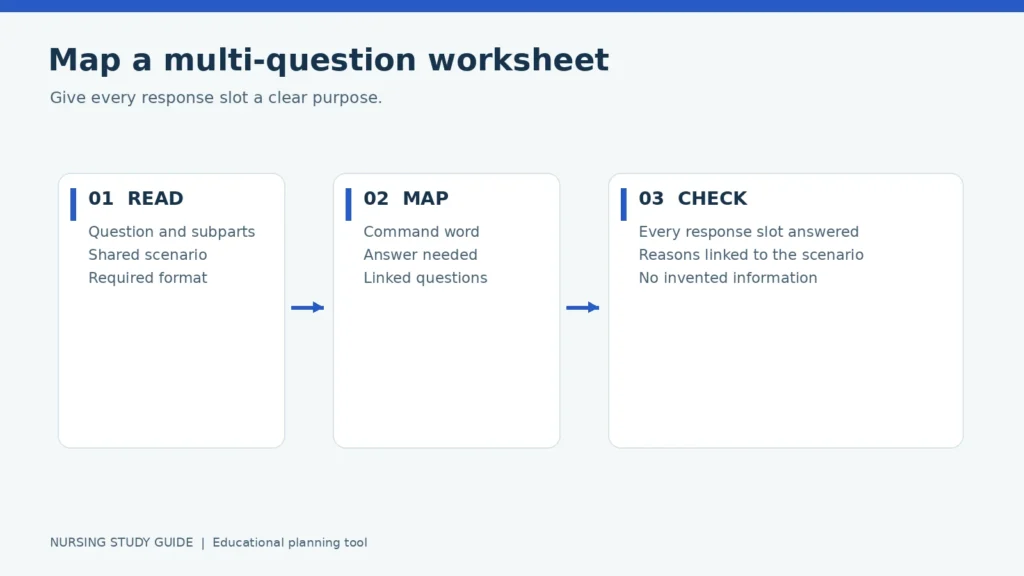
Short-answer questions in nursing homework can feel harder to organise when several appear on one worksheet. Each prompt may require a different response, and a long answer to the first question can leave little time for the rest.
Start by treating the sheet as a set of small learning tasks. Identify what each answer must demonstrate, check whether questions depend on one another, and decide what a complete response looks like before writing.
This guide focuses on multi-question worksheets. For a full essay outline, use the separate assignment brief-to-writing-plan guide.
Read the whole sheet before answering question one
A case may appear above several questions, while extra instructions sit at the bottom of the page. Read everything first. Notice whether the task asks you to use one scenario throughout, restrict answers to supplied information, or show calculations and reasoning.
Then count the actual response slots. Question 2 may have parts a, b and c, each requiring a separate answer. Mark them individually so a completed paragraph does not hide an unanswered subquestion.
Check the submission format as well. A worksheet table, discussion box and short written document have different space constraints. Use the format requested rather than turning every task into an essay.
Make a question map
Create a small planning table before drafting. Its purpose is to reveal what you must do, not to produce polished prose.
| Prompt | Required action | Answer shape | Dependency |
|---|---|---|---|
| Identify two relevant cues | Select from the scenario | Two cues with their locations | Read the scenario carefully |
| Explain why one cue matters | Connect finding and significance | A short explanation | Use one selected cue |
| State what information is missing | Recognise uncertainty | A gap and why it matters | Avoid inventing information |
| Suggest how an outcome would be checked | Describe evaluation | Measure, comparison and timing if supplied | Refer to the stated outcome |
Notice that these prompts are related without asking for the same answer. Copying one broad paragraph into all four response boxes would miss their different purposes.
Match the response to the command word
“Identify” usually calls for selecting or naming. “Explain” requires showing how or why. “Compare” needs a shared basis for examining alternatives. “Justify” asks for reasons that support a choice.
Always read those words with the rest of the prompt. “Identify two findings and explain their significance” contains two actions. Naming the findings completes only the first part.
Try rewriting each question privately as an instruction: “I need to name two cues and explain why each changes the interpretation.” That short instruction can keep your answer focused when the topic is familiar and you are tempted to include everything you know.
Use marks and space as clues, not rigid formulas
If marks are shown, use them to notice differences in expected effort. A one-mark identification and a six-mark explanation are unlikely to need identical treatment. However, do not assume that every mark equals a fixed number of words unless the module explicitly says so.
If there is no word limit, aim for an answer that completes the required action without repeating the question or adding unrelated background. Definitions are useful when they enable the answer; they are less useful when they displace the reasoning being assessed.
For linked subquestions, avoid explaining the entire case repeatedly. Answer each part directly and refer back only when the worksheet format allows this.
Draft a small answer skeleton
For an explanation question, a useful starting structure is: direct answer, relevant scenario detail, reason, and any important limitation. It is a planning aid rather than a universal marking formula.
Consider a fictional question asking why a student’s conclusion is uncertain. A focused response might identify the missing follow-up observation, explain why a single observation cannot establish change, and state what additional comparison the exercise would need.
That is different from listing every assessment tool associated with the topic. The answer stays anchored to the uncertainty named in the question.
Write the first version from understanding. Then check it against the course reading and correct inaccuracies. Mark any borrowed phrase as a quotation in your notes so it does not enter your response unnoticed. The Open University discusses note-making as an active study activity, rather than passive copying (The Open University, n.d.).
Handle linked questions without carrying an error forward
Some worksheets build later questions on an earlier choice. If you are uncertain about that choice, flag it in your working notes and review it before completing the dependent answers.
Suppose question one asks you to select a priority and question two asks for an outcome related to that priority. A well-written outcome still fails to address question two if it concerns a different problem. Check the connection before adding detail.
If you change the first answer, revisit the later ones. A common source of inconsistency is revising an early judgement while leaving its old rationale or outcome unchanged.
Record missing information honestly
A short scenario rarely contains a complete clinical record. Separate what is stated from what you infer and what remains unknown. Do not invent a patient preference, a result or an improvement simply because it would make your answer easier.
If the prompt asks what else you would assess, identify the information needed and why. If it asks you to interpret only the supplied data, keep your conclusion within that limit. When instructions conflict, note the exact wording and ask the module team for clarification.
These examples concern academic reasoning. They are not patient-specific clinical advice or a substitute for supervision.
Run a completion check across every response slot
- Check that every numbered question and lettered subquestion has an answer.
- Underline the sentence that directly responds to each prompt.
- Check that linked answers use the same scenario details and assumptions.
- Remove repeated background that does not add a new reason.
- Verify citations where the task requires evidence.
- Save and preview the file in the required submission format.
If a response contains useful information but no direct answer, revise its opening before proofreading individual words. A clear response makes the assessed reasoning easy to locate.
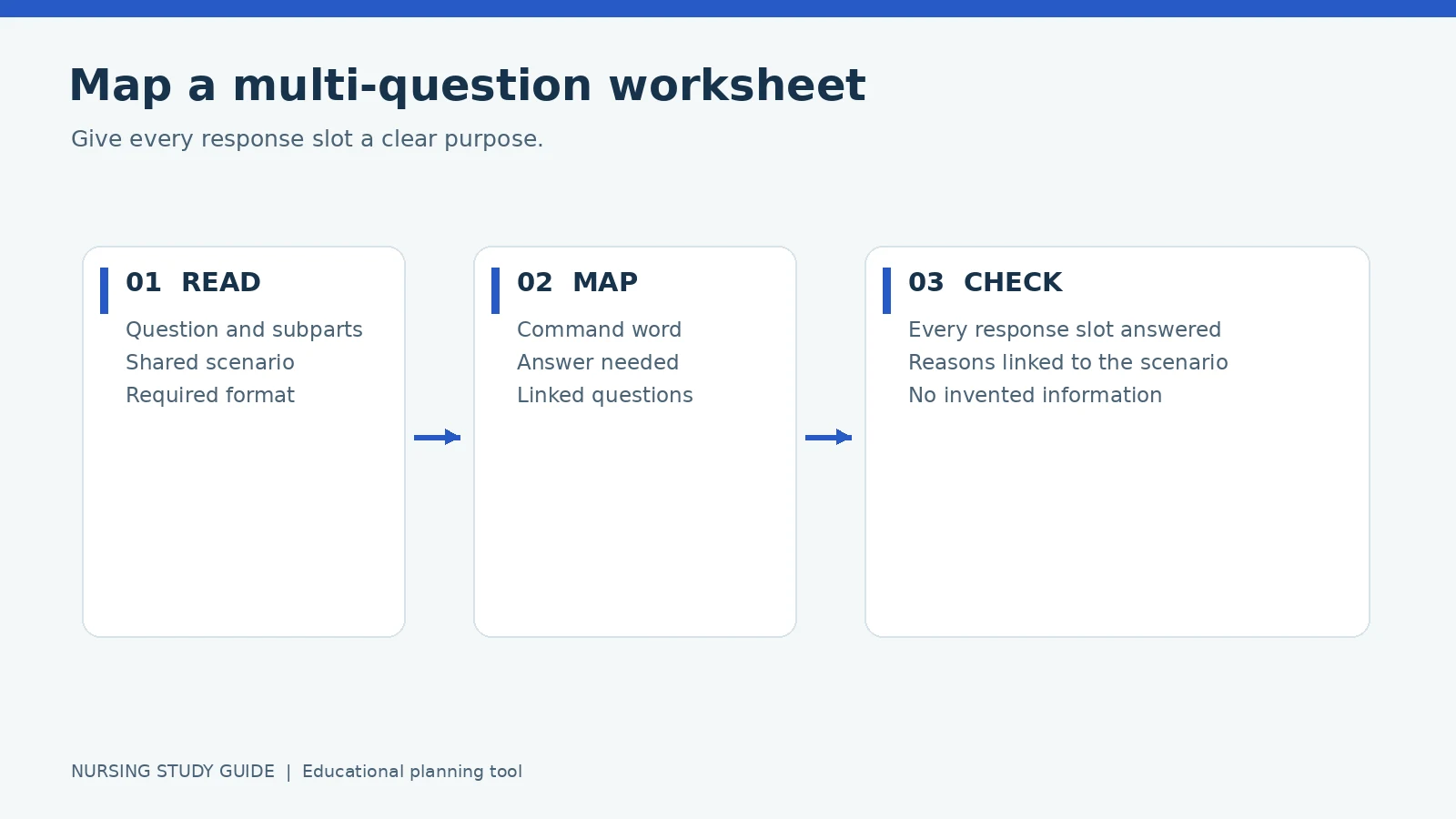
Work through a complete fictional worksheet
Consider a fictional classroom exercise with a short scenario and four response boxes. The instructions ask you to identify two relevant observations, explain one uncertainty, propose an intended outcome and describe how that outcome would be reviewed. No real patient information is involved.
Before drafting, create four headings in your working notes. Under each, write the verb, the information supplied and the response needed. This stops a familiar topic from turning into four nearly identical paragraphs. It also reveals which answer depends on an earlier choice.
Response one: select rather than repeat the entire scenario
If the question requests two observations, choose two that matter to the stated issue. Copying the whole scenario does not explain selection. Record the observations accurately, then add significance only if the prompt requests it. Do not turn an observation into an established cause.
For instance, the exercise may state that a person asked for the information to be repeated. That is a reported detail. It does not establish why repetition was needed. Your answer should preserve the difference between the detail and its possible interpretation.
Response two: explain uncertainty precisely
The next question might ask what cannot yet be concluded. Identify the missing connection: the scenario records information being delivered, but it does not describe the person’s understanding. Explain that limitation directly. A broad statement that more assessment is always necessary would be less useful.
Then check the command word. If the task asks only for the uncertainty, do not add a full assessment plan. If it asks how the uncertainty could be resolved, identify the relevant information and explain why it would address the gap.
Response three: describe the intended result
An outcome question needs a result rather than another staff activity. In this fictional exercise, an intended result could concern the person’s ability to explain the agreed information. The wording should reflect the actual task and avoid invented clinical targets.
Check that the outcome relates to the issue already identified. A polished outcome about a different need will not repair a weak connection. If your module supplies a required outcome format, use it and check every component against the scenario.
Response four: connect the review to the result
The last answer should explain how the intended result would be judged. Specify the information needed for that judgement. If the scenario supplies no later observation, describe the review process without announcing that the outcome was achieved.
Finally, read all four responses together. They should form a consistent set while doing different jobs. If an early answer changes, revisit each dependent response rather than leaving an old assumption in a later box.
Choose an answer format for the actual question
A short-answer worksheet may allow bullets, a table or connected prose. Choose according to the instructions and the reasoning required. A list is efficient for named items. An explanation usually needs sentences that make the connection clear.
| Task | Useful format when permitted | Common problem to avoid |
|---|---|---|
| Name three features | Three clearly separated items | Hiding the third item inside unrelated detail |
| Explain a relationship | A direct point followed by its reason | Using arrows without explaining what they mean |
| Compare two approaches | Matched points or a comparison table | Describing each approach on a different basis |
| Justify one choice | Choice, supporting reason and relevant limitation | Listing benefits without connecting them to the case |
Tables can make parallel points clear, but they do not automatically provide analysis. Each cell still needs enough information to perform the task. If the institution requires prose, keep the table as a planning tool and write the final answer in the requested form.
Manage a short word allowance across several questions
If the worksheet has a total word limit, note whether the instructions allocate words to individual questions. Where they do, follow that allocation. Where they do not, estimate the space each answer needs from its complexity and marking emphasis.
Draft the central answer to every question before expanding background. This gives you a complete first version and makes it easier to see where words are doing useful work. An unanswered question is visible; an overdeveloped first answer can otherwise consume the whole allowance.
When reducing length, remove repeated definitions, introductions that restate the prompt and examples that do not change the reasoning. Preserve the evidence and explanation needed to justify your conclusion. A shorter answer should still make sense to someone who cannot see your private notes.
Recognise when a short answer needs a citation
Follow the task’s evidence requirements. A statement drawn from a professional standard, publication or research finding may need attribution even when the answer is only a few sentences. An observation quoted from the supplied fictional case has a different source.
Keep a note of where each claim comes from. Do not attach one reference to several unrelated statements and assume it supports them all. If you need a compact source record, use the nursing homework evidence-note guide.
Check the required referencing style before submitting. An answer can be accurate but difficult to verify if the reference is incomplete. Equally, perfect formatting cannot make an irrelevant source suitable for the claim.
Prepare a specific clarification question
If the wording remains ambiguous, identify the exact point before contacting the module team. State the question number, the phrase causing uncertainty and the two interpretations you are considering. Ask which interpretation fits the intended task.
For example: “Question three asks for an evaluation, but the scenario contains no follow-up result. Should I explain how the outcome would be evaluated?” This request shows the reasoning problem without asking someone else to supply the answer.
While waiting, work on independent questions. Mark the uncertain response in your draft so it is not mistaken for a completed answer later. Keep any clarification with the task so that the final version follows the latest instruction.
Use a final read focused on omissions
Review one type of omission at a time. First, check response slots. Next, check command words. Then check links between answers and any required evidence. Finish with presentation and the submission file.
This order helps you notice a missing explanation before spending time polishing its surrounding sentences. If you discover a conceptual mistake, correct that first and recheck the dependent answers. A final language edit belongs after the answer set is complete.
Keep a brief record of the question type that caused difficulty. The next worksheet becomes easier to plan when you know whether your recurring obstacle is selecting evidence, explaining relevance or recognising the limits of the scenario.
Use a two-pass drafting routine
On the first pass, write the direct response to each independent question. Leave a clear note where you need evidence or clarification. The purpose is to make the answer set visible before you spend time improving individual sentences.
On the second pass, strengthen the reasoning. Check that each explanation identifies the relevant detail and shows why it matters. Add the source-supported information needed by the task, then remove material that belongs to another question.
For linked prompts, review the chain together. A new priority in the first answer may require a different outcome later. Keep the changes consistent across the sheet. This is a useful point to check terminology, especially where the module uses a specific framework.
Finally, read the answers without your planning notes. Would a reader understand the decision and its reason? If the answer depends on an explanation that exists only in your head, add that missing connection. If the same explanation appears several times, decide where it belongs and shorten the repetition elsewhere.
This routine is a study suggestion, not a substitute for the rubric. Some exercises require you to show a particular method or complete questions in a specified order. Those requirements take priority over a general planning routine.
Use your error log to record any recurring omission. A single practical reminder, such as checking every lettered subquestion, can be easier to use next time than a long list of broad writing aims.
Frequently asked questions
Should every short answer have an introduction and conclusion?
Usually the prompt and format determine the structure. A brief response often needs a direct answer and explanation rather than a miniature essay. Follow explicit module instructions.
Can I answer the easiest questions first?
Yes, if they are independent. Identify linked questions first so you do not build several answers on an unchecked assumption.
How many references should I use?
Use the number or type specified by the task. When none is stated, select evidence because it supports a claim, rather than adding a citation to every sentence.
Turn a confusing worksheet into a manageable task
Map the questions, distinguish the required actions and check the links between answers. If one response remains difficult, bring your attempt and explain the precise step causing trouble. Our nursing homework help service offers a route to request focused tutoring and feedback.
For repeated errors, use the homework error-log method to identify what to practise next.
Reference
The Open University (n.d.) Introduction: Note-taking techniques. Available at: https://help.open.ac.uk/notetaking-techniques (Accessed: 21 October 2026).