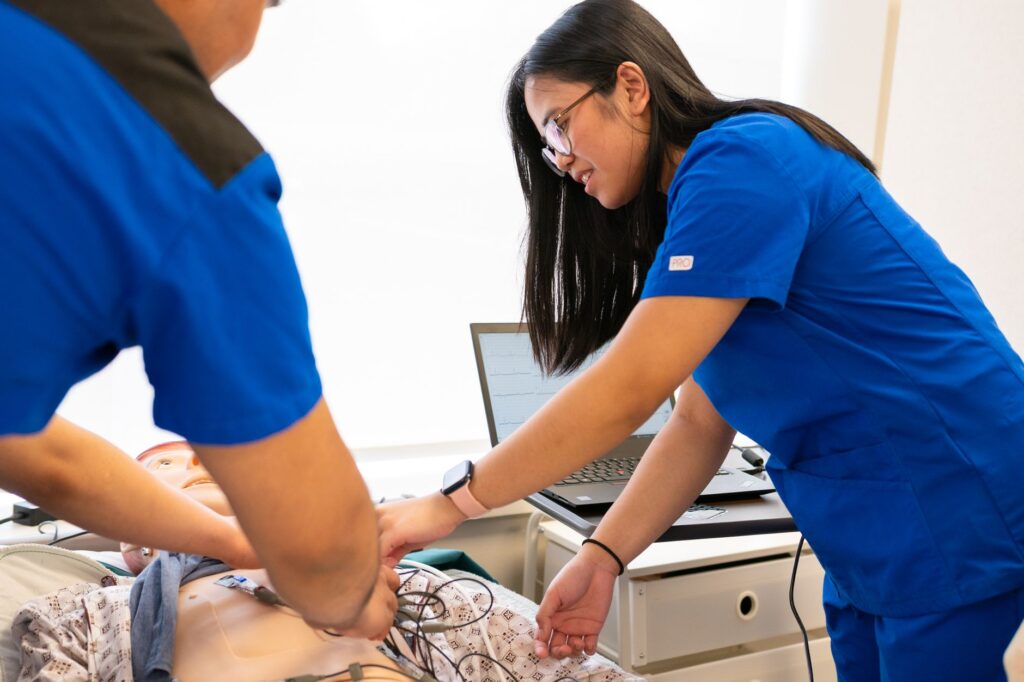
Featured image: AI-generated illustration of a fictional nursing education scene.
Positive risk-taking in mental health nursing essays concerns how a person can pursue meaningful goals while foreseeable harms are considered and managed proportionately. A strong discussion analyses a particular decision, its possible benefits, safeguards and review arrangements.
This article focuses on decision reasoning. The broader recovery-oriented practice guide addresses recovery concepts and research. The present guide does not provide individual risk assessment or clinical instructions.
Define the opportunity as well as the possible harm
Begin by identifying what the person wants to achieve. “Take a risk” is too vague. The goal might involve participation, a daily activity or greater independence in a scenario where the relevant facts are provided.
NICE’s rehabilitation guidance for adults with complex psychosis includes encouraging positive risk-taking within recovery-oriented practice (NICE, 2020). That recommendation belongs to a defined population and service context. Do not apply it as blanket permission for any activity in any mental health situation.
Your essay needs to explain why the opportunity matters and what could be lost through unnecessary restriction. At the same time, it must identify foreseeable harm and uncertainty without describing all uncertainty as unacceptable.
Use a decision comparison rather than a risk list
| Element | Question for critical analysis |
|---|---|
| Goal | What personally meaningful outcome is sought? |
| Options | Which realistic routes are available? |
| Potential benefits | What might participation enable? |
| Foreseeable harms | What evidence supports concern? |
| Safeguards | Which measures address the identified concern? |
| Review | How will the decision be reconsidered? |
Consider the consequences of each option, including doing nothing or maintaining a restriction. Avoid treating the absence of an incident as the only possible sign of a good outcome. Your assessment question may also require attention to participation, trust or independence.
Fictional example: a graded opportunity
A teaching scenario describes an adult in a rehabilitation service who wants to resume an ordinary community activity. The scenario gives some concerns but does not establish a complete current assessment, legal status or agreed care plan.
A weak essay either endorses the activity immediately in the name of autonomy or rejects it because risk exists. A stronger essay identifies the missing assessment and explores how a proportionate, collaborative decision could be reached within the relevant care framework.
You can compare possible levels of support without claiming one is clinically appropriate for this fictional person. Explain which further facts would change the decision. This preserves the distinction between an academic illustration and an individual care recommendation.
Examine collaboration and power
Identify who defines the goal and how the person’s views enter the decision. Participation is not demonstrated simply by writing “the service user agreed”. Use only preferences actually supplied by the case.
Our patient-voice guide explains how to represent those accounts accurately. Here, go further by examining whether the options offered are meaningful and how professional authority influences the discussion.
Also distinguish disagreement from incapacity. If decision-making capacity or a legal restriction is relevant, use current sources for the correct jurisdiction. A diagnosis alone cannot supply the missing legal analysis.
Discuss safeguards critically
A safeguard should address a specific concern. If the essay proposes support, communication or review, explain what that measure is intended to achieve. Avoid listing generic controls without showing their relationship to the decision.
Then consider burden and feasibility. A highly restrictive safeguard may undermine the opportunity it is meant to enable. Conversely, an unsupported promise of independence may leave the person without the resources needed to participate.
Where you discuss intervention effectiveness, add appropriate research rather than citing recovery guidance as proof that a particular arrangement works. Professional recommendations and measured outcomes serve different evidential purposes.
Evaluate the decision without hindsight bias
Assess the quality of the information, collaboration and reasoning available at the time. An adverse outcome does not automatically establish that every earlier decision was unreasonable. A favourable outcome does not prove that the assessment process was adequate.
Your conclusion should identify the conditions under which the proposed approach is defensible and the uncertainties that require review. Avoid claiming that positive risk-taking eliminates risk.
Frequently asked questions
Is positive risk-taking the same as ignoring risk?
No. The essay should connect the meaningful opportunity to assessment, proportionate safeguards and review.
Should I include a numerical risk score?
Only if the brief and evidence make it relevant. Do not invent a score or present a number as a complete decision.
Review your essay argument
Use nursing assignment support for feedback on the balance between opportunity, harm and professional accountability. Request a defined review through essay support quote information.
Reference
National Institute for Health and Care Excellence (NICE) (2020) Rehabilitation for adults with complex psychosis. NG181. Available at: NICE NG181 recommendations (Accessed: 18 October 2026).