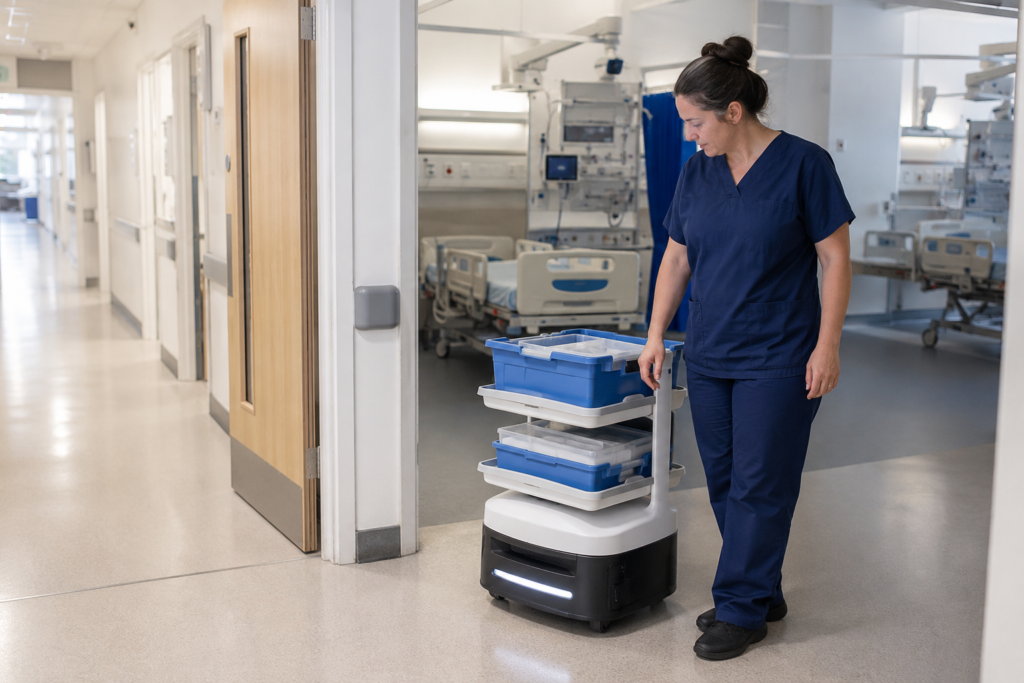
Robotics in nursing care should be evaluated as a set of task-specific technologies rather than as a replacement for nursing. Robots may reduce repetitive workload, support rehabilitation, extend remote access or assist with routine prompts, but they also introduce questions about safety, accountability, privacy, cost, equity and human contact.
Current evidence supports a cautious approach in which robotics complements rather than displaces professional judgement. An umbrella review of robotics in nursing identified potential benefits alongside concerns about reliability, skills, ethics, liability and reduced human interaction, while also noting that direct experiential evidence from nurses remains limited (Adeyemo et al., 2025).
Key nursing principle
Robotics is most defensible when a clearly bounded task is automated while assessment, interpretation, communication, ethical judgement and accountability remain with appropriately prepared professionals.
Different robots create different nursing consequences
| Robot type | Nursing connection | Potential value | Critical question |
|---|---|---|---|
| Logistics robot | Moves supplies, linen or meals | Reduces repetitive transport | Does it improve workflow without disrupting urgent care? |
| Rehabilitation robot | Supports repeated movement | Provides structured repetition and performance data | Can care still be adapted to pain, fatigue and changing ability? |
| Socially assistive robot | Prompts, activities or structured interaction | May support routine and engagement | Does it support relationships or replace needed human contact? |
| Telepresence robot | Remote consultation or observation | Extends access to expertise | Are privacy, consent and escalation adequate? |
| Robotically assisted surgical system | Perioperative workflow | Supports controlled minimally invasive procedures | Are staff trained and responsibilities clear? |
Robotically assisted surgery should not be described as autonomous surgery. The U.S. Food and Drug Administration states that these systems require direct human control by trained clinicians (U.S. Food and Drug Administration [FDA], n.d.).
Potential benefits
Reducing repetitive workload
Logistics robots may reduce time spent transporting supplies or equipment. The relevant nursing outcome is not simply “time saved,” but whether the saved time becomes meaningful capacity for assessment, communication or direct care.
Supporting rehabilitation
Rehabilitation robots can provide repeated, standardised movement and collect performance data. However, nurses and therapists still need to identify pain, fatigue, anxiety, skin risk or reduced motivation and adapt care accordingly.
Extending access
Telepresence can support specialist input where geography or workforce distribution limits access. Its usefulness depends on connectivity, privacy, communication quality, physical-assessment requirements and a clear escalation route.
Supporting routine and engagement
Socially assistive robots may provide prompts and structured interaction. Studies in long-term care and dementia settings report both perceived benefits and practical or relational concerns, showing that acceptance is conditional rather than universal (Ruan et al., 2025; Shi et al., 2025).
Important limitations and risks
Task performance is not contextual judgement
A device may carry out a programmed task correctly while missing a wider clinical change. Human oversight must therefore be an active safety control rather than a symbolic presence.
Technical failure creates risk and workload
Robotic systems depend on sensors, software, power, networks and maintenance. Organisations need downtime procedures, clear escalation and staff who can override or remove a device safely.
Human contact can be reduced in the wrong places
Automation may strengthen care when it removes non-clinical burdens and releases nursing time. It can weaken care if used to justify reduced staffing or substitute technology for interactions that carry assessment, emotional or safeguarding value.
Privacy and dignity require active safeguards
Devices may use cameras, microphones, mapping technology or cloud services. Patients should receive understandable information about what is collected, why, who can access it and how long it is retained.
Cost must include the whole system
Purchase price is only one cost. Integration, software licences, maintenance, training, infrastructure, cleaning, storage and replacement parts all matter. A technology can be innovative and still represent poor value.
Unequal access can widen inequalities
Robotic systems may work better for people who use the dominant language, have stable connectivity or fit the assumptions built into the device. Disability, communication differences and digital exclusion should be tested before and during implementation.
What the evidence says about socially assistive robots
A 2025 systematic review of qualitative studies found mixed caregiver perceptions of socially assistive robots in dementia care, including perceived benefits, practical barriers and expectations for future development (Shi et al., 2025). A 2025 scoping review of long-term-care workers likewise found that robot-assisted care is shaped by organisational, relational and practical factors rather than technology alone (Ruan et al., 2025).
These studies do not support simplistic claims that patients or staff either “accept robots” or “reject robots.” Acceptance depends on purpose, design, context and the individual.
A decision matrix for nursing implementation
| Claim | Evidence to request | Risk to test | Safe sign |
|---|---|---|---|
| Reduces workload | Observed time and interruptions | Setup/troubleshooting burden | Saved time reaches meaningful care |
| Improves safety | Task-specific errors and incidents | Automation bias or delayed intervention | Clear stop rules and human override |
| Patients accept it | Experience data from diverse users | Coercion, distress or novelty effects | Real choice and repeat consent |
| Improves access | Waiting time and reach across groups | Digital, language or disability exclusion | Accessible alternatives |
| Is cost-effective | Whole-life costs and meaningful outcomes | Hidden infrastructure costs | Comparison with credible alternatives |
What nurses should check before deployment
- Define the care problem. Start with a measurable patient or workflow need.
- Check task suitability. Separate predictable tasks from complex assessment and communication.
- Involve patients and frontline staff. Include people likely to experience language, disability or access barriers.
- Set accountability. Identify who monitors the system, responds to failure and reports incidents.
- Prepare downtime care. Test power, network and equipment-failure procedures.
- Train for judgement. Training should cover limitations and escalation, not only device operation.
- Measure meaningful outcomes. Include patient experience, equity, workload and adverse effects.
- Set stop criteria. Define when the device should be modified, suspended or withdrawn.
The NMC Code continues to apply when technology is used. Robotics changes how professional duties are exercised; it does not remove accountability (Nursing and Midwifery Council [NMC], 2018).
How to write critically about robotics in nursing
Define the population, task, context and outcome. “Robots improve nursing care” is too broad to defend. A stronger question might ask how socially assistive robots affect engagement among residents with dementia in long-term care and what safeguards preserve choice and human contact.
Match claims to study design. A qualitative study can explain experience but cannot estimate prevalence. A usability study does not establish long-term effectiveness. An umbrella review provides broad synthesis but remains dependent on the quality of the underlying reviews.
Connect the analysis to nursing values: autonomy, dignity, beneficence, non-maleficence, justice and accountability. Explain how patients can accept, refuse or stop the technology and how staff will recognise when it is no longer appropriate.
Four misleading shortcuts to avoid
- “Robots will replace nurses.” Automation may change tasks, but nursing still requires assessment, communication, advocacy and accountability.
- “Patients either accept or reject robots.” Acceptance is conditional and task-specific.
- “More efficient means more caring.” Efficiency only creates an opportunity; saved time must be translated into better care.
- “Human oversight solves every risk.” Oversight only works when staff have the time, competence and authority to intervene.
Frequently asked questions
What are the main benefits?
Potential benefits include reduced repetitive transport, rehabilitation support, remote access, structured prompts and operational data. Benefits depend on the device, task, patient group and implementation context.
What are the main limitations?
Important limitations include technical failure, weak contextual judgement, privacy concerns, training demands, cost, unequal access and possible reduction in human contact.
Can robots replace registered nurses?
Robots can perform bounded tasks, but nursing includes assessment, interpretation, communication, advocacy, ethical judgement and accountability. Current evidence does not support wholesale replacement of nursing practice.
Is robotic surgery autonomous?
No. The FDA states that robotically assisted surgical devices require direct human control.
Related Nursing Guides
- Critical Care Nursing Assignment Support: ICU Clinical Analysis
- How to Write a Nursing Care Plan
- Palliative Care Nursing Dissertation Topics: 45 Ideas
Conclusion
Robotics in nursing should be judged by task-specific evidence, patient outcomes, equity, workflow, professional responsibility and human relationships. The strongest implementation model is one in which technology has a bounded purpose, patients retain meaningful choice and nurses have the competence and authority to intervene.
For help developing a critical nursing technology assignment, use our nursing assignment support or contact page.
References
- Adeyemo, A., Coffey, A., & Kingston, L. (2025). Utilisation of robots in nursing practice: An umbrella review. BMC Nursing, 24, 247. https://doi.org/10.1186/s12912-025-02842-2
- Nursing and Midwifery Council. (2018). The Code: Professional standards of practice and behaviour for nurses, midwives and nursing associates. https://www.nmc.org.uk/standards/code/
- Ruan, Y.-X., et al. (2025). A scoping review on long-term care workers’ perceptions of robot-assisted care for older adults in long-term care facilities. Journal of Advanced Nursing, 81(12), 8409–8431. https://doi.org/10.1111/jan.16853
- Shi, W., et al. (2025). Exploring the perceptions and experiences of caregivers with the application of socially assistive robots in dementia care. International Journal of Nursing Studies, 167, 105084. https://doi.org/10.1016/j.ijnurstu.2025.105084
- U.S. Food and Drug Administration. (n.d.). Computer-assisted surgical systems. https://www.fda.gov/medical-devices/surgery-devices/computer-assisted-surgical-systems