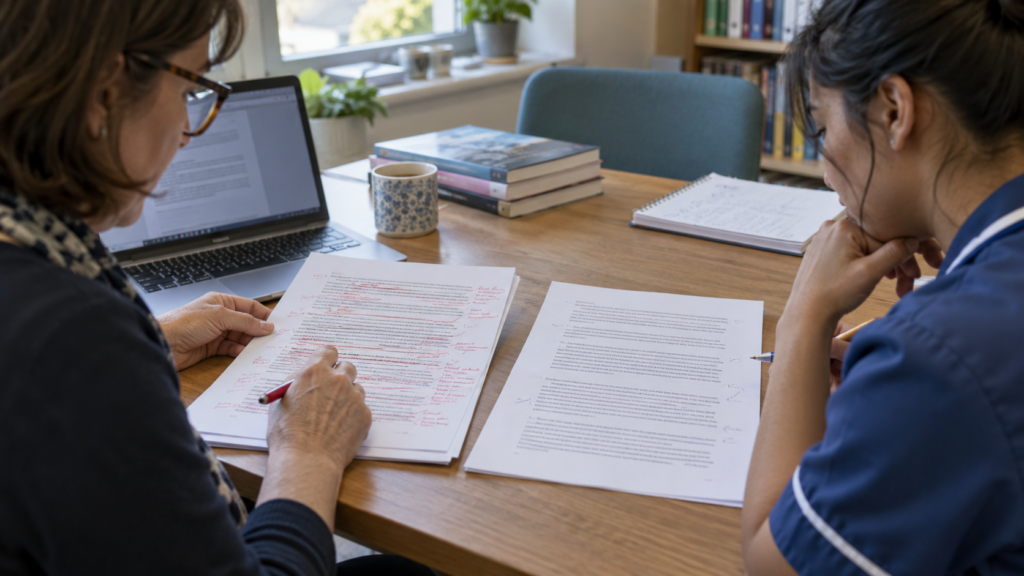
Nursing dissertation editing or proofreading should be chosen according to the problem in your draft and the help your university permits. Editing may address organisation and clarity; final proofreading focuses on surface errors and presentation. Providers use these terms differently, so request an explicit scope.
If your supervisor says the discussion does not answer the question, correcting punctuation will not resolve that concern. If the argument is complete but abbreviations and page numbers are inconsistent, a final proof may be the appropriate next step.
What is the difference?
For this comparison, developmental feedback means comments on how the argument is organised and supported. Language editing means attention to sentence clarity and expression. Proofreading means a final check for errors after substantive revisions are complete.
These working descriptions help you ask questions. They do not override institutional rules, which may permit only a narrow range of corrections or prohibit outside assistance for the particular assessment.
| Task | Question it addresses | Typical output to discuss |
|---|---|---|
| Developmental feedback | Does the argument and chapter structure work? | Comments identifying issues for the student to revise |
| Language editing | Is the meaning communicated clearly? | Permitted suggestions or tracked language changes |
| Final proofreading | Are surface errors and inconsistencies left? | Marked corrections and unresolved queries |
Ask which activities the quote includes. A provider who promises to “improve everything” has not yet defined a usable task.
Signs you need feedback before proofreading
Read a paragraph and state its purpose in one sentence. If you cannot explain how it contributes to the question, the difficulty may be structural. Other signs include repeated background, unexplained changes in population, claims that exceed the findings and an evidence review that lists studies without comparison.
Start with the supervisor’s exact comment. “Be more critical” usually calls for an examination of reasoning and evidence, rather than simply longer sentences. You may need to compare designs, explain conflicting findings or qualify an interpretation.
A reviewer can identify these problems where permitted. You should remain responsible for the argument and any substantive revision. Our four-pass self-editing guide explains how to review alignment before polishing language.
Signs your draft is ready for a final proof
Proofreading becomes useful when the question, methods and argument are stable. The latest supervisor comments should be addressed, references should be organised and tables should be in their intended positions.
A final proof can then look for inconsistent abbreviations, missing words, punctuation problems, repeated headings, figure labels and formatting discrepancies. It can also flag an unclear expression for your attention instead of guessing the intended meaning.
Do not assume proofreading includes verifying every citation or recalculating statistics. Source verification and analysis require an explicitly agreed task, and university policy may restrict those activities. See the final proofreading checklist for document checks.
A nursing example: unclear evidence or a surface error?
Imagine a literature-review paragraph that says an intervention “proved effective” even though it cites a small observational study. A surface correction cannot establish whether the claim is justified. The student needs to examine the design and revise the interpretation.
Now consider a paragraph where the argument is accurate but “Type 2 diabetes” appears as “type II diabetes” elsewhere. That is a terminology consistency query. The reviewer can identify the difference while the student confirms the required wording.
Similarly, a percentage that conflicts with a table should be flagged. The author must check the underlying result. A proofreader should not silently choose whichever number looks more plausible.
Check university policy before choosing either service
The distinction is also an authorship issue. Oxford’s policy, for example, separates permitted error identification from changes to ideas, argument and structure (University of Oxford, n.d.). This illustrates why you must check your own institution’s limits rather than rely on a provider’s definition.
Send the relevant policy with your request. State whether the permitted output should be comments, marked suggestions or direct corrections. Ask whether assistance must be acknowledged and keep the version history.
If the rules do not permit outside editing, use the university’s authorised learning resources and supervision route. A commercial offer does not create an exception to assessment requirements.
Questions to settle in the quote
- Is this developmental feedback, language editing or final proofreading?
- Are references checked for format only or also for existence and relevance?
- Are tables, figures and appendices included?
- Will changes be marked so you can review them?
- How are unclear clinical or statistical statements handled?
- Is a final formatted file check included?
- What happens if a structural problem appears during proofreading?
If the draft needs substantial revision, agree whether the final proof should wait. Changing the work midway can invalidate corrections made to an earlier version.
Choose the next step
Use nursing dissertation editing support to discuss permitted review of an existing draft. When the substantive work is stable, specify the final surface and formatting checks you require.
For taught Master’s research, use MSc nursing dissertation support. For work on accessible care, inclusion or communication, explore learning disability nursing dissertation support.
Frequently asked questions
Can proofreading make a descriptive review critical?
Surface corrections cannot supply missing evaluation. You need to revise the evidence comparison yourself, using permitted feedback where available.
Can I request both?
Yes, where allowed, but agree the sequence. Complete substantive revisions first and proofread the stable version afterwards.
Does proofreading include changing the word count?
Not automatically. Cutting content can change meaning and may exceed institutional proofreading limits. Discuss the permitted scope before requesting reductions.
Which should I choose close to submission?
Choose from the actual problem, not only the time remaining. A polished sentence cannot fix an incorrect method or unsupported conclusion.
Get a scope review before booking
Send the draft, university policy and supervisor feedback. Explain whether you need help identifying substantive problems or checking a stable final document.
Conclusion
Choose nursing dissertation editing or proofreading from the problem in your draft and the university’s permitted scope. Resolve substantive issues before the final proof. Review every suggestion and check specialist meaning against your own evidence.
References
University of Oxford (n.d.) Use of Third Party Proof-readers. Available at: Oxford proofreading policy (Accessed: 12 October 2026).