
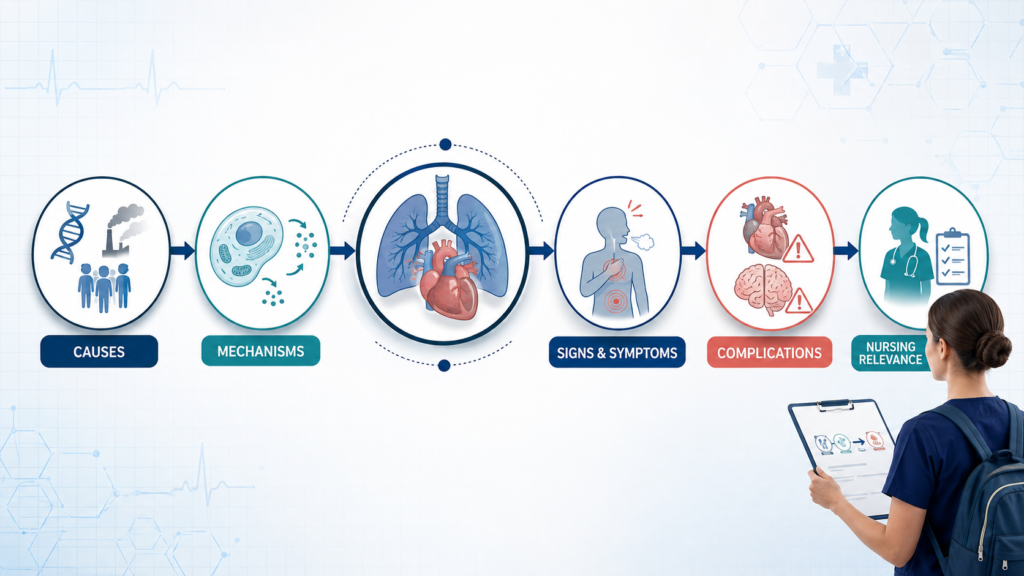
How to make a pathophysiology concept map for nursing students becomes easier when you trace one disease from its causes to cellular changes, clinical manifestations, complications and nursing relevance. This guide provides a repeatable method, a worked heart-failure example and a final checklist so that your map explains the disease process instead of merely decorating a page with disconnected facts.
A strong map should answer one central question: how does the underlying biological disturbance produce the signs, symptoms and risks seen in the person? It is therefore different from a generic mind map, a nursing care plan or a list of nursing diagnoses. Those tools may be useful elsewhere, but this article concentrates specifically on pathophysiological reasoning.
What is a pathophysiology concept map?
A pathophysiology concept map is a visual explanation of the mechanisms through which a disease develops and affects normal body function. It places the condition at the centre or top, then uses labelled arrows to show causal relationships among aetiology, risk factors, biological mechanisms, manifestations, investigations, complications and nursing implications.
The word pathophysiology combines pathology—the study of disease—with physiology—the study of normal function. Consequently, a useful map does more than name a disease. It first identifies what normal function has been disrupted and then shows the sequence of changes that follows. For example, a heart-failure map should not jump directly from “heart failure” to “breathlessness”. It should show the intervening mechanism: reduced ventricular function can reduce cardiac output and increase filling pressures; pulmonary congestion can then impair gas exchange and contribute to breathlessness.
Concept mapping has an established history in nursing education. Nursing and medical-education research suggests that it can help students connect new knowledge with existing knowledge and apply theory to clinical situations (Garwood, Ahmed and McComb, 2018; Fonseca et al., 2024; Mohamad Azmi, Smyth and Keith, 2026). However, the evidence should not be overstated. Differences in map design, teaching support, assessment methods and study quality mean that a concept map is a learning aid rather than proof that critical thinking has automatically occurred.
Why nursing students use pathophysiology concept maps
Nursing assessments often require students to connect bioscience with the person’s presentation. A paragraph can explain those relationships, but a map makes the direction of causation visible. Recent systematic-review evidence indicates that nursing students commonly perceive concept maps as useful for organising knowledge and linking theory with practice, although outcomes depend on how mapping is taught and assessed (Mohamad Azmi, Smyth and Keith, 2026). This can help you identify missing steps before writing a case study, presentation or examination answer.
A well-constructed map may help you:
- revise normal anatomy and physiology before examining disease;
- separate causes and risk factors from biological mechanisms;
- explain why particular signs and symptoms occur;
- link laboratory or assessment findings to the underlying disturbance;
- recognise possible deterioration and complications;
- prioritise clinically relevant observations; and
- plan a logically structured written explanation.
These uses align with the wider expectation that nurses apply knowledge, think critically and deliver evidence-based, person-centred care. The Nursing and Midwifery Council (NMC) standards emphasise knowledge and skills for safe and effective nursing across different fields and settings. Nevertheless, the map must remain educational: it cannot replace individual assessment, local policy, clinical guidance or escalation to an appropriately qualified professional.
How to make a pathophysiology concept map for nursing students: the seven-step method
The clearest method is to build the map in layers. Complete the scientific chain first and add nursing relevance only after you understand the mechanism. This prevents interventions or care-plan language from obscuring the pathophysiology.
Step 1: define the condition and map normal function
Write the precise condition at the centre of the page. Avoid a broad label such as “cardiac disease” when the task concerns chronic heart failure. Add a one-sentence definition based on an authoritative clinical source. Then identify the organ, system, tissue or regulatory process that normally performs the affected function.
Ask three questions:
- What does this structure or system normally do?
- Which normal control mechanism is disrupted?
- What changes first when the system can no longer compensate?
Keep the normal-physiology box brief. Its purpose is to create a baseline for comparison, not to reproduce an anatomy textbook. For heart failure, the baseline might state that effective ventricular contraction maintains cardiac output and tissue perfusion. For asthma, it might state that open conducting airways permit airflow while normal inflammatory control protects the airway without excessive narrowing.
Step 2: separate aetiology, triggers and risk factors
Aetiology means the cause or origin of the condition. A risk factor increases probability but may not directly cause the condition in every person. A trigger precipitates an episode or worsening in a susceptible person. Place these in separate boxes because combining them produces inaccurate reasoning.
For example, tobacco exposure is an important risk factor for chronic obstructive pulmonary disease, whereas a respiratory infection may precipitate an acute exacerbation. In a case-based assignment, distinguish facts actually provided in the scenario from general risks found in the literature. Do not assume that the fictional or real person has a risk factor merely because it is common.
Step 3: build the mechanism as a causal chain
This is the core of how to make a pathophysiology concept map for nursing students. Break the disease process into a sequence of small, defensible changes. Each arrow should mean something precise, such as “causes”, “reduces”, “increases”, “stimulates”, “impairs” or “results in”.
A useful generic sequence is:
cause or injury → cellular/tissue response → organ dysfunction → compensatory response → further physiological effect.
Do not write “leads to” on every arrow. Specific linking phrases expose weak logic. If you cannot state whether one concept increases, decreases or impairs the next, you probably need to check the mechanism again.
Include compensation when relevant. The body may initially respond to maintain homeostasis, yet prolonged compensation can create additional problems. In heart failure, neurohormonal activation may temporarily support blood pressure and perfusion, but fluid retention and increased cardiac workload can worsen congestion. Showing this feedback explains why a response that is initially adaptive may become harmful.
Step 4: connect mechanisms to signs and symptoms
Now link each important manifestation to the mechanism that explains it. Avoid placing every symptom in one unconnected list. Breathlessness, peripheral oedema and fatigue may coexist in heart failure, but they arise through different though related processes.
Use the case evidence where available. Mark subjective symptoms, such as reported fatigue, separately from objective signs, such as oxygen saturation, respiratory rate or ankle oedema. If the scenario contains no laboratory result, do not invent one. You may state what an investigation assesses, but you must not present an expected abnormality as though it were an observed result.
Step 5: add investigations only where they test the mechanism
An investigation belongs on the map when it helps confirm, quantify or distinguish part of the disease process. Link the test to the concept it evaluates. For example, an echocardiogram can assess cardiac structure and function; it should not float beside the disease name without explanation.
Use current, condition-specific guidance to decide which assessments are relevant. A concept map is not a licence to list every possible blood test. Select findings that answer a physiological question. Also distinguish diagnostic investigations from routine nursing observations and deterioration monitoring.
Step 6: map complications and deterioration pathways
Complications should branch from the mechanism that creates them. State what could happen and why. This makes the map clinically meaningful without turning it into a treatment algorithm.
For each serious complication, consider:
- the physiological change that increases the risk;
- the observable cues that could indicate deterioration;
- the limitations of relying on one observation; and
- the need to follow local escalation procedures.
NEWS2, for example, combines routinely recorded physiological measurements into an early-warning score. It can support recognition of acute deterioration, but the score does not diagnose the underlying disease and should not override clinical concern. Your map should therefore connect observations with escalation and assessment rather than present a score as a pathophysiological mechanism.
Step 7: finish with nursing relevance
After completing the scientific pathway, add a final nursing-relevance layer. This may identify focused assessment, monitoring, communication, person-centred education and escalation linked to the mechanisms already shown. Keep the wording within the student’s competence and the task’s requirements.
For instance, if pulmonary congestion is linked to breathlessness, nursing relevance may include assessing respiratory pattern, oxygen saturation, the person’s symptoms and response to activity, then communicating deterioration according to local policy. Avoid turning the map into a prescriptive medication plan. Medicine selection and adjustment require authorised clinical decision-making, patient-specific assessment and applicable guidance.
Pathophysiology concept map structure at a glance
| Map section | Question it answers | What to include | Common mistake |
|---|---|---|---|
| Condition | What disease is being explained? | Precise name and concise definition | Using an overly broad diagnosis |
| Normal physiology | What should normally happen? | Key structure, function and control | Adding excessive anatomy |
| Aetiology and risks | Why can it develop? | Causes, predisposition and triggers | Treating every risk as a direct cause |
| Mechanism | What changes, and in what order? | Cellular, tissue, organ and compensatory changes | Skipping intermediate steps |
| Manifestations | Why does the person present this way? | Signs and symptoms linked to mechanisms | Creating an unrelated symptom list |
| Investigations | How is the mechanism assessed? | Selected tests and what they evaluate | Inventing case results |
| Complications | What deterioration may occur? | Mechanism, cues and safety relevance | Listing complications without causation |
| Nursing relevance | Why does this science matter in care? | Assessment, monitoring, communication and education | Replacing the map with a care plan |
Worked example: a heart-failure pathophysiology concept map
This simplified example demonstrates the logic rather than providing a complete clinical model. The sequence is supported by a peer-reviewed review of cardiac injury, neurohormonal compensation and congestion in heart failure (Schwinger, 2021), while current UK diagnostic and management context should be checked against NICE guidance (NICE, 2018, updated 2025). Always adapt it to the exact type of heart failure, case facts, learning outcomes and guidance required by your university.
Central condition: heart failure, a clinical syndrome in which cardiac abnormality impairs the heart’s ability to maintain adequate circulation or does so only with increased filling pressures.
Normal function: ventricular filling and contraction maintain cardiac output, blood pressure and tissue perfusion.
Possible underlying pathway:
- Myocardial injury or sustained pressure/volume stress impairs ventricular function.
- Reduced effective pumping lowers forward cardiac output and can increase cardiac filling pressures.
- Reduced perfusion activates compensatory sympathetic and renin–angiotensin–aldosterone responses.
- Vasoconstriction and sodium/water retention may initially support circulation.
- Persistent fluid retention and increased workload can worsen congestion and cardiac stress.
- Raised left-sided pressures can contribute to pulmonary congestion, reduced gas exchange and breathlessness.
- Systemic venous congestion may contribute to peripheral oedema and weight increase.
- Reduced tissue perfusion may contribute to fatigue, reduced exercise tolerance or renal dysfunction.
Nursing relevance: connect each case cue to the mechanism. Breathlessness requires focused respiratory and cardiovascular assessment rather than an assumption that heart failure is the only possible cause. Trends in observations, fluid balance, weight, symptoms, functional tolerance and mental state may be relevant depending on the setting and care plan. New or worsening deterioration requires timely communication and escalation.
The strongest written explanation would acknowledge complexity. A manifestation such as breathlessness is not specific to heart failure, and comorbid respiratory disease, infection, anaemia or anxiety may influence the presentation. Therefore, the map should organise reasoning while preserving differential thinking.
How to choose and cite evidence for your map
Use sources according to their function. An anatomy and physiology textbook can explain normal processes. A recent pathophysiology textbook can support detailed mechanisms. NICE or another authoritative guideline can support current diagnostic and management context. Peer-reviewed reviews and primary research can support educational or clinical claims.
Do not use the NMC Code as evidence for a biochemical mechanism. The Code establishes professional standards, not the cellular basis of disease. Conversely, a biomedical textbook cannot establish a UK nurse’s professional responsibilities. Matching each claim to the right source improves both accuracy and critical quality.
Every image, diagram or adapted map also needs appropriate attribution under your university’s rules. If you reproduce or closely adapt a published figure, check copyright and licence conditions. The safest academic approach is often to create an original map from your understanding and cite the sources used to build it.
For wider assignment planning, compare the expectations for different types of nursing assignments. If the map supports a postgraduate paper, the guide to structuring a Level 7 nursing assignment can help you convert the visual reasoning into an analytical discussion.
Common mistakes when making a pathophysiology concept map
Listing facts without labelled relationships
A collection of boxes is not automatically a concept map. Use directional arrows and linking phrases that form readable propositions, such as “reduced contractility lowers stroke volume”. Test each connection by reading it aloud as a sentence.
Skipping from the disease to the symptom
The missing middle is usually where the learning occurs. Insert the tissue, organ and compensatory changes that explain the presentation. However, do not add molecular detail unless it contributes to the assignment question.
Confusing a concept map with a care plan
A care plan normally organises assessed needs, goals, interventions and evaluation. A pathophysiology map explains disrupted function and causal mechanisms. Nursing relevance can appear at the edge of the map, but it should follow from the biology rather than replace it.
Making the map patient-specific by inventing information
Use only the observations, history and results given in the case. Label general possibilities as risks or expected features; do not convert them into patient facts. This distinction is essential for academic integrity and safe clinical reasoning.
Overloading the page
Too many colours, crossing arrows and long paragraphs hide the causal pathway. Use a consistent visual key, short box labels and enough white space. If the condition has several major pathways, create a high-level overview and one detailed branch rather than shrinking everything onto one unreadable page.
Using weak or mismatched references
Do not rely on unsourced revision websites for complex mechanisms when textbooks, scholarly reviews or authoritative guidance are available. Before submission, use the nursing assignment quality checklist to check evidence-to-claim matching, structure and accuracy.
How to make your concept map readable and assessable
Begin on paper or with simple boxes before using design software. Decide whether the logic flows from top to bottom or from the centre outwards. Then apply a restrained visual system. For example:
- blue for normal physiology;
- red for injury or abnormal mechanisms;
- orange for compensatory responses;
- purple for manifestations and investigations; and
- green for nursing relevance.
Add a legend so that colour is not the only means of interpretation. Use readable font sizes, sufficient contrast and concise labels. Accessibility matters: a marker should still understand the map if it is printed in greyscale. Export the final version at a resolution that keeps text legible and follow the required format for figures, captions and appendices.
If the map appears inside an assignment, introduce it in the main text and explain its purpose. Do not expect the figure to make the argument alone. Refer to the relevant pathway, interpret it and support the discussion with evidence. Our guide on using the NMC Code in nursing assignments explains how to connect professional standards to analysis without treating the Code as clinical evidence.
How to make a pathophysiology concept map for nursing students: final checklist
- The condition is precise and correctly defined.
- Normal physiology is stated briefly.
- Causes, risk factors and triggers are distinguished.
- The mechanism follows a logical causal sequence.
- Every major arrow has a meaningful linking phrase.
- Compensation and feedback are shown where relevant.
- Signs and symptoms connect to the mechanisms that explain them.
- Investigations are linked to what they assess.
- Case facts are separated from general possibilities.
- Complications branch from an explained mechanism.
- Nursing relevance follows from the pathophysiology.
- Claims use appropriate, credible sources.
- The map is readable, accessible and correctly referenced.
- The work follows the assignment brief and university policy.
Ethical use of academic support
A tutor, editor or academic-support service may help you understand feedback, check scientific coherence, improve layout or identify gaps in a draft. However, you remain responsible for understanding the content, verifying every source and complying with your university’s academic-integrity rules. Never submit a map that you cannot explain.
If you need developmental help with a complex nursing case study or bioscience assignment, review our nursing research, writing and editing services. Send the complete brief, marking rubric and your current work so that the required scope can be assessed accurately.
Frequently asked questions
What should be included in a nursing pathophysiology concept map?
Include the condition, relevant normal physiology, aetiology, risk factors, biological mechanisms, compensatory responses, signs and symptoms, selected investigations, complications and nursing relevance. The exact content should follow the assignment brief and the person’s case information.
What is the difference between a pathophysiology concept map and a nursing care plan?
A pathophysiology concept map explains how disease disrupts normal function and produces clinical manifestations. A nursing care plan organises assessed needs, goals, interventions and evaluation. A map may inform a care plan, but the two are not interchangeable.
Can I use a template to make a pathophysiology concept map?
Yes, provided the template fits the task and does not dictate inaccurate relationships. Treat it as a layout aid. Build and verify the scientific content yourself, cite the sources used and follow your university’s rules concerning templates and external assistance.
How many branches should a pathophysiology concept map have?
There is no universal number. Use enough branches to explain the main causal pathways without making the page unreadable. Relevance and logical connection matter more than the number of boxes.
Should medications appear on the map?
Only if the brief requires treatment links. If included, connect the medicine class to the relevant physiological target and use current authoritative sources. Do not present patient-specific prescribing decisions or doses without an appropriate clinical basis.
Can a pathophysiology concept map go in an appendix?
It may go in the main text or an appendix depending on the brief, word-count rules and its importance to the argument. If it is placed in an appendix, refer to it clearly in the main discussion. See the guide to writing appendices in a nursing dissertation for labelling and cross-referencing principles.
Conclusion
Knowing how to make a pathophysiology concept map for nursing students means showing causation, not simply arranging facts. Start with normal function, distinguish causes from risks, build the mechanism in small steps and connect each manifestation or complication to the change that explains it. Finally, add nursing relevance grounded in the map, the case facts and appropriate professional guidance.
A clear concept map should make your reasoning easier to inspect. If an arrow cannot be explained or supported, revise it. That process turns the map into a useful bridge between bioscience knowledge, critical thinking and safe nursing application.
References
- Mohamad Azmi, M.K.I.E.B., Smyth, A. and Keith, N. (2026) ‘The perceptions of undergraduate nursing students using concept maps to influence educational experiences: A systematic review’, Journal of Professional Nursing, 63, pp. 116–127. doi: 10.1016/j.profnurs.2026.02.008.
- Fonseca, M., Marvão, P., Oliveira, B., Heleno, B., Carreiro-Martins, P., Neuparth, N. and Rendas, A. (2024) ‘The effectiveness of concept mapping as a tool for developing critical thinking in undergraduate medical education: a BEME systematic review’, Medical Teacher, 46(9), pp. 1120–1133. doi: 10.1080/0142159X.2023.2281248.
- Garwood, J.K., Ahmed, A.H. and McComb, S.A. (2018) ‘The effect of concept maps on undergraduate nursing students’ critical thinking’, Nursing Education Perspectives, 39(4), pp. 208–214. doi: 10.1097/01.NEP.0000000000000307.
- National Institute for Health and Care Excellence (2018, updated 2025) Chronic heart failure in adults: diagnosis and management. NICE guideline NG106. Available at: https://www.nice.org.uk/guidance/ng106 (Accessed: 26 August 2026).
- Schwinger, R.H.G. (2021) ‘Pathophysiology of heart failure’, Cardiovascular Diagnosis and Therapy, 11(1), pp. 263–276. doi: 10.21037/cdt-20-302.
- National Institute for Health and Care Excellence (2020) National Early Warning Score systems that alert to deteriorating adult patients in hospital. Available at: https://www.nice.org.uk/advice/mib205/chapter/The-technology (Accessed: 26 August 2026).
- Nursing and Midwifery Council (2018, updated 2024) Standards of proficiency for registered nurses. Available at: https://www.nmc.org.uk/globalassets/sitedocuments/standards/2024/standards-of-proficiency-for-nurses.pdf (Accessed: 26 August 2026).
- Nursing and Midwifery Council (2018) The Code: Professional standards of practice and behaviour for nurses, midwives and nursing associates. Available at: https://www.nmc.org.uk/standards/code/ (Accessed: 26 August 2026).


