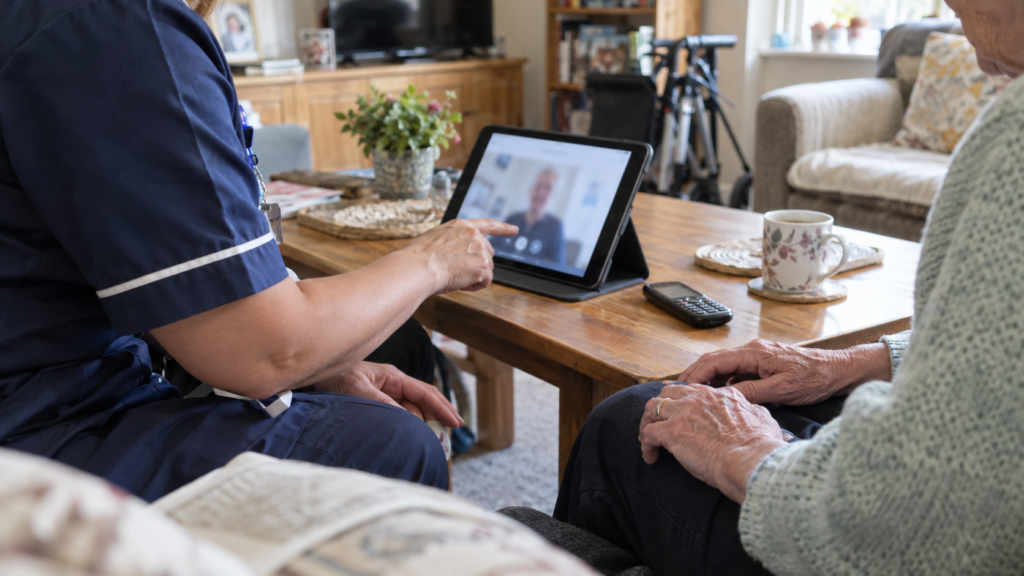
Digital exclusion in a community nursing dissertation should be examined as a defined access or service problem. Avoid assuming it means only not owning a smartphone or that every person who struggles with remote care lacks motivation.
Define the barrier your question examines
Distinguish equipment and connectivity from skills, accessible design, language, confidence, privacy or preference. These issues can interact, but a dissertation question needs manageable boundaries.
NHS England’s digital inclusion framework provides a policy context for inclusive digital healthcare (NHS England, 2023). Use it to identify relevant dimensions, then seek research evidence addressing the actual nursing service and population you selected.
Keep the nursing contribution explicit
Identify the care process affected, such as remote follow-up, appointment communication, wound-care advice or supported monitoring. Explain which nursing decision or interaction the research examines.
“Digital inequality among older people” is broad. A more focused experience question might examine how adults receiving district nursing describe access barriers to a particular remote follow-up process. Do not assume a clinical effect before collecting or reviewing evidence.
Include people who cannot easily use digital channels
A digital-only survey about digital exclusion may overlook the people most relevant to the question. Discuss how recruitment and response methods influence whose experiences are represented.
Alternative methods need the appropriate permissions and a feasible plan. Do not claim inclusive recruitment simply because several channels were advertised; report what was actually offered and which groups participated.
Separate user barriers from service design
Consider whether a problem arises from the person’s access circumstances, a complicated interface, unclear instructions or the lack of a usable alternative pathway. Evidence may support more than one explanation.
Avoid framing every solution as patient training. A service design change or communication adjustment may be relevant, but recommendations must follow the findings rather than your preferred technology or intervention.
Assess benefits and trade-offs
Remote care can be experienced differently across people and tasks. Examine convenience alongside usability, confidentiality, support needs and the ability to communicate concerns. Do not presume digital contact is either universally beneficial or uniformly harmful.
Compare study designs and populations. An uptake statistic does not explain experience by itself, while qualitative accounts do not establish the prevalence of an access problem in the whole population.
Develop a proportionate discussion
Connect the evidence to the nursing question, identify missing perspectives and explain what remains uncertain. NHS England’s framework encourages action on inclusion, but a policy direction is not proof that a proposed local solution works.
Use the community population guide to examine exclusions and the nursing focus guide to keep the project professionally relevant. If evaluating an existing remote service, consider service evaluation support.
Digital exclusion: a worked nursing example
Illustrative planning example: a district nursing team offers video follow-up after a wound-care visit. Some people decline, but the appointment record does not explain why. A student wants to investigate access without assuming that refusal reflects poor digital skills.
First, identify what the records can show. They may distinguish an offered appointment from a completed appointment. However, they cannot establish why someone declined unless the reason was recorded accurately. Therefore, avoid turning a service statistic into a claim about patient motivation.
Next, propose a question with clear boundaries: “How do adults receiving district nursing describe barriers to using video follow-up for wound-care advice?” The question names the population, contact method and nursing activity. It leaves room for practical, personal and service-related explanations.
Finally, explain the design your university permits. A literature review would examine published accounts. A primary study would require an approved recruitment and consent plan. An evaluation of the local pathway would need its own governance classification. Do not present these routes as interchangeable.
Digital exclusion assessment: organise the evidence
The following table is a planning aid, not a validated screening instrument. Use the categories to organise questions and evidence. Avoid assigning someone a deficit label simply because they prefer an alternative way to receive care.
| Dimension | Question to examine | Limit to acknowledge |
|---|---|---|
| Equipment and connection | Can the person access a suitable device and stable connection? | Ownership alone does not establish practical access. |
| Usability | Can they navigate the particular appointment system? | Difficulty may arise from interface design. |
| Communication | Does the channel support language and communication needs? | A completed call may still provide an unsatisfactory experience. |
| Privacy | Is there a private place to discuss concerns? | A working connection does not guarantee confidentiality. |
| Choice and support | What assistance or alternative contact is available? | Declining video care does not automatically indicate exclusion. |
Build a transparent recruitment and analysis plan
For an approved study, describe where invitations will appear, how people can respond and who may be missed. For example, an invitation delivered only through an online portal cannot show that everyone using the nursing service had an equal opportunity to participate.
In addition, distinguish participation support from answering on someone’s behalf. Explain any assistance in the methods and acknowledge its possible influence on the account. A relative’s description of a technical problem provides a different perspective from the service user’s own experience.
During analysis, keep your categories open to revision. A participant may report confidence with technology but reject video care because the consultation feels rushed. Another may welcome remote contact but need accessible instructions. Both accounts challenge a simple “digitally able or unable” classification.
When you discuss findings, connect each proposed explanation to the evidence. Use cautious language where the source is limited: “Participants described…” or “The records suggest…” is more defensible than “Digital care caused…” when the design cannot establish causation.
Use this final digital inclusion checklist
- Name one nursing care process and a defined population.
- Distinguish access, experience, uptake and clinical outcomes.
- Check whether recruitment reaches people outside digital channels.
- Explain whose account each source represents.
- Consider service design alongside individual circumstances.
- Link recommendations to findings and state uncertainty.
For broader project planning, use the community nursing dissertation guide. For reporting study limitations, consult the critical appraisal guide. Keep this article focused on digital access rather than repeating a general population-selection chapter.
Frequently asked questions
Is lack of a device the only form of exclusion?
No. Define the particular access, usability or service-design issues relevant to your question.
Can I study people who choose not to use digital care?
Yes, if their experiences fit the question and the approved methods allow appropriate participation.
Does a policy recommendation establish effectiveness?
No. Use suitable research evidence and evaluate the local context before making effectiveness claims.
Can appointment records prove why someone avoided video care?
Only if the relevant reason was captured reliably. Otherwise, report the uptake pattern and explain that the cause remains uncertain.
Should I recommend digital skills training for everyone?
No. Match any recommendation to the barrier identified. Interface changes, communication support or an alternative care channel may be more appropriate.
Conclusion
A strong digital exclusion discussion defines the access problem, examines the nursing process and represents people who may be missed. Use policy to frame the question, research to evaluate it and transparent limitations to keep recommendations proportionate.
Get feedback on your project
For a review of your own question, plan or draft, use community and public health nursing support. Send your university brief and supervisor comments through our contact page. Follow your university’s rules on external support and share only material you are authorised to disclose.
References
NHS England (2023) Inclusive digital healthcare: a framework for NHS action on digital inclusion. Available at: NHS England framework (Accessed: 12 October 2026).